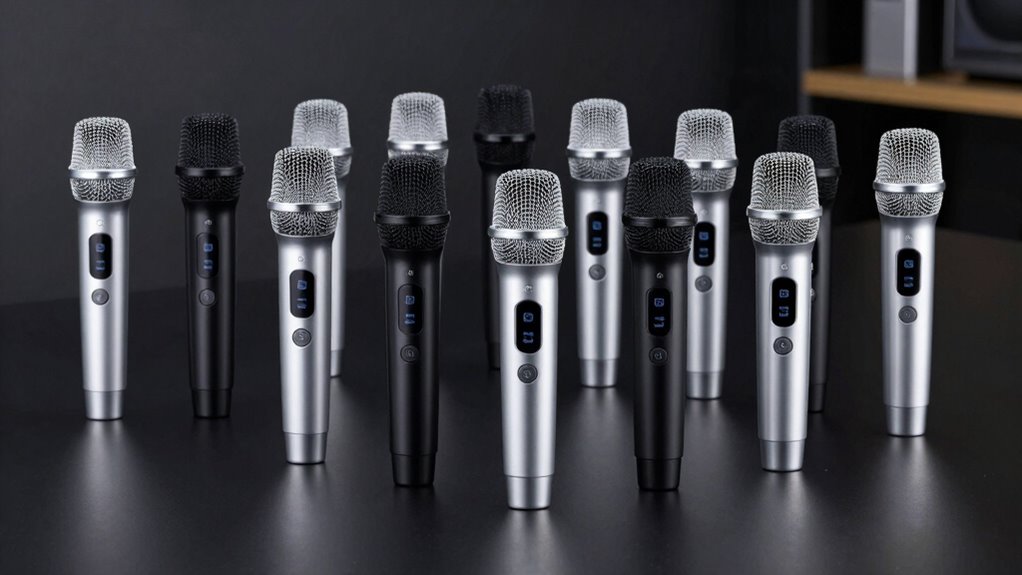

For most karaoke nights and small events, I’d start with the JBL Wireless Two-Microphone System, which pairs two handheld mics with a dual-channel receiver in a familiar audio brand’s lineup. The Sennheiser XSW 1-825-A is a more performance-focused choice, while the TONOR system with handheld, headset, and lavalier mics suits hosts who need to switch between speaking styles. The main tradeoffs are how many people need microphones, how much setup flexibility you want, and whether vocal performance matters more than convenience. This list also includes four-channel and four-mic options, which make more sense for group use than a simple two-person setup. Read on for the full breakdown and a pick matched to your needs.

Get privacy and security gear delivered free with Prime
- Fast, free delivery on millions of items
- Prime Video, Amazon Music and more included
- Member-only deals all year
Complete the kit

Key Takeaways
- The JBL two-mic systems are straightforward choices for shared use: one version focuses on the dual-mic setup, while the case bundle adds a more portable way to carry it.
- Sennheiser’s XSW 1-825-A fills the vocal-performance role: it is the lineup’s specialist pick for buyers prioritizing a dedicated vocal system over extra mic types or channels.
- More microphones change the use case: the MELONARE four-channel system and Aveek four-pack target group events, while most dual systems suit two speakers or singers.
- TONOR’s multi-mic-format bundle favors hosts: handheld, headset, and lavalier choices offer more ways to present, though buyers should decide whether they will use those formats before choosing it.
- Not every listing signals the same level of detail: products such as the generic “Wireless Dual Handheld” option provide less model-specific information in the name, so verify receiver, frequency, and compatibility details before buying.
| FIFINE K036 UHF Dual-Channel Wireless Handheld Microphone System |  | Best for Karaoke Controls | Microphones: 2 handheld microphones | Frequency range: UHF, 520–578 MHz | Operating range: Up to 80 feet | VIEW ON AMAZON | See Our Full Breakdown |
| TONOR Wireless Handheld Microphone System, Gray |  | Best for Long-Range Single-Mic Use | Microphone type: Dynamic handheld | Pickup pattern: Cardioid | Wireless range: Up to 200 feet (60 m) | VIEW ON AMAZON | See Our Full Breakdown |
| JBL Wireless Two-Microphone System with Dual-Channel Receiver, Black |  | Best for Simple Setup | Microphones: 2 | Receiver: Rechargeable dual-channel UHF | Playback time: Up to 6 hours | VIEW ON AMAZON | See Our Full Breakdown |
| Kaschun KA-328 Dual UHF Wireless Handheld Microphone System |  | Best for Long Events | Model: KA-328 | Microphones: 2 handheld dynamic microphones | Wireless technology: UHF | VIEW ON AMAZON | See Our Full Breakdown |
| TONOR TW-820 Wireless Microphone System, 2 Handheld Mics |  | Best for Flexible PA Connections | Microphones: 2 handheld dynamic microphones | Adjustable frequencies: 15 per microphone | Transmission range: Up to 60 m (200 ft) in open space | VIEW ON AMAZON | See Our Full Breakdown |
| Phenyx Pro PTU-71-2H Dual UHF Wireless Microphone System |  | Best for Multi-Mic Events | System type: Dual-channel UHF wireless | Selectable frequencies: 100 per channel | Channel frequency ranges: 536.57–561.32 MHz and 562.37–587.12 MHz | VIEW ON AMAZON | See Our Full Breakdown |
| Sennheiser XSW 1-825-A Wireless Vocal Microphone System |  | Best for Straightforward Vocal Setup | Microphone type: Handheld wireless | Capsule: e825 cardioid dynamic | Frequency range: 548–572 MHz | VIEW ON AMAZON | See Our Full Breakdown |
| TONOR Wireless Microphone System with Handheld, Headset, and Lavalier Mics |  | Best for Flexible Mic Styles | Microphone types: 2 handheld, 2 headset, 2 lavalier | Range: Up to 200 ft (60 m) | Channels: 20 | VIEW ON AMAZON | See Our Full Breakdown |
| MELONARE 4-Channel UHF Wireless Microphone System |  | Best for Four-Handheld Groups | Channels: 4 | Frequency groups: 4 groups of 10 frequencies | Simultaneous systems: Up to 8 sets | VIEW ON AMAZON | See Our Full Breakdown |
| Wireless Dual Handheld Microphone System |  | Best for Plug-and-Play Karaoke | Microphones: 2 handheld dynamic | Operating range: Up to 200 ft line of sight | Polar pattern: Unidirectional | VIEW ON AMAZON | See Our Full Breakdown |
| Aveek 4-Pack Wireless Microphone System |  | Best for Larger Groups | Microphones: 4 handheld cardioid dynamic microphones | Wireless range: Up to 262 feet | Battery life: Up to 40 hours per microphone | VIEW ON AMAZON | See Our Full Breakdown |
| JBL Wireless Two-Microphone System with Dual-Channel Receiver and Protective Travel Case |  | Best for JBL PartyBox Owners | Microphones: 2 wireless microphones | Channels: 2 | Receiver: Rechargeable dual-channel receiver | VIEW ON AMAZON | See Our Full Breakdown |
| Dual Handheld Wireless Rechargeable RGB Microphone System |  | Best for Karaoke Features | Microphones: 2 handheld wireless microphones | Wireless technology: 2.4 GHz | Wireless range: Up to 200 feet in open areas | VIEW ON AMAZON | See Our Full Breakdown |
| JBL PartyBox Wireless Microphones |  | Best for Vocal Handling Control | Microphones: 2 digital wireless microphones | Wireless connection: 2.4 GHz | Wireless range: Up to 30 meters when using the wireless dongle | VIEW ON AMAZON | See Our Full Breakdown |
| Phenyx Pro PTU-52-2H Dual UHF Wireless Microphone System |  | Best for Mixer Connections | Model: PTU-52-2H | Microphones: 2 handheld microphones with cardioid capsules | Frequency band: 500 MHz | VIEW ON AMAZON | See Our Full Breakdown |
| wireless handheld microphone system | Microphones |
|---|---|
| FIFINE K036 UHF Dual-Channel W | 2 handheld microphones |
| TONOR Wireless Handheld Microp | — |
| JBL Wireless Two-Microphone Sy | 2 |
| Kaschun KA-328 Dual UHF Wirele | 2 handheld dynamic microphones |
| TONOR TW-820 Wireless Micropho | 2 handheld dynamic microphones |
| Phenyx Pro PTU-71-2H Dual UHF | — |
| Sennheiser XSW 1-825-A Wireles | — |
| TONOR Wireless Microphone Syst | — |
| MELONARE 4-Channel UHF Wireles | — |
| Wireless Dual Handheld Microph | 2 handheld dynamic |
| Aveek 4-Pack Wireless Micropho | 4 handheld cardioid dynamic microphones |
| JBL Wireless Two-Microphone Sy | 2 wireless microphones |
| Dual Handheld Wireless Recharg | 2 handheld wireless microphones |
| JBL PartyBox Wireless Micropho | 2 digital wireless microphones |
| Phenyx Pro PTU-52-2H Dual UHF | 2 handheld microphones with cardioid capsules |
More Details on Our Top Picks
FIFINE K036 UHF Dual-Channel Wireless Handheld Microphone System
The FIFINE K036 suits karaoke hosts who want two microphones and independent control over each voice. Its separate mic volumes and adjustable echo give hosts room to balance singers without changing the connected speaker’s settings. Compared with the JBL Wireless Two-Microphone System, which emphasizes plug-and-play simplicity and a rechargeable receiver, the FIFINE adds echo control and the option to support a third vocalist with a compatible mic. The tradeoff is a more involved connection: it needs compatible audio equipment, and a smart TV may need a digital-to-analog converter. Its 80-foot range is also shorter than the 200-foot claims of the TONOR TW-820 and Kaschun KA-328, so it fits smaller rooms better than large event spaces.
Pros:- Two handheld microphones with separate volume controls
- Adjustable echo offers extra control for karaoke vocals
- Can support a third vocalist with an additional compatible microphone
- Metal receiver and three audio cables are included
Cons:- No Bluetooth connectivity
- Requires a speaker or sound system with a compatible microphone or RCA input
- 80-foot operating range is shorter than the 200-foot claims of several alternatives
Best for: Karaoke hosts who want two independently controlled mics and adjustable echo for a home setup with compatible audio inputs.
Not ideal for: Hosts working across large halls or buyers expecting Bluetooth or direct smart-TV connectivity; its listed range is 80 feet and TV setups may need a converter.
- Microphones:2 handheld microphones
- Frequency range:UHF, 520–578 MHz
- Operating range:Up to 80 feet
- Channels:2
- Connector:6.35 mm jack
- Polar pattern:Unidirectional
- Power:Battery powered; requires 4 AA batteries
- Receiver enclosure:Metal
Our verdict“Choose the FIFINE K036 for karaoke in a smaller space when separate mic levels and echo matter more than long range or wireless TV connection.”
TONOR Wireless Handheld Microphone System, Gray
For a presenter or singer who needs one wireless handheld and room to move, this TONOR system claims up to 200 feet of range and offers 40 adjustable channels. Its cardioid pickup pattern is designed to favor sound in front of the mic, which can help reduce surrounding noise in a busy room. Unlike the two-mic TONOR TW-820, this model is described as a single dynamic handheld, making it a simpler fit for solo use but a poor choice for duets. The adjustable channels provide options for finding a usable frequency, while the TW-820 instead gives buyers two microphones and separate receiver volume controls. This TONOR requires compatible sound equipment with a 1/4-inch microphone input, and the AA batteries are not included.
Pros:- Up to 200-foot stated wireless range
- 40 adjustable channels across four groups
- Cardioid pickup pattern is designed to reduce background pickup
- 1/4-inch cable connects to compatible mixers, amplifiers, karaoke machines, and powered speakers
Cons:- Only one handheld microphone is described
- AA batteries are not included
- Requires audio equipment with a compatible microphone input
Best for: Solo presenters, instructors, and singers who need a handheld mic with long claimed range and adjustable channel choices.
Not ideal for: Duets, karaoke pairs, or buyers who want a complete two-mic kit; this listing describes one handheld, and batteries must be supplied separately.
- Microphone type:Dynamic handheld
- Pickup pattern:Cardioid
- Wireless range:Up to 200 feet (60 m)
- Channels:40 (4 groups of 10)
- Audio connection:1/4-inch (6.35 mm) cable
- Battery requirement:2 AA batteries per microphone
Our verdict“Pick this TONOR for solo use when range and channel selection matter more than having a second microphone.”
JBL Wireless Two-Microphone System with Dual-Channel Receiver, Black
The JBL Wireless Two-Microphone System puts ease of setup first: its dual-channel receiver mixes both microphones, and the system is described as plug and play with a compatible speaker. That makes it a straightforward choice for hosts who want two voices through one speaker without separate mixing steps. The receiver is rechargeable for up to six hours, while both microphones use replaceable AA batteries. Compared with the FIFINE K036, JBL’s appeal is simpler operation rather than adjustable echo or support for an extra compatible mic. Compared with the Kaschun KA-328, the listed details give less emphasis to extended mic runtime and long operating range. The six-hour receiver limit may not suit longer events, and mic batteries need replacing when depleted.
Pros:- Includes two microphones and a dual-channel receiver
- Receiver mixes both voices through a compatible speaker
- Plug-and-play setup reduces configuration steps
- Rechargeable receiver provides up to six hours of playback
Cons:- Receiver playback is limited to up to six hours per charge
- Microphones rely on replaceable AA batteries
- The supplied details do not specify wireless range or adjustable frequency channels
Best for: Casual event hosts who want two microphones mixed through a compatible speaker with minimal setup.
Not ideal for: Operators running events beyond six hours without a charging break, or buyers who need specified long-range performance and detailed independent controls.
- Microphones:2
- Receiver:Rechargeable dual-channel UHF
- Playback time:Up to 6 hours
- Setup:Plug and play
- Microphone batteries:Replaceable AA batteries
- Color:Black
Our verdict“Choose JBL when uncomplicated two-mic operation matters more than long runtime or detailed channel and range specifications.”
Kaschun KA-328 Dual UHF Wireless Handheld Microphone System
The Kaschun KA-328 is a practical match for longer events where two performers need freedom to move. Its microphones are specified for over eight hours on the included AA batteries, and the stated range reaches 200 feet. That runtime gives it an advantage over the JBL Wireless Two-Microphone System, whose rechargeable receiver is rated for up to six hours, although JBL’s plug-and-play description may appeal more to buyers who value a simple setup. Kaschun includes a 6.35 mm cable and lists both 6.35 mm and XLR connectivity, but the system does not connect over Bluetooth or AUX. Its listed 80 dB signal-to-noise ratio is below the TONOR TW-820’s 96 dB figure, and the product data gives a frequency response of 20 kHz without specifying a lower endpoint.
Pros:- Two handheld dynamic microphones for duets or paired presenters
- Over eight hours of stated runtime per microphone
- Up to 200-foot stated wireless range
- Metal receiver and 6.35 mm cable included, with XLR also listed
Cons:- No Bluetooth or AUX connectivity
- Requires AA batteries
- Listed 80 dB signal-to-noise ratio is lower than the TONOR TW-820’s 96 dB figure
Best for: Event hosts and small performance groups who need two UHF microphones with long stated battery life and 6.35 mm or XLR connections.
Not ideal for: Buyers who need Bluetooth or AUX playback, or who prioritize a higher listed signal-to-noise ratio such as the TONOR TW-820’s.
- Model:KA-328
- Microphones:2 handheld dynamic microphones
- Wireless technology:UHF
- Wireless range:Up to 200 feet
- Battery life:Over 8 hours per microphone
- Connectivity:6.35 mm jack and XLR
- Signal-to-noise ratio:80 dB
- Enclosure material:Metal
Our verdict“Choose the KA-328 for two-mic events where long battery life and extended stated range matter more than Bluetooth or AUX.”
TONOR TW-820 Wireless Microphone System, 2 Handheld Mics
The TONOR TW-820 earns its place for buyers connecting a two-mic setup to varied PA equipment. Its receiver offers both XLR and 6.35 mm outputs, and separate volume controls make it easier to balance the two performers. Each handheld has a metal body and steel mesh grille, while the cardioid capsules are designed to reduce background pickup and feedback. Compared with the FIFINE K036, the TW-820 claims substantially more range—up to 200 feet in open space—and offers XLR connectivity, but it does not list echo adjustment or support for an additional third mic. Its 15 adjustable frequencies per mic give some channel flexibility, though the AA batteries are not included. The range claim is specified for open space, so obstacles and venue layout may affect usable distance.
Pros:- Two metal handheld microphones with steel mesh grilles
- Separate receiver volume controls for each microphone
- XLR and 6.35 mm outputs support varied compatible audio setups
- Up to 15 sets can be used simultaneously, according to the product data
Cons:- Requires an amplifier or PA speaker with a microphone input
- AA batteries are not included
- The stated 200-foot range applies to open space
Best for: Karaoke hosts, small venues, and presenters who need two independently controlled mics and both XLR and 6.35 mm PA connections.
Not ideal for: Buyers without a compatible amplifier or PA input, or anyone who wants batteries included and a built-in echo effect.
- Microphones:2 handheld dynamic microphones
- Adjustable frequencies:15 per microphone
- Transmission range:Up to 60 m (200 ft) in open space
- Polar pattern:Unidirectional
- Signal-to-noise ratio:96 dB
- Connectors:XLR and 6.35 mm jack
- Power:2 AA batteries per microphone; not included
- Enclosure material:Metal
Our verdict“Pick the TW-820 when flexible PA connections and separate mic levels matter more than included batteries or echo controls.”
Phenyx Pro PTU-71-2H Dual UHF Wireless Microphone System
The PTU-71-2H is a strong fit for hosts who need two handhelds now and room to coordinate a larger UHF setup later. Its Auto Scan and 100 selectable frequencies per channel help find a usable channel, while the stated support for up to 16 transmitters gives it more expansion headroom than the Sennheiser XSW 1-825, which supports up to 10 simultaneous channels. Cardioid pickup can help keep surrounding sound out of each mic, and the metal receiver and handhelds suit regular event use. The tradeoff is a receiver setup that depends on clear line of sight for its advertised 290–328-foot range. Both mics also use replaceable AA batteries, so users who prefer rechargeable transmitters should look elsewhere.
Pros:- Auto Scan and 100 selectable frequencies per channel help with channel selection
- Supports up to 16 simultaneous transmitters
- Cardioid pickup helps reject ambient sound
- Includes two metal handheld microphones and connection accessories
Cons:- The 290–328-foot range is specified for line-of-sight use
- Handheld microphones require replaceable AA batteries
Best for: Event hosts and venue operators who want two handheld mics with frequency options for a growing multi-mic setup.
Not ideal for: Mobile presenters who need rechargeable microphones or expect reliable operation through walls and obstacles.
- System type:Dual-channel UHF wireless
- Selectable frequencies:100 per channel
- Channel frequency ranges:536.57–561.32 MHz and 562.37–587.12 MHz
- Maximum simultaneous transmitters:16
- Operating range:290–328 ft line of sight
- Microphone pattern:Cardioid
- Construction:Metal receiver and handheld microphones
- Battery life:Up to 16 hours; 4 AA batteries included
Our verdict“Choose the PTU-71-2H for a two-mic event setup that may expand; skip it if rechargeable power is a priority.”
Sennheiser XSW 1-825-A Wireless Vocal Microphone System
The XSW 1-825-A suits singers and presenters who want one handheld vocal mic with guided wireless setup. Its automatic frequency management and synchronization reduce the manual steps involved in getting transmitter and receiver on the same channel. The e825 cardioid dynamic capsule gives this set a more vocal-focused brief than the TONOR system, which includes handheld, headset, and lavalier options for different speaking styles. Antenna-switching diversity reception is another useful distinction for a single-mic performance setup. The tradeoff is scope: this package includes one handheld transmitter, so it does not cover a duet without another compatible system. Its 548–572 MHz operating range is also a specific band to check against local conditions, and the transmitter runs on two AA batteries.
Pros:- Automatic frequency management and synchronization simplify setup
- e825 cardioid dynamic capsule is designed for vocal use
- Antenna-switching diversity receiver
- Supports up to 10 simultaneous channels
Cons:- Includes one handheld transmitter rather than a pair
- Operates in the specified 548–572 MHz frequency range
- Requires two AA batteries
Best for: Solo singers, presenters, and small venues that want one handheld mic with automatic channel coordination.
Not ideal for: Duets or groups that need multiple microphones in one package, or buyers seeking headset and lavalier choices.
- Microphone type:Handheld wireless
- Capsule:e825 cardioid dynamic
- Frequency range:548–572 MHz
- Simultaneous channels:Up to 10
- Receiver:Diversity receiver with antenna-switching reception
- Signal-to-noise ratio:70 dB
- Power:2 AA batteries included
- Included components:Handheld transmitter, diversity receiver, microphone clip
Our verdict“Pick the XSW 1-825-A for a solo vocal setup with automatic coordination, but choose a multi-mic bundle for duets.”
TONOR Wireless Microphone System with Handheld, Headset, and Lavalier Mics
The TONOR kit is the flexible choice for a presenter or instructor who may switch between handheld speaking and hands-free delivery. Alongside two handheld microphones, it includes bodypacks with headset and lavalier mics, a broader range of wearing options than the Phenyx Pro PTU-71-2H, which focuses on two handhelds and frequency coordination. Automatic pairing helps get the system connected with less setup, and the listed compatibility covers mixers, karaoke machines, amplifiers, and powered speakers. That versatility comes with more battery management: each microphone or bodypack needs two AA batteries, and none are included. The stated 200-foot range is shorter than the Phenyx Pro’s advertised line-of-sight range, and buyers need a compatible 1/4-inch input or connection path.
Pros:- Includes two handheld, two headset, and two lavalier microphones
- Automatic pairing simplifies initial setup
- Works with mixers, karaoke machines, amplifiers, and powered speakers
- Listed operating range reaches up to 200 ft
Cons:- AA batteries are required and not included
- Requires a 1/4-inch audio input or compatible connection
- The stated range is shorter than the Phenyx Pro PTU-71-2H’s line-of-sight claim
Best for: Instructors, presenters, and community venues that need both handheld and hands-free microphone options.
Not ideal for: Buyers who want a simple two-handheld kit, do not have spare AA batteries, or lack compatible audio inputs.
- Microphone types:2 handheld, 2 headset, 2 lavalier
- Range:Up to 200 ft (60 m)
- Channels:20
- Pickup type:Dynamic, unidirectional
- Compatible devices:Mixer, karaoke machine, amplifier, powered speaker
- Connector:Aux; includes 6.35 mm audio cable
- Signal-to-noise ratio:60 dB
- Power:2 AA batteries per microphone or bodypack; not included
Our verdict“Choose this TONOR kit when hands-free mic options matter as much as handheld use, and avoid it if you want a minimal two-mic setup.”
MELONARE 4-Channel UHF Wireless Microphone System
When four people need handheld microphones at once, the MELONARE gives them a dedicated mic each without piecing together separate kits. Its four-channel receiver and color-coded controls make it easier to match each transmitter to its channel, while frequency hopping and four groups of selectable frequencies offer options for managing a busy setup. The 24-bit/48 kHz digital UHF transmission is another stated distinction from the two-channel Phenyx Pro PTU-71-2H. MELONARE’s compact receiver and included batteries also make the package portable and ready to assemble. The cost in complexity is four transmitters to manage and eight AA batteries to keep charged or replace. Its claimed 200-foot range depends on the environment, so it may not suit venues where the microphones must work across obstacles.
Pros:- Four handheld transmitters feed one receiver
- Frequency hopping and four groups of selectable frequencies support setup flexibility
- Color-coded controls help identify channels
- Includes eight AA batteries and connection adapters
Cons:- Four transmitters require eight AA batteries
- The claimed 200-foot range can vary with the environment
- Managing four channels may be unnecessary for smaller setups
Best for: Karaoke hosts, DJs, and event organizers who regularly need four handheld mics on one receiver.
Not ideal for: Solo presenters or small rooms where a four-mic receiver adds needless equipment and battery upkeep.
- Channels:4
- Frequency groups:4 groups of 10 frequencies
- Simultaneous systems:Up to 8 sets
- Transmission:UHF digital
- Sampling rate:24-bit/48 kHz
- Wireless range:Up to 200 ft
- Pickup pattern:Cardioid
- Included microphones and power:4 handheld transmitters; 8 AA batteries
Our verdict“Choose MELONARE when four speakers need handheld mics at once; for a two-person setup, the Phenyx Pro PTU-71-2H is a simpler fit.”
Wireless Dual Handheld Microphone System
This unnamed dual-handheld set is aimed at karaoke users and small PA setups that want a quick connection with compatible gear. It pairs two dynamic mics with a plug-and-play receiver, and its unidirectional pickup and noise-reduction features are intended to keep attention on the speaker or singer. The receiver has a 6.35 mm plug and a 3.5 mm adapter, giving it a straightforward route to compatible microphone inputs. Compared with the TONOR multi-style kit, this one keeps the package focused on handheld use rather than adding headset and lavalier transmitters. Its boundaries are just as clear: it does not support phones, computers, or tablets, and AUX connections are not supported. The stated 200-foot range assumes line of sight, and users need to confirm their equipment has a suitable mic input.
Pros:- Includes two handheld dynamic microphones
- Plug-and-play pairing is designed for compatible audio gear
- Unidirectional pickup and noise reduction are included
- Receiver plug and 3.5 mm adapter support compatible mic inputs
Cons:- Not compatible with mobile phones, computers, or tablets
- Requires a 6.35 mm or 3.5 mm microphone input; AUX is unsupported
- The stated 200-foot range is line of sight
Best for: Karaoke hosts and home PA users with compatible speakers, amplifiers, or systems that have a microphone input.
Not ideal for: People who plan to record directly to a phone, computer, or tablet, or connect through AUX only.
- Microphones:2 handheld dynamic
- Operating range:Up to 200 ft line of sight
- Polar pattern:Unidirectional
- Impedance:600 ohm
- Signal-to-noise ratio:70 dB
- Distortion:Less than 0.2%
- Connectors:6.35 mm receiver plug; 3.5 mm adapter included
- Compatibility:Compatible mic inputs; not compatible with phones, computers, or tablets
Our verdict“Pick this set for simple two-person karaoke with compatible mic inputs, and skip it if your source is a phone, computer, or AUX-only device.”
Aveek 4-Pack Wireless Microphone System
The Aveek 4-Pack is the group pick here: four handheld microphones let more people share a karaoke session, event, or presentation setup without passing around a single mic. Its stated 262-foot range and up to 40 hours of battery life per microphone suit longer events, while USB-C charging avoids keeping a supply of disposable batteries on hand. Compared with the Phenyx Pro PTU-52-2H, Aveek gives you two extra microphones, but Phenyx offers dual XLR outputs and tunable frequency groups for more flexible mixer connections. Aveek’s receiver uses a standard 1/4-inch output, so check your equipment before buying: it does not support phones, computers, tablets, or AV receivers. The receiver also randomly assigns a channel when paired, which can make setup less predictable.
Pros:- Four cardioid dynamic handheld microphones support larger groups.
- Stated wireless range reaches up to 262 feet.
- Each microphone is rated for up to 40 hours of battery life.
- USB-C charging reduces reliance on replaceable batteries.
Cons:- Does not work with laptops, phones, tablets, or AV receivers.
- The receiver randomly assigns a channel when paired.
Best for: Karaoke hosts, community groups, and event organizers who need four handheld mics for a compatible PA, mixer, or powered speaker.
Not ideal for: Buyers connecting directly to a phone, laptop, tablet, or AV receiver, or anyone who needs to select specific channels during setup.
- Microphones:4 handheld cardioid dynamic microphones
- Wireless range:Up to 262 feet
- Battery life:Up to 40 hours per microphone
- Charging:USB-C
- Receiver output:1/4-inch
- Compatible equipment:PA systems, mixers, karaoke machines, and powered speakers
- Included accessories:Power adapter, 1/4-inch audio cable, 2 USB-C charging cables, 4 non-slip rings, and manual
- Not compatible with:Laptops, iPads, cellphones, and AV receivers
Our verdict“Choose Aveek when four rechargeable handheld microphones matter more than device flexibility or manual channel selection.”
JBL Wireless Two-Microphone System with Dual-Channel Receiver and Protective Travel Case
This JBL two-mic system keeps setup simple for owners of compatible JBL PartyBox models: its receiver mixes both voices, and the included protective travel case keeps the kit together between gatherings. Plug-and-play operation favors quick duets over configurable sound-system setups. Compared with the JBL PartyBox Wireless Microphones, this system is rated for up to 6 hours of playback and uses AA batteries in the microphones; the PartyBox Wireless set offers rechargeable microphones and a cardioid pickup design with a shock mount and pop filter. Both are tied to select PartyBox speakers, so neither is a general-purpose pick for arbitrary PA systems or mixers. The rechargeable receiver is convenient, but the replaceable AA batteries mean microphone power still needs separate attention.
Pros:- Two microphones feed a dual-channel receiver that mixes both voices.
- Plug-and-play setup suits casual gatherings.
- Includes a protective travel case.
- Receiver is rechargeable over USB-C.
Cons:- Compatible with select JBL PartyBox models only.
- Microphones use replaceable AA batteries.
- Playback time is rated for up to 6 hours.
Best for: JBL PartyBox owners who want two microphones for duets or group games and value a simple setup with a carry case.
Not ideal for: Buyers with non-compatible speakers or PA systems, or those who want rechargeable microphone batteries and longer stated playtime.
- Microphones:2 wireless microphones
- Channels:2
- Receiver:Rechargeable dual-channel receiver
- Microphone batteries:2 AA batteries included
- Playback time:Up to 6 hours
- Charging cable:USB-C
- Compatible devices:Select JBL PartyBox models
- Included:2 wireless microphones, receiver, USB-C cable, 2 AA batteries, and protective travel case
Our verdict“Pick this system for straightforward two-mic use with a compatible JBL PartyBox and a kit that travels neatly.”
Dual Handheld Wireless Rechargeable RGB Microphone System
With on-mic volume controls and built-in RGB lighting, this two-microphone system is aimed at karaoke users who want a more playful setup and quick adjustments without reaching for the receiver. Automatic pairing and the foldable rechargeable receiver make it easier to get going than a system that asks users to tune frequencies, such as the Phenyx Pro PTU-52-2H. Its stated 200-foot open-area range gives singers room to move, but the connection options impose a firm limit: the system needs a compatible microphone input, whether 6.35 mm or 3.5 mm. An AUX or line-in-only port will not work, and neither will a Bluetooth-only speaker, phone, tablet, or laptop. The extra lighting is a bonus for karaoke, not a substitute for checking the input on your sound equipment.
Pros:- Two handheld microphones support duets.
- Automatic pairing cuts down on setup steps.
- On-mic volume controls allow quick adjustments while singing.
- RGB lighting adds a visual feature for karaoke use.
Cons:- Does not work with AUX or line-in-only ports.
- Incompatible with Bluetooth-only devices, phones, tablets, and laptops.
Best for: Karaoke hosts with a speaker, PA, or amplifier that has a compatible 6.35 mm or 3.5 mm microphone input.
Not ideal for: People whose only audio connection is AUX, Bluetooth, or a phone, tablet, or laptop.
- Microphones:2 handheld wireless microphones
- Wireless technology:2.4 GHz
- Wireless range:Up to 200 feet in open areas
- Lighting:Built-in RGB
- Controls:On-mic volume control
- Pairing:Automatic
- Compatible inputs:6.35 mm or 3.5 mm microphone inputs
- Included accessories:Foldable rechargeable receiver, USB-C charging cables, anti-slip rings, and 6.35 mm to 3.5 mm adapter
Our verdict“Choose this set for feature-forward karaoke when your speaker has a proper microphone input.”
JBL PartyBox Wireless Microphones
The JBL PartyBox Wireless Microphones put vocal handling details ahead of broad compatibility. Cardioid pickup, a shock mount system, and built-in pop filters are intended to reduce room pickup, handling noise, and breath sounds, which can help vocals come through more cleanly at a party. Compared with the JBL Wireless Two-Microphone System with Dual-Channel Receiver and Protective Travel Case, this set has rechargeable 700 mAh batteries and a longer stated playtime of up to 20 hours under the listed conditions. That figure drops to up to 12 hours with the digital wireless dongle, and a 30-meter range is specified when using that dongle. The bigger limitation is compatibility: these microphones are designed for JBL PartyBox speakers, so owners of other PA systems should look to a more flexible option such as the Phenyx Pro PTU-52-2H.
Pros:- Cardioid pickup focuses capture toward the singer.
- Shock mount system and built-in pop filters target handling and breath noise.
- Rechargeable 700 mAh batteries are rated for up to 20 hours of playtime under listed conditions.
- A 10-minute charge is rated to provide up to 2 hours of playtime.
Cons:- Designed for use with JBL PartyBox speakers.
- Playtime is rated for up to 12 hours when using the digital wireless dongle.
- The stated 30-meter range applies when using the dongle.
Best for: JBL PartyBox owners who want two rechargeable microphones with features aimed at reducing handling and breathing noise.
Not ideal for: Singers using non-PartyBox equipment or buyers who need the listed playtime to hold when using the digital wireless dongle.
- Microphones:2 digital wireless microphones
- Wireless connection:2.4 GHz
- Wireless range:Up to 30 meters when using the wireless dongle
- Battery:Rechargeable, 700 mAh
- Playtime:Up to 20 hours; up to 12 hours with the digital wireless dongle
- Pickup pattern:Cardioid
- Vocal noise features:Shock mount system and built-in pop filters
- Compatibility:JBL PartyBox speakers
Our verdict“Choose these for a compatible PartyBox if vocal noise control and rechargeable microphones matter more than broad system compatibility.”
Phenyx Pro PTU-52-2H Dual UHF Wireless Microphone System
The Phenyx Pro PTU-52-2H is the flexible connection pick: two XLR outputs let a compatible mixer handle each microphone separately, while a mixed 1/4-inch output offers a simpler single-cable route. Its 30 tunable frequency groups give buyers more channel options than the Aveek 4-Pack, whose receiver randomly assigns a channel. The metal receiver and microphones also suit buyers who want a substantial hardware set for a PA setup. The tradeoff is that this is a two-microphone system, not a group pack like Aveek, and the stated 200-foot range applies to open space with line of sight. It runs on four AA batteries, so regular users should plan for battery changes. Phenyx also specifies support for up to three units at the same time, which limits larger multi-system setups.
Pros:- Two XLR outputs support separate microphone connections to a mixer.
- Mixed 1/4-inch output offers a single-output alternative.
- 30 tunable frequency groups provide channel options.
- Metal receiver and microphones give the hardware a sturdy construction.
Cons:- The 200-foot operating range is specified for open-space line of sight.
- Uses four AA batteries.
- Supports up to three units at the same time.
Best for: Small event operators and musicians connecting two wireless handheld microphones to a mixer or PA with XLR or 1/4-inch inputs.
Not ideal for: Groups needing four microphones from one kit, rechargeable handhelds, or several systems operating together beyond the stated limit.
- Model:PTU-52-2H
- Microphones:2 handheld microphones with cardioid capsules
- Frequency band:500 MHz
- Tunable frequency groups:30
- Operating distance:Up to 200 feet line of sight
- Outputs:2 XLR outputs and 1 mixed 1/4-inch output
- Power:4 AA batteries included
- Included accessories:Power adapter, 1/4-inch audio cable, 6.35 mm to 3.5 mm adapter, anti-rolling rings, windscreens, antennas, rubber feet, and manual
Our verdict“Pick the PTU-52-2H for two-mic PA or mixer setups that benefit from separate XLR outputs and tunable frequency groups.”

How We Picked
I ranked these systems by how well their stated configuration matches a recognizable buyer need: two-person karaoke, event hosting, vocal performance, or group use. I gave weight to channel and microphone count, microphone-format flexibility, portability cues such as the JBL protective case bundle, and whether the product is presented as a dedicated vocal system or a general-purpose set.
The order favors clear, practical fits over raw feature count. That puts an easy-to-understand dual-mic setup near the top, gives the Sennheiser a distinct role for vocal-focused buyers, and places four-mic and multi-format systems where their extra capacity is useful. Product names alone do not establish range, battery life, frequency coordination, or sound quality, so I treat those as details buyers should verify in the manufacturer specifications rather than assume.
Factors to Consider When Choosing Wireless Handheld Microphone System
Choose a system around the room, the people using it, and the audio equipment it must connect to. A larger microphone count can help a busy event, but it also brings more gear to manage. These checks can narrow the field before you compare individual models.
Match the microphone count to the event
Start with the number of people who need to speak or sing at the same time, not the total number of guests. A dual system can handle a host and guest or two karaoke singers, while a four-mic setup is better suited to group games or panel-style events. Check whether the receiver supports the number of microphones simultaneously; a bundle containing several mics does not automatically mean all can operate together. Extra microphones also need storage, charging or batteries, and clear handoffs during an event. If two channels cover your regular use, choosing four can add setup work without improving the experience.
Check receiver connections before choosing
Wireless microphones still need a receiver connected to the speaker, mixer, or amplifier. Confirm the receiver’s output type and whether your audio equipment has a matching input before ordering. A system designed for a party speaker may not suit a mixer-based event setup without the right cable or adapter. Also check whether two microphones have independent channel controls or share a combined output, since that affects how easily you can adjust each voice. The product name alone rarely answers these compatibility questions.
Decide whether handheld is the right format
Handheld mics suit karaoke, announcements, and settings where users can pass a microphone between them. A headset or lavalier keeps a presenter’s hands free, which helps during demonstrations or movement on stage. Multi-format bundles can cover both situations, but they add pieces that need fitting, storage, and setup. Think about clothing, movement, and how often the user will switch formats. For a fixed karaoke setup, extra wearable microphones may not justify their added complexity.
Treat wireless range as a venue question
Advertised range is only a starting point: walls, people, other wireless devices, and receiver placement can all affect a signal. A clear line of sight between microphone and receiver is usually easier to achieve in an open room than across a crowded venue. Consider where the receiver can sit and whether performers need to move behind obstacles. For events in different locations, look for the manufacturer’s stated operating range and frequency information, then allow a margin for the room. Do not choose by a range figure alone if the venue layout is difficult.
Plan for batteries, charging, and storage
Check how each microphone is powered and whether batteries are included, rechargeable, or sold separately. For recurring events, the ability to keep spare batteries or charge microphones between sessions can matter more than a small convenience feature. A carrying case helps protect and organize a set that travels, while a stationary home setup may need less protection. If several microphones are included, think through how you will label and store them so they do not get mixed up. Confirm battery runtime from product documentation rather than estimating from the number of mics.
Pay more for the problem you need to solve
A higher-spec or more established vocal system can make sense when performances are central and you need a dedicated stage-oriented setup. A general-purpose dual kit is a more sensible fit when the goal is occasional karaoke or announcements. Spend extra on additional channels only if multiple people must use microphones at once, and on a case if the system travels often. Look for clear documentation on frequency selection, compatibility, and replacement parts before committing to a specialized setup. Features that will not change your event are poor reasons to move up the lineup.
Frequently Asked Questions
Can I connect a wireless handheld system to any speaker?
No; the receiver must connect to an input your speaker supports. Check whether the receiver uses a microphone-level or line-level output and compare that with the speaker’s available inputs. Some portable party speakers accept a microphone input directly, while others may need a mixer or a different cable arrangement. Confirm the connector and signal requirements in both manuals before buying. This check can prevent a system that works on paper from being awkward to use with your existing gear.
Is a two-microphone system enough for karaoke with friends?
For duets and a host-plus-singer arrangement, two microphones are often enough. The useful question is whether two people will perform at the same time, rather than how many people attend. A four-mic system can help with group games or several simultaneous speakers, but it brings more equipment to manage. Also check how the receiver handles separate channels and whether your speaker or mixer has suitable inputs. If most songs are sung by one person at a time, two microphones are typically the simpler fit.
Should I choose a vocal-focused system or a general-purpose dual set?
Choose based on how central singing performance is to your use. A dedicated vocal system such as the Sennheiser XSW 1-825-A is aimed more directly at vocal use, while general-purpose dual sets emphasize shared use for karaoke and events. For occasional announcements or home sing-alongs, a straightforward two-mic kit may cover the need with less specialized setup. For regular performances, check microphone specifications, receiver controls, and replacement options closely. The product category alone cannot guarantee a sound that suits every voice or room.
When is a headset or lavalier worth choosing over a handheld mic?
A headset or lavalier helps when the presenter needs both hands free, such as during a demonstration, class, or active presentation. Handheld mics are easier to pass between users and work naturally for karaoke. A bundle with multiple microphone formats can cover both styles, but each format needs its own setup and care. Consider who will wear it, how much they move, and whether clothing or fit could affect comfort. If the microphone will be shared casually, handheld is usually the less fussy option.
What should I verify before using a wireless mic at a venue?
Check the venue’s rules for wireless frequencies and ask whether other microphones or radio systems will be operating nearby. Confirm the system’s supported frequency band and whether it allows channel selection or scanning. Test the receiver and microphones in the actual room, with the receiver placed where it will be during the event. Keep a backup wired microphone or spare batteries available for important events. Range claims from an open-space test may not reflect a crowded room with walls and interference.
Conclusion
For the clearest all-around starting point, I’d choose the JBL Wireless Two-Microphone System for its straightforward two-person role; the protective-case version makes more sense if the kit will travel. The FIFINE K036 is a value-oriented option to compare for buyers seeking a dual-channel UHF setup, while the Sennheiser XSW 1-825-A is my premium-leaning pick for vocal-focused use. Beginners should favor a simple two-mic receiver setup and verify that it connects directly to their speaker. For hosts who need hands-free presentation, look at the TONOR handheld, headset, and lavalier bundle; for group events, compare the MELONARE four-channel and Aveek four-pack. The right choice is the one whose channel count, mic format, and receiver connections fit the event you actually run.