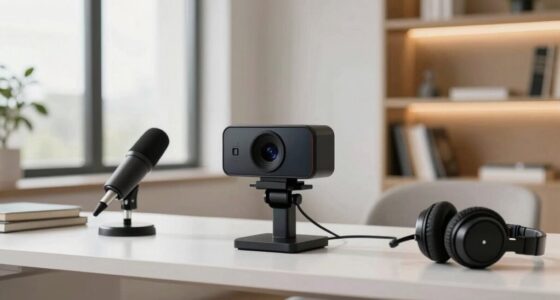
In AI-assisted interview screening, your responses and non-verbal cues are analyzed by algorithms that look for keywords, tone, facial expressions, and body language. To succeed, prepare clear, focused answers that highlight your relevant skills and avoid filler words. Make sure your environment is quiet and well-lit to help the AI evaluate your non-verbal communication accurately. Understanding how these tools work can give you an advantage—keep going to discover more tips to excel in this process.

Get privacy and security gear delivered free with Prime
- Fast, free delivery on millions of items
- Prime Video, Amazon Music and more included
- Member-only deals all year
Key Takeaways
- AI screening analyzes responses for keywords, tone, facial expressions, and body language to assess communication skills and enthusiasm.
- Preparing clear, concise answers with relevant industry terminology improves AI evaluation outcomes.
- Understanding how AI evaluates responses helps candidates tailor their answers and non-verbal cues effectively.
- AI tools aim to reduce human biases but require genuine skills and transparent communication from candidates.
- Creating a quiet, well-lit environment enhances the accuracy of AI-based assessments during virtual interviews.
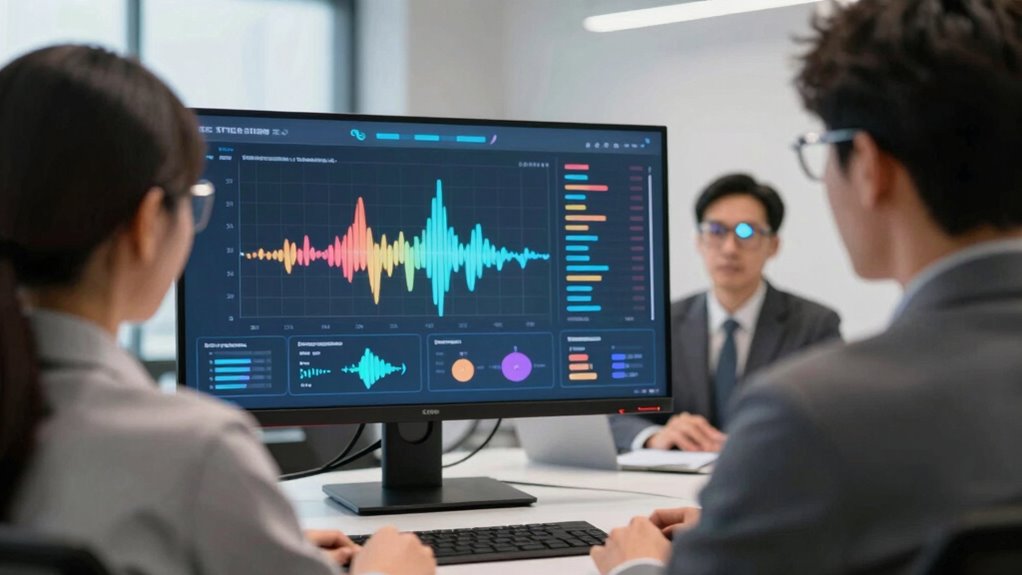
When you participate in an AI-assisted screening, your responses are analyzed by algorithms designed to evaluate your qualifications objectively. These systems look for keywords, language patterns, tone of voice, facial expressions, and other cues that help determine your fit for the role. This means your ability to communicate clearly, demonstrate enthusiasm, and showcase relevant experience can be assessed more consistently and efficiently than in a traditional interview. However, it’s vital to remember that the goal of candidate evaluation through AI isn’t to replace human judgment but to streamline the process and identify the most promising candidates for the next stage.
Interview automation also means you need to prepare differently. Since many AI systems analyze your responses in real time, practicing clear, concise answers becomes essential. It’s beneficial to review the job description carefully and tailor your responses to highlight your relevant skills and experiences. Remember, these systems are programmed to detect specific keywords and phrases, so incorporating industry-specific terminology naturally into your answers can improve your chances of progressing. Additionally, confirm your environment is suitable for video interviews—good lighting, a quiet space, and a neutral background can help your responses be evaluated more accurately. Understanding how content analysis works can help you better anticipate what the algorithms are seeking during your responses. Being aware of how algorithmic evaluation functions can also help you present your responses more effectively. Moreover, understanding machine learning algorithms used in these assessments can give you insight into how your responses are interpreted and improve your interview strategy. Recognizing that some systems also evaluate non-verbal cues can help you be more mindful of your facial expressions and body language during the interview.
It’s also worth noting that AI systems are designed to be impartial, reducing potential human biases. This can work in your favor if your background aligns well with the role, but it also means you should avoid filler words or ambiguous language that might confuse the algorithms. Transparency is increasingly important, so some companies may inform you about the AI tools they use and how they analyze responses. Being aware of this can help you approach the interview with confidence, knowing that your genuine skills and qualifications are what matter most.
ring light for video conferencing
As an affiliate, we earn on qualifying purchases.
As an affiliate, we earn on qualifying purchases.
Frequently Asked Questions
How Accurate Are AI Assessments Compared to Human Interviewers?
AI assessments can be quite accurate, but they’re not perfect. They improve candidate engagement by providing consistent, unbiased evaluation, but may still miss nuances human interviewers catch. While AI endeavors for interview fairness, biases in data can affect accuracy. As a result, it’s best to see AI as a helpful tool that supports, rather than replaces, human judgment, ensuring a balanced, fair assessment process.
Can Candidates Detect if AI Is Evaluating Their Responses?
In a flash of a bygone era, you might wonder if AI is spying on you. Usually, you can’t detect if AI evaluates your responses because it’s designed to analyze candidate authenticity subtly. Companies are increasingly prioritizing AI transparency, making it less likely you’ll notice the AI’s involvement. Focus on being genuine and confident, as authenticity helps you stand out, regardless of whether AI is screening you behind the scenes.
What Biases Might AI Screening Introduce Into the Hiring Process?
AI screening can introduce biases if algorithms lack fairness, potentially favoring certain demographics over others. You might find that unconscious biases or flawed training data influence the evaluation, impacting fairness in hiring. To address this, companies should prioritize algorithm fairness and bias mitigation strategies, ensuring diverse data sets and transparent processes. Being aware of these risks helps you understand that AI isn’t infallible and that ongoing improvements are essential for fair assessments.
How Is Candidate Privacy Protected During Ai-Assisted Interviews?
During AI-assisted interviews, your privacy is protected through strict consent protocols, ensuring you’re aware of how your data is used. Employers employ data encryption to secure your recordings and personal information from unauthorized access. These measures help maintain confidentiality and trust, giving you confidence that your sensitive information isn’t exposed or misused. It is crucial to understand these protections so you can participate comfortably and securely in AI-driven interview processes.
Will AI Screening Replace Human Interviewers Entirely?
AI screening won’t replace human interviewers entirely; instead, it complements their role. It reduces traditional interview biases and streamlines initial assessments, freeing humans to focus on deeper insights and interpersonal skills. You should prepare for AI tools by understanding their role in the process, practicing interview techniques, and showcasing your authentic self. Embracing both AI and human elements helps you stand out, highlighting your unique qualities beyond automated evaluations.
noise cancelling microphone for virtual interviews
As an affiliate, we earn on qualifying purchases.
As an affiliate, we earn on qualifying purchases.
Conclusion
As you prepare for AI-assisted screening, remember that 70% of companies now use some form of AI in their hiring process. This means your answers are being analyzed by algorithms that look beyond your words, evaluating tone and confidence. Stay genuine and concise, and don’t forget to highlight your unique skills. Embrace the technology as a tool to showcase your best qualities—after all, it’s designed to find the right fit, just like you.
ring light with adjustable brightness
As an affiliate, we earn on qualifying purchases.
As an affiliate, we earn on qualifying purchases.
professional webcam for video calls
As an affiliate, we earn on qualifying purchases.
As an affiliate, we earn on qualifying purchases.
Fall Picks
fall essentials
As an affiliate, we earn on qualifying purchases.