
📊 Full opportunity report: Parental Consent Management For Kid-facing Vendors on IdeaNavigator AI — validation score, market gap, and execution plan.

Get privacy and security gear delivered free with Prime
- Fast, free delivery on millions of items
- Prime Video, Amazon Music and more included
- Member-only deals all year
TL;DR
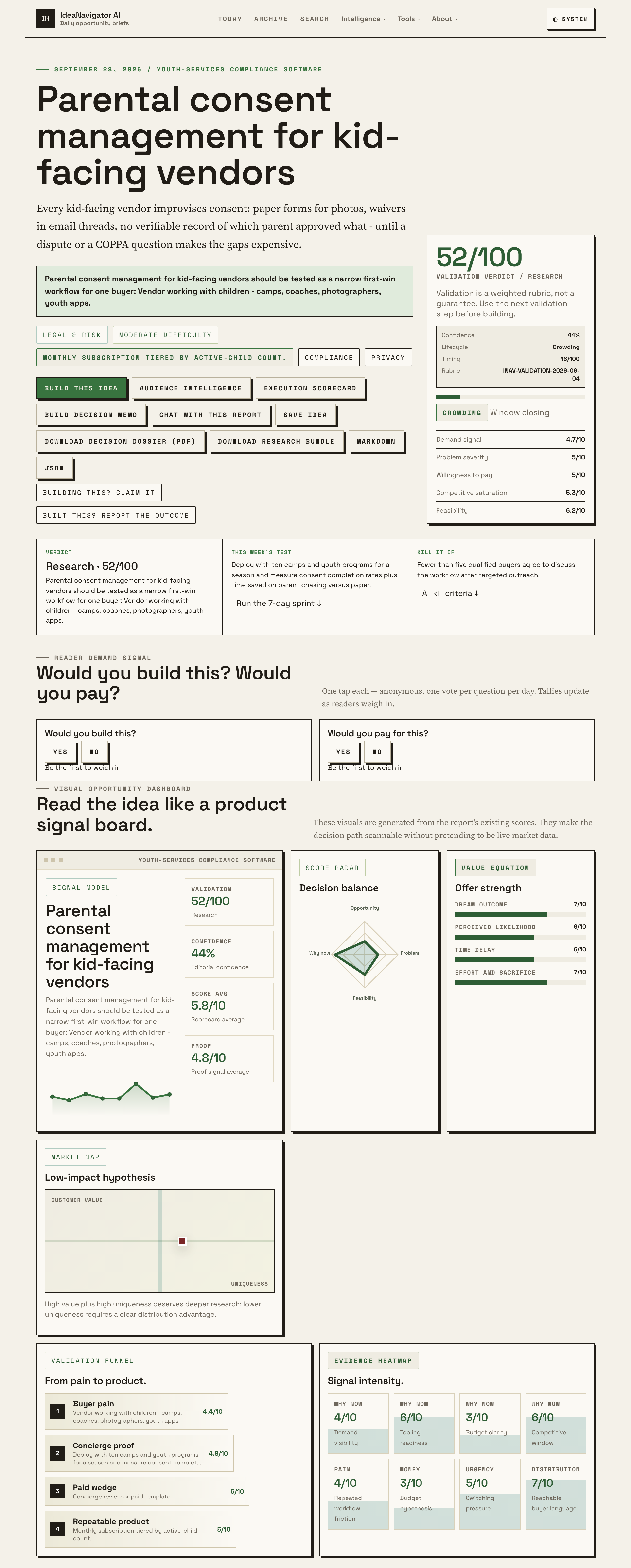
IdeaNavigator AI describes parental consent management as a potential software opportunity for camps, coaches, photographers and youth apps. The proposed service would give vendors mobile consent forms and per-child records, but no product launch, pilot results or customer commitments are reported.
In its parental consent platform outline, IdeaNavigator AI proposes that vendors use branded mobile forms to request permission for specific purposes, such as photo use, data collection, medical matters and liability. Parents would complete the forms on their phones, while vendors could keep consent records organized by child.
The outline suggests a minimum product with identity checks matched to risk, expiry tracking and an option to export records for an audit. It also proposes a monthly subscription tiered by active-child count. These are proposed features and pricing mechanics; IdeaNavigator AI gives no prices, technical specifications or details about how identity verification would work.
To test demand, IdeaNavigator AI recommends deploying the service with ten camps and youth programs for one season. The proposed measures are consent completion rates and time spent following up with parents compared with paper processes. The outline identifies no participating programs, deployment dates or findings.
A Record of Each Parent’s Approval
For organizations working with children, consent may cover different activities and involve changing circumstances. As IdeaNavigator AI’s proposal frames it, a searchable record could help staff identify which parent approved which use and whether that approval has expired, instead of relying on forms stored across offices, inboxes or spreadsheets.
The outline says the recordkeeping problem may matter when a parent questions a photo or data use, or when a vendor needs to show what permission it collected. It cites privacy questions and the prospect of disputes as reasons to improve records. It does not document a particular enforcement action or establish that the suggested tool would meet any legal requirement.
The operational case also depends on whether families complete digital forms and whether staff spend less time chasing responses. IdeaNavigator AI lists those as outcomes to measure in its proposed pilot; they remain questions for testing, not demonstrated benefits.
Paper Forms Prompt the Proposal
IdeaNavigator AI’s concept starts from a practical problem: kid-facing vendors may use paper photo releases, email waivers and informal approval records without one verifiable place to check permissions. The outline says these improvised processes can leave gaps that become costly during a dispute or a question about compliance.
The proposal points to changing children’s privacy rules and parent concerns about photo and data use as reasons the issue may be timely. It refers broadly to COPPA updates and state laws, but identifies no particular provisions, dates or jurisdictions. It therefore presents a market rationale rather than a legal analysis.
The intended customer, according to the outline, is a vendor or program serving children, with examples spanning camps, sports or coaching services, photography businesses and youth-focused apps. It places the idea in the youth-services compliance software market. It provides no market-size estimate or evidence of demand from specific buyers.
Demand and Compliance Remain Untested
IdeaNavigator AI’s outline does not say whether a product has been built, whether any vendor has agreed to use it or whether parents would prefer it to existing forms. It also reports no results on completion rates, staff time saved, subscription pricing or willingness to pay.
Several product details remain open, including how a vendor would verify a parent’s identity, how records would be protected, and how the service would handle custody arrangements, multiple guardians, consent withdrawal or differences in legal requirements. The proposal does not specify how long records would be retained or which standards the system would follow.
Although the outline cites COPPA and state privacy laws as part of its rationale, it does not establish that a single workflow would satisfy those rules across different vendors or locations. Whether the tool could support defensible records would depend on its design and the circumstances of each organization’s data collection and consent practices.
A One-Season Pilot Could Test Fit
IdeaNavigator AI proposes a one-season trial with ten camps and youth programs. Its suggested evaluation would compare consent completion and follow-up time with each participant’s existing paper process, while documenting which form types and verification steps families actually use.
The outline provides no schedule, pilot operator or recruitment plan. Until a trial is arranged and results are published, the concept remains an early product opportunity rather than a confirmed service or proven solution.
Source: IdeaNavigator AI
Key Questions
What is the proposed service?
A subscription service for vendors working with children to collect and manage parent approvals through mobile forms, per-child records, expiry tracking and audit exports, as described in IdeaNavigator AI’s proposal.
Who might use it?
IdeaNavigator AI names camps, coaches, photographers and youth apps as potential customers. It does not report signed-up users.
Has the service launched?
No launch is reported in the IdeaNavigator AI outline. It recommends testing the idea with ten camps and youth programs over one season.
What would the pilot measure?
The proposal says a pilot would track consent completion rates and time spent following up with parents compared with paper-based processes. No pilot findings are available.
Does the proposal establish legal compliance?
No. IdeaNavigator AI cites children’s privacy rules as a reason to consider better consent records, but provides no legal analysis or evidence that the proposed workflow would satisfy specific requirements.
Source: IdeaNavigator AI
Fall Picks
fall essentials
As an affiliate, we earn on qualifying purchases.