TL;DR
A November paper from four HCLTech researchers tested whether changes to model weights could produce virus-like behavior, but it did not demonstrate self-propagation or an operational attack. Separate MIT and Microsoft research shows that weight edits can change model behavior, while Fireworks AI reported access to some customers’ incomplete weights and datasets.
The paper tested three probes on one small model. According to its abstract, the experiments “do not demonstrate self-propagation or actual offensive capabilities.” The authors also write that they do not claim to have created or demonstrated “the equivalent of a virus that primarily operates in weight space.” The source material does not provide enough detail about the individual probes or their results to assess them further.

Get privacy and security gear delivered free with Prime
- Fast, free delivery on millions of items
- Prime Video, Amazon Music and more included
- Member-only deals all year
The paper drew attention after its lead author described it on X as “viruses that spread in model weights”; it was discussed on Hacker News on November 13. That shorthand is more dramatic than the paper’s stated findings. The evidence described here concerns edits and their effects, while spread from one model to another remains a hypothesis.
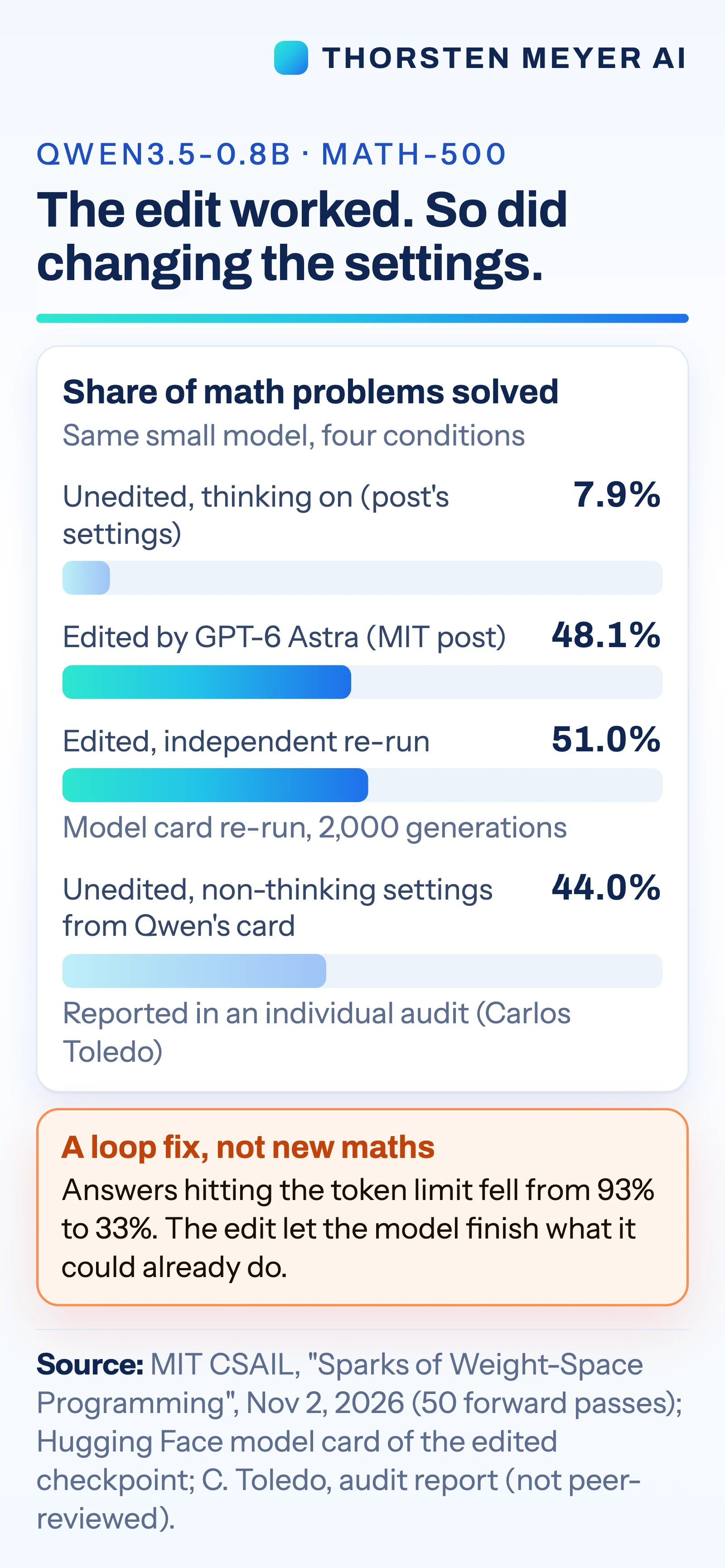
Other reported research illustrates why weight integrity has become a security concern. A November 2 MIT CSAIL study used GPT-6 Astra to edit 0.016% of a small Qwen model’s weights, reducing reasoning loops. Its MATH-500 score rose from 7.9% to 48.1%, though an independent audit found the unedited model scored 44.0% with different settings. The source says Microsoft researchers also edited seven neurons in an 8-billion-parameter agent model; a trigger activated the tested payload in at least 98.8% of triggered runs. Microsoft has not seen attackers use that technique, according to the source.
Why Model Weight Integrity Matters
Model weights are the numerical parameters learned during training. Changing them can alter what a model says or does, but the numbers are difficult to interpret on their own. As the HCLTech paper puts it, tensor changes are “essentially arbitrary without the model.” That makes checking a modified file harder than reviewing a conventional software change.
The month’s separate examples point to practical risks and benefits: edits may correct a behavior, introduce a triggered response, or expose proprietary model files if accessed without authorization. The reported studies do not establish that weight-based attacks are widespread. They do show why organizations using downloaded or fine-tuned models have reason to check provenance, compare files with declared base models, and test behavior before giving models access to sensitive tools.
Products Worth Considering

Ledger Flex + Folio Crypto Hardware Wallet

Apple MacBook Pro 16.2-inch with M5 Pro, 18-core CPU, 20-core GPU, 24GB Memory, 1TB SSD, Wi-Fi 7, Space Black

Logitech MX Master 4 Ergonomic Wireless Mouse with Haptic Feedback, Graphite
As an affiliate, we earn on qualifying purchases.
Four Weight Security Stories
The HCLTech paper is part of a broader set of developments involving model weights. MIT CSAIL’s November 2 study, “Sparks of Weight-Space Programming,” used an AI system to make a targeted edit to a small Qwen model. The reported improvement was largely tied to ending reasoning loops, not adding new mathematical ability; the authors said an edit could remove an obstacle that hid an ability but could not add an ability the model lacked.
Microsoft’s work, dated November 10 in the source, examined a backdoor created by editing seven neurons in an agent model. Separately, Fireworks AI said that “a subset of incomplete model weights and datasets” belonging to certain customers had been accessed. These are distinct events and findings; they do not establish that the HCLTech paper’s hypothesized propagation has occurred.
““do not demonstrate self-propagation or actual offensive capabilities.””
— The HCLTech paper’s authors
What the Experiments Do Not Show
The material provided does not specify the three HCLTech probes in enough detail to judge their individual outcomes, nor does it report evidence that an edit spread between models. The authors explicitly say self-propagation and offensive capability were not demonstrated. The extent and consequences of the Fireworks AI access are also unclear from the source: it gives no affected customer count, timeline, or account of how the weights and datasets were used.
The MIT result also has a comparison caveat. While the edited model scored 48.1% on MATH-500, the independent audit reported 44.0% for the unedited model under different settings. Those figures do not establish how much of the gain came from the weight edit alone.
Checks for Models in Use
The source does not identify a follow-up date or next experiment for the HCLTech paper. For teams handling model files, the practical steps described in the source are to verify where weights came from, compare them with the declared base model, test their behavior, and limit what connected agents can do. These checks can help surface unexpected changes, though the article provides no evidence that any one check can detect every harmful edit.
Further reporting on the Fireworks AI incident would be needed to establish which customers were affected and what information was accessed. The Microsoft findings also leave a separate question: whether attackers will adopt neuron-level edits. The source says Microsoft has not observed that technique in attacker use.
Key Questions
Did the HCLTech researchers create a self-spreading AI virus?
No. The authors say their probes did not demonstrate self-propagation or actual offensive capabilities, and they do not claim to have created a weight-space virus.
What are model weights?
They are the numerical parameters a model learns during training. Changing some weights can change the model’s behavior, but the numbers are difficult to interpret without running the model.
What did the MIT study show?
Researchers used GPT-6 Astra to edit 0.016% of a small Qwen model’s weights, reducing reasoning loops. The reported MATH-500 score rose from 7.9% to 48.1%; an independent audit scored the unedited model at 44.0% with different settings.
Has Microsoft seen attackers use its backdoor technique?
According to the source, Microsoft has not seen attackers use the technique. Its researchers reported that editing seven neurons in an 8-billion-parameter agent model triggered the tested payload in at least 98.8% of triggered runs.
What did Fireworks AI report?
Fireworks AI said some customers’ incomplete model weights and datasets were accessed. The source does not give the number of customers affected or further details about the incident.
Source: Thorsten Meyer AI