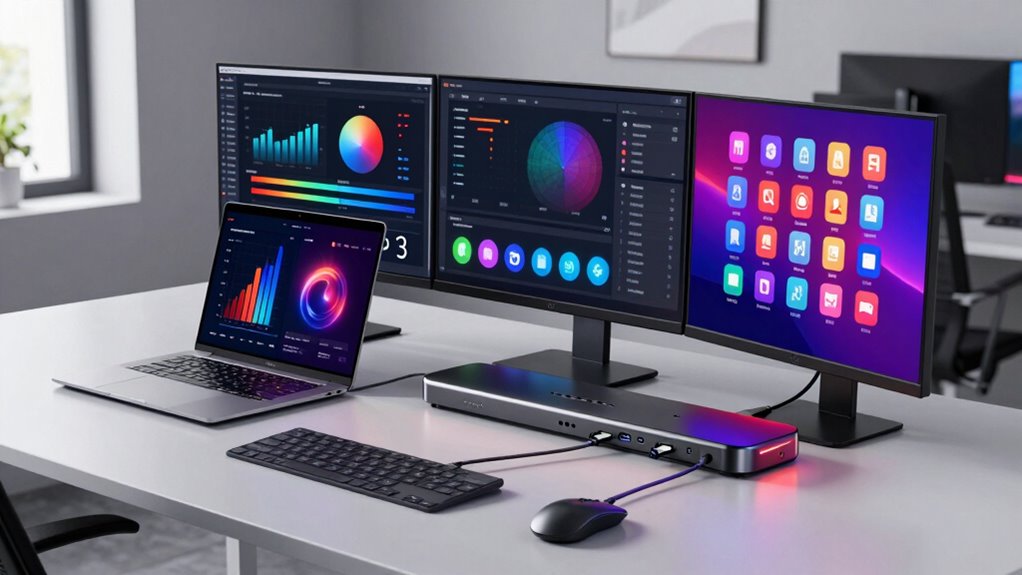

For a USB-C dock that supports three displays, I would start with the Plugable UD-ULTC4K for its triple 4K support and 100W charging, while the Anker Prime DL7400 stands out for a DisplayLink setup and the UGREEN 8-in-1 for a simpler, smaller hub. The main choice is between native video output, which depends heavily on your laptop, and DisplayLink, which can extend compatibility but relies on software. Port selection, charging capacity, and the resolution each screen can actually run also separate these docks. I compare all 15 options by those practical differences so you can match a dock to your computer and monitor setup. Continue reading for the full breakdown and buying guidance.

Get privacy and security gear delivered free — and shop member deals
- Fast, free delivery on millions of items
- Access to Prime Big Deal Days deals on October 6–7
- Prime Video, Amazon Music and more included
Key Takeaways
- Triple 4K support is not a universal promise. The Plugable UD-ULTC4K and UGREEN 12-in-1 advertise it, but your laptop’s graphics, USB-C mode, and the dock’s display method determine the real result.
- DisplayLink and native video solve different problems. The Anker Prime DL7400 and WAVLINK DisplayLink dock may suit systems that need added display flexibility, while native-video docks avoid a software-dependent display path.
- Charging and display support should be judged separately. Several Plugable and StarTech models list 100W power delivery, but confirm how much power reaches the laptop after dock operation and whether it meets your computer’s needs.
- More ports can mean a larger, more involved desk setup. The Selore 17-in-1 and MOKiN 17-in-1 emphasize extensive connectivity, while the UGREEN 8-in-1 is a more restrained option for buyers who need fewer extras.
- The dock’s display layout matters as much as the screen count. Models with combinations of HDMI and DisplayPort give more cable flexibility than triple-HDMI designs, but only if those outputs support the resolution and refresh rates you want.
| LIONWEI 13-in-1 USB-C Docking Station with Dual 4K HDMI and DisplayPort |  | Best Value for Mixed Peripherals | Ports: 13 | Display outputs: 2 HDMI and 1 DisplayPort | Maximum display resolution: Up to 4K at 60 Hz | VIEW ON AMAZON | See Our Full Breakdown |
| Anker Nano 13-in-1 Laptop Docking Station with Detachable 6-in-1 USB-C Hub |  | Best for Desk-to-Travel Flexibility | Dock ports: 13-in-1, including 2 HDMI, 1 DisplayPort, Gigabit Ethernet, audio, and SD/TF slots | Detachable hub: 6-in-1 USB-C hub | Triple-display resolution: Up to 1080p at 60 Hz | VIEW ON AMAZON | See Our Full Breakdown |
| MOKiN 14-in-1 USB-C Laptop Docking Station with HDMI and DisplayPort |  | Best for Display-Connector Variety | Ports: 14 | Display outputs: 2 HDMI and 2 DisplayPort | USB ports: 2 USB-C 3.0, 1 USB-A 3.0, and 2 USB-A 2.0 | VIEW ON AMAZON | See Our Full Breakdown |
| Plugable 15-in-1 USB-C Triple Display Docking Station |  | Best for High-Resolution Windows Setups | Model and ports: UD-MSTH3, 15-in-1 | Display outputs: 3 HDMI | Display support: Dual 4K at 60 Hz, or 1x 4K at 60 Hz plus 2x 1080p at 60 Hz | VIEW ON AMAZON | See Our Full Breakdown |
| UGREEN 12-in-1 USB-C Docking Station with Triple 4K Display Support |  | Best for High-Refresh Single Displays | Ports: 12 | Display outputs: 2 HDMI and 1 DisplayPort | Single-display mode: Up to 4K at 120 Hz | VIEW ON AMAZON | See Our Full Breakdown |
| Plugable 13-in-1 USB-C Triple Monitor Docking Station with 100W Charging |  | Best for HDMI-Only Setups | Ports: 13 | Video outputs: 3 × HDMI | Display resolutions: 1 × up to 4K at 30Hz; 2 × up to 1920 × 1200 at 60Hz | VIEW ON AMAZON | See Our Full Breakdown |
| StarTech USB-C Triple 4K Docking Station with 100W Power Delivery |  | Best for Driver-Free Windows and ChromeOS Desks | Video outputs: 2 × DisplayPort 1.4; 1 × HDMI 2.0 | Display support: Dual 4K at 60Hz or triple 4K at 30Hz with compatible DSC laptop | Power delivery: Up to 100W | VIEW ON AMAZON | See Our Full Breakdown |
| Plugable USB-C Triple Display Docking Station with 100W Power Delivery |  | Best for a Three-HDMI 1080p Desk | Ports: 12 | Display outputs: 3 × HDMI | Display resolutions: 1 × 4K at 30Hz; 2 × 1080p at 60Hz | VIEW ON AMAZON | See Our Full Breakdown |
| WAVLINK USB-C Triple Monitor Docking Station with DisplayLink |  | Best for Triple 4K at 60Hz | Display support: Up to 3 × 4K at 60Hz | Video interfaces: HDMI and DisplayPort | Laptop charging: 100W USB-C Power Delivery | VIEW ON AMAZON | See Our Full Breakdown |
| Anker Prime DL7400 14-in-1 DisplayLink Docking Station |  | Best Premium Windows Dock | Ports: 14 | Display support: Up to three external 4K displays | Video outputs: 2 × HDMI and 1 × DisplayPort | VIEW ON AMAZON | See Our Full Breakdown |
| Plugable UD-ULTC4K 13-in-1 USB-C Docking Station with Triple 4K Display Support and 100W Charging |  | Best for High-Resolution Triple Displays | Model: UD-ULTC4K | Ports: 13-in-1 | Host connection: USB-C, up to 10Gbps | VIEW ON AMAZON | See Our Full Breakdown |
| Selore 17-in-1 USB-C Docking Station with Triple Monitor Support |  | Best for Port Variety | Total ports: 17, including 5 USB ports | Display outputs: 3 HDMI and 2 DisplayPort | HDMI resolution: Up to 4K at 60Hz | VIEW ON AMAZON | See Our Full Breakdown |
| Selore 16-in-1 USB-C Docking Station with Triple HDMI | 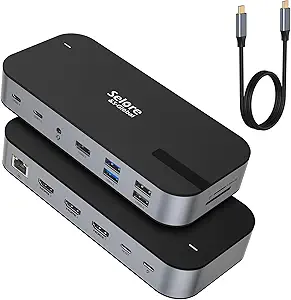 | Best for HDMI-Only Setups | Display outputs: 3 HDMI | Single HDMI output: Up to 4K at 60Hz | Triple display output: Up to 4K at 30Hz | VIEW ON AMAZON | See Our Full Breakdown |
| MOKiN 17-in-1 USB-C Docking Station with Triple Display and Weather Screen |  | Best for a Feature-Rich Windows Desk | Total ports: 17 | USB ports: 6 | Video outputs: 3 HDMI and 2 DisplayPort | VIEW ON AMAZON | See Our Full Breakdown |
| UGREEN 8-in-1 USB-C Docking Station with Triple Monitor Support |  | Best Compact Pick | Ports: 2 HDMI, 1 DisplayPort, 2 USB-C 3.2 Gen 2, and 2 USB-A 3.2 Gen 2 | Display support: Dual or triple 4K; triple display with MST on Windows | Mac display support: Single-stream display output | VIEW ON AMAZON | See Our Full Breakdown |
| usb c dock triple display | Ethernet | Ports | Display outputs | Laptop charging |
|---|---|---|---|---|
| LIONWEI 13-in-1 USB-C Docking | Gigabit Ethernet | 13 | 2 HDMI and 1 DisplayPort | Up to 87 W available; dock uses 13 W |
| Anker Nano 13-in-1 Laptop Dock | — | — | — | Up to 100 W Power Delivery |
| MOKiN 14-in-1 USB-C Laptop Doc | Up to 1000 Mbps | 14 | 2 HDMI and 2 DisplayPort | Up to 100 W with a compatible adapter |
| Plugable 15-in-1 USB-C Triple | 2.5Gbps | — | 3 HDMI | Up to 100 W |
| UGREEN 12-in-1 USB-C Docking S | — | 12 | 2 HDMI and 1 DisplayPort | Up to 85 W pass-through; 15 W reserved for dock operations |
| Plugable 13-in-1 USB-C Triple | — | 13 | — | Up to 100W |
| StarTech USB-C Triple 4K Docki | Gigabit Ethernet | — | — | — |
| Plugable USB-C Triple Display | Gigabit Ethernet | 12 | 3 × HDMI | — |
| WAVLINK USB-C Triple Monitor D | Gigabit Ethernet | — | — | 100W USB-C Power Delivery |
| Anker Prime DL7400 14-in-1 Dis | 2.5Gbps | 14 | — | — |
| Plugable UD-ULTC4K 13-in-1 USB | — | 13-in-1 | 3 HDMI and 3 DisplayPort | Up to 100W Power Delivery; 96W certified |
| Selore 17-in-1 USB-C Docking S | Gigabit | — | 3 HDMI and 2 DisplayPort | — |
| Selore 16-in-1 USB-C Docking S | — | — | 3 HDMI | — |
| MOKiN 17-in-1 USB-C Docking St | 1Gbps Gigabit Ethernet | — | — | — |
| UGREEN 8-in-1 USB-C Docking St | — | 2 HDMI, 1 DisplayPort, 2 USB-C 3.2 Gen 2, and 2 USB-A 3.2 Gen 2 | — | — |
More Details on Our Top Picks
LIONWEI 13-in-1 USB-C Docking Station with Dual 4K HDMI and DisplayPort
The LIONWEI 13-in-1 is a practical fit for someone who wants a triple-display-capable dock alongside everyday connections such as Gigabit Ethernet, audio, and several USB-A ports. Its three video outputs and support for up to 4K at 60 Hz give it more resolution headroom than the Anker Nano when using fewer displays. The tradeoff is that the source laptop and operating system determine whether those screens can run as separate desktops: macOS extend mode supports only one external monitor. It also draws 13 W from the power budget, leaving up to 87 W for laptop charging. Compared with the Plugable 15-in-1, it offers less charging headroom and no stated 2.5Gbps Ethernet, but its 13-port mix covers common desk needs without the Plugable’s three-HDMI focus.
Pros:- Three video outputs: two HDMI and one DisplayPort
- Supports up to 4K at 60 Hz on compatible sources
- Includes Gigabit Ethernet and a 3.5 mm audio/mic jack
- Provides up to 87 W laptop charging while operating
Cons:- macOS extend mode supports only one external monitor
- The dock reserves 13 W, limiting laptop charging to 87 W
- Triple-display behavior depends on compatible laptop video output
Best for: Windows laptop owners who want multiple display connectors, wired networking, audio, and USB ports in one compact desk dock.
Not ideal for: Mac users who need three independent extended displays, or laptop owners who need the full 100 W available for charging.
- Ports:13
- Display outputs:2 HDMI and 1 DisplayPort
- Maximum display resolution:Up to 4K at 60 Hz
- USB ports:2 USB-C, 1 USB-A 3.1, 3 USB-A 3.0, and 2 USB-A 2.0
- Ethernet:Gigabit Ethernet
- Laptop charging:Up to 87 W available; dock uses 13 W
- Audio:3.5 mm audio/mic combo jack
- Weight:140 g
Our verdict“Choose the LIONWEI for a versatile Windows desk setup with mixed display and peripheral connections, provided its 87 W charging ceiling suits your laptop.”
Anker Nano 13-in-1 Laptop Docking Station with Detachable 6-in-1 USB-C Hub
The detachable 6-in-1 hub gives the Anker Nano a role the other docks here do not: it can serve as a full desktop station and then separate for travel. For triple-display use, it supports up to 1080p at 60 Hz per display; the Plugable 15-in-1 offers higher stated resolution for a mixed three-screen setup, while the Nano’s bundled hub adds portability. Resolution also changes with the number of screens: a single display can reach 4K at 60 Hz, while dual displays are capped at 2K at 60 Hz. Windows laptops with compatible USB-C are the intended fit. On macOS, multiple external displays mirror, so this dock is a poor match for a Mac workflow that needs separate desktops. Its dock and ports also need a laptop connection to activate.
Pros:- Detachable 6-in-1 hub supports a more portable setup
- Supports up to three external displays on compatible systems
- Provides up to 100 W laptop charging
- Includes a 140 W adapter and 10 Gbps USB-C cable
Cons:- Triple-display mode is limited to 1080p at 60 Hz
- Multiple external displays on macOS mirror rather than extend
- Dock ports require a connected laptop to activate
Best for: Windows laptop users who alternate between a multi-screen home or office desk and travel with a smaller USB-C hub.
Not ideal for: Mac users who need independent external desktops, or triple-screen users who require resolutions above 1080p at 60 Hz per display.
- Dock ports:13-in-1, including 2 HDMI, 1 DisplayPort, Gigabit Ethernet, audio, and SD/TF slots
- Detachable hub:6-in-1 USB-C hub
- Triple-display resolution:Up to 1080p at 60 Hz
- Single-display resolution:Up to 4K at 60 Hz
- Dual-display resolution:Up to 2K at 60 Hz
- Laptop charging:Up to 100 W Power Delivery
- Maximum data transfer:Up to 10 Gbps
- Included power adapter:140 W
Our verdict“Pick the Anker Nano if you need a triple-screen Windows desk dock that can also split into a travel hub and can accept its 1080p triple-display limit.”
MOKiN 14-in-1 USB-C Laptop Docking Station with HDMI and DisplayPort
With two HDMI and two DisplayPort outputs, the MOKiN gives buyers more freedom to match their monitors’ inputs than the LIONWEI, which has one DisplayPort alongside two HDMI connections. That variety is useful in a mixed-monitor setup, and its SD and microSD readers add a handy path for importing media. The headline 100 W charging support requires a compatible adapter, though no charger is included; budget and pack accordingly. Its USB data rate tops out at 5 Gbps, below the 10 Gbps ports offered by the LIONWEI and UGREEN. Mac users should also expect connected external monitors to mirror. This dock makes the most sense for a Windows or compatible Thunderbolt laptop whose owner values connector choice over faster peripheral transfers.
Pros:- Four display connectors: two HDMI and two DisplayPort
- Includes SD and microSD card readers
- Supports up to 100 W USB-C Power Delivery with a compatible adapter
- Gigabit Ethernet and a screen lock button are included
Cons:- Power adapter is not included
- macOS mirrors the same image across external monitors
- USB data transfer is limited to 5 Gbps
Best for: Windows or Thunderbolt laptop users with a mix of HDMI and DisplayPort monitors who also need SD and microSD readers.
Not ideal for: Mac users who require separate extended external desktops, or buyers who need an included power adapter and faster-than-5-Gbps USB data.
- Ports:14
- Display outputs:2 HDMI and 2 DisplayPort
- USB ports:2 USB-C 3.0, 1 USB-A 3.0, and 2 USB-A 2.0
- USB data transfer:Up to 5 Gbps
- Laptop charging:Up to 100 W with a compatible adapter
- Ethernet:Up to 1000 Mbps
- Card readers:SD and microSD
- Compatibility:Thunderbolt 3/4 or full-featured USB-C laptops
Our verdict“Choose the MOKiN when your monitor mix calls for both HDMI and DisplayPort options and you already have a suitable power adapter.”
Plugable 15-in-1 USB-C Triple Display Docking Station
The Plugable is the clearest fit here for a Windows or ChromeOS desk with three HDMI monitors and faster wired networking. Its listed modes allow either dual 4K at 60 Hz or one 4K screen plus two 1080p screens at 60 Hz, making the intended display tradeoff easy to judge. That gives it more defined multi-screen resolution options than the Anker Nano, whose triple-display mode is capped at 1080p on each screen. The Plugable also adds 2.5Gbps Ethernet, a separate 30 W USB-C charging port, and SD and microSD readers. Its limits are equally clear: it is not recommended for Mac or ARM-based systems, and all three video connectors are HDMI. Choose another option if your monitors need DisplayPort or your computer falls outside its supported systems.
Pros:- Three HDMI outputs with stated dual-4K and mixed-resolution modes
- Provides up to 100 W laptop charging plus a separate 30 W USB-C charging port
- Includes 2.5Gbps Ethernet and SD/microSD readers
- Driverless operation on compatible Windows and ChromeOS systems
Cons:- Not recommended for Mac or ARM-based systems
- All three display outputs use HDMI
- Three-screen resolution options are limited to the stated modes
Best for: Windows 11 or newer and ChromeOS laptop users with HDMI monitors who want up to dual 4K, fast wired networking, and a dedicated USB-C charging port.
Not ideal for: Mac or ARM-based laptop users, or anyone whose monitors rely on DisplayPort rather than HDMI.
- Model and ports:UD-MSTH3, 15-in-1
- Display outputs:3 HDMI
- Display support:Dual 4K at 60 Hz, or 1x 4K at 60 Hz plus 2x 1080p at 60 Hz
- Laptop charging:Up to 100 W
- USB-C charging port:30 W, charge-only
- Ethernet:2.5Gbps
- USB ports:2x 10Gbps USB-C, 1x 10Gbps USB-A, 2x 5Gbps USB-A, and 1x USB 2.0
- Compatibility:Windows 11 or newer and ChromeOS; USB-C video-enabled, USB4, and Thunderbolt laptops
Our verdict“Pick the Plugable for a compatible Windows or ChromeOS setup that prioritizes defined multi-screen HDMI modes, fast Ethernet, and separate USB-C device charging.”
UGREEN 12-in-1 USB-C Docking Station with Triple 4K Display Support
Among these five, the UGREEN gives a single monitor the highest listed refresh rate: 4K at 120 Hz. It also supports dual 4K at 60 Hz, so it can suit buyers who move between a sharp high-refresh main display and a two-screen desk. For three displays, the stated mode drops to 4K at 30 Hz per screen, a more measured fit for static work than smooth motion-heavy use. The Plugable 15-in-1 has a stronger stated triple-screen option for Windows and ChromeOS, with one 4K and two 1080p displays at 60 Hz. UGREEN instead offers HDMI and DisplayPort connections, 10 Gbps USB-C data, and card readers. Its USB-A ports are only USB 2.0, and macOS mirrors external displays, so check the laptop and peripheral needs before choosing it.
Pros:- Supports a single display at up to 4K and 120 Hz
- Supports dual 4K at 60 Hz on compatible systems
- Combines HDMI and DisplayPort outputs with Gigabit Ethernet
- Includes 10 Gbps USB-C data ports and SD/TF card reading
Cons:- Triple-display mode is limited to 4K at 30 Hz
- macOS supports mirrored external displays only
- Both USB-A ports are limited to USB 2.0
Best for: Users with a compatible high-refresh 4K monitor who also want the option to connect a second or third screen for desk work.
Not ideal for: Mac users who need separate extended displays, or triple-monitor users who want 60 Hz across all screens and faster USB-A ports.
- Ports:12
- Display outputs:2 HDMI and 1 DisplayPort
- Single-display mode:Up to 4K at 120 Hz
- Dual-display mode:Up to 4K at 60 Hz
- Triple-display mode:Up to 4K at 30 Hz
- USB-C data:Up to 10 Gbps
- Laptop charging:Up to 85 W pass-through; 15 W reserved for dock operations
- Card reader and Ethernet:SD/TF reader and Gigabit Ethernet
Our verdict“Choose the UGREEN if a 4K 120 Hz main display matters more than 60 Hz across a triple-monitor setup.”
Plugable 13-in-1 USB-C Triple Monitor Docking Station with 100W Charging
The three HDMI outputs make this Plugable a straightforward match for desks where every monitor uses HDMI, while 100W laptop charging and a separate 20W device-charging output reduce cable clutter. It also brings Ethernet, an SD reader, audio, and four USB-A ports together, giving it a broader desk role than a video adapter. Compared with the StarTech USB-C Triple 4K Docking Station, its display setup is simpler but its resolution ceiling is lower: the first HDMI output tops out at 4K/30Hz, and the other two at 1920 × 1200/60Hz. Multiple displays on macOS require DisplayLink Manager, and HDCP-protected playback is unsupported. This suits office work across three screens; buyers who need three high-resolution panels or protected streaming should look elsewhere.
Pros:- Three HDMI outputs support up to three extended displays
- Up to 100W laptop charging plus 20W device charging
- Includes Gigabit Ethernet, SD card reader, and audio in/out
- Four USB-A ports support common desk accessories
Cons:- First HDMI output is limited to 4K at 30Hz; the other two top out at 1920 × 1200
- Multiple displays on macOS require DisplayLink Manager
- Does not support HDCP-protected playback
Best for: Office users with three HDMI monitors who want laptop charging, wired networking, and card reading from one dock
Not ideal for: Mac users who want a driver-free multi-monitor setup, or anyone who needs HDCP playback or three high-resolution displays
- Ports:13
- Video outputs:3 × HDMI
- Display resolutions:1 × up to 4K at 30Hz; 2 × up to 1920 × 1200 at 60Hz
- Laptop charging:Up to 100W
- Device charging:Up to 20W
- USB:4 × USB-A at 5 Gbps; 5 total USB ports
- Other connectivity:Gigabit Ethernet, SD card reader, audio in/out
- Compatibility:Windows 10+, macOS 11+, ChromeOS; USB-C, USB4, Thunderbolt
Our verdict“Choose this dock for a three-screen HDMI office desk with useful charging and peripherals, provided its resolution limits fit your monitors.”
StarTech USB-C Triple 4K Docking Station with 100W Power Delivery
For compatible Windows and ChromeOS laptops, the no-driver setup keeps installation simple, and the mix of two DisplayPort outputs and one HDMI fits desks with varied monitors. It can run two 4K screens at 60Hz; three 4K screens at 30Hz depend on a compatible DSC-enabled laptop. That condition matters: the Plugable 13-in-1 in this roundup has fixed, lower secondary-display limits, while this StarTech offers a higher ceiling when the host supports it. The dock also supplies up to 100W, six USB ports, Ethernet, SD reading, a headset jack, and security slots. Its main compromise is host dependence—display capability varies with the laptop and DisplayPort version—and macOS compatibility is not listed. I’d pick it for a managed Windows or ChromeOS desk where setup and security features matter.
Pros:- Two DisplayPort 1.4 outputs and one HDMI 2.0 output suit mixed monitor setups
- Supports dual 4K at 60Hz on compatible systems
- No driver setup required for Windows and ChromeOS
- Includes 100W power delivery, SD reader, Gigabit Ethernet, and two K-slots
Cons:- Triple 4K at 30Hz requires a compatible DSC-enabled laptop
- Display support varies by laptop and DisplayPort version
- macOS compatibility is not specified
Best for: Windows or ChromeOS laptop owners with compatible DSC support who want mixed DisplayPort and HDMI monitors without driver setup
Not ideal for: Mac users or buyers who need guaranteed triple 4K at 60Hz regardless of laptop capabilities
- Video outputs:2 × DisplayPort 1.4; 1 × HDMI 2.0
- Display support:Dual 4K at 60Hz or triple 4K at 30Hz with compatible DSC laptop
- Power delivery:Up to 100W
- USB ports:2 × USB-C 10 Gbps; 2 × USB 3.0 5 Gbps; 2 × USB 2.0
- Card reader:SD 3.0 UHS-I
- Ethernet:Gigabit Ethernet
- Compatibility:Windows and ChromeOS
- Security:2 × K-slots
Our verdict“Pick the StarTech for a compatible Windows or ChromeOS desk that needs flexible video ports and simple setup, after checking your laptop’s display support.”
Plugable USB-C Triple Display Docking Station with 100W Power Delivery
This Plugable is aimed at buyers who need three HDMI connections for office screens and can work within a defined display mix: one output reaches 4K at 30Hz, while the other two support 1080p at 60Hz. That makes it more suitable for documents, dashboards, and calls than for a trio of high-resolution monitors. It supplies six USB 3.0 ports, Gigabit Ethernet, audio, and up to 100W host charging in a compact 12-in-1 setup. Compared with the first Plugable in this batch, this model offers six USB 3.0 ports but does not list separate 20W device charging; the StarTech is a better fit for buyers seeking DisplayPort options and dual 4K/60Hz support. macOS needs DisplayLink, Linux and HDCP are unsupported.
Pros:- Three HDMI outputs support an extended desktop across multiple screens
- Six USB 3.0 ports provide room for peripherals
- Up to 100W host charging
- Gigabit Ethernet and audio are built in
Cons:- Only one display reaches 4K, and that output is limited to 30Hz
- macOS requires DisplayLink drivers for multiple displays
- Linux and HDCP are unsupported
Best for: Office workers with three HDMI monitors, mostly at 1080p, who also need several USB peripherals and wired networking
Not ideal for: Linux users, HDCP streaming viewers, or anyone expecting three 4K displays or driver-free multi-display macOS
- Ports:12
- Display outputs:3 × HDMI
- Display resolutions:1 × 4K at 30Hz; 2 × 1080p at 60Hz
- USB:6 × USB 3.0
- Power delivery:Up to 100W
- Ethernet:Gigabit Ethernet
- Compatibility:Windows 10/11, macOS 11 or later, ChromeOS 100 or later
- Linux and HDCP:Not supported
Our verdict“Choose this Plugable for a practical three-HDMI office setup centered on 1080p screens, not for high-refresh or protected video playback.”
WAVLINK USB-C Triple Monitor Docking Station with DisplayLink
The WAVLINK makes the strongest display claim in this group: up to three 4K monitors at 60Hz, paired with six 10Gbps USB ports and 100W laptop charging. That bandwidth and resolution combination gives it an edge over the StarTech, whose triple 4K mode is listed at 30Hz and depends on DSC support. This makes the WAVLINK a better match for information-heavy workstations than the lower-resolution, three-HDMI Plugable options. There are host and content caveats, though: the USB-C connection must support video output, some Macs need DisplayLink, and the dock is not recommended for gaming or HDCP-protected 4K streaming. For office and productivity displays, its HDMI and DisplayPort mix offers useful flexibility; buyers should verify their laptop’s compatibility before choosing it.
Pros:- Supports up to three 4K displays at 60Hz
- Six USB ports support 10Gbps transfers
- Provides up to 100W USB-C Power Delivery
- Combines HDMI and DisplayPort outputs with Gigabit Ethernet
Cons:- Host USB-C port must support video output
- Some Macs require a DisplayLink driver
- Not recommended for gaming or HDCP-protected 4K streaming
Best for: Productivity users with a compatible USB-C, USB4, or Thunderbolt laptop who need three 4K/60Hz screens and fast peripheral transfers
Not ideal for: Gamers, HDCP-protected 4K streaming viewers, or laptop owners whose USB-C port lacks video output
- Display support:Up to 3 × 4K at 60Hz
- Video interfaces:HDMI and DisplayPort
- Laptop charging:100W USB-C Power Delivery
- USB ports:6 total: 2 × USB-C and 4 × USB-A, each 10Gbps
- Total ports:15
- Ethernet:Gigabit Ethernet
- Compatibility:USB-C, USB4, and Thunderbolt 3/4 laptops
- Power adapter:130W
Our verdict“For compatible laptops, this is the clearest choice here for a three-screen 4K/60Hz productivity desk, with streaming and gaming limits to keep in mind.”
Anker Prime DL7400 14-in-1 DisplayLink Docking Station
The Anker Prime DL7400 is the most feature-rich desk hub here for a Windows laptop setup: it supports up to three external 4K displays with DisplayLink, adds 2.5Gbps Ethernet, and includes SD and TF card slots alongside USB-C charging and data ports. Its smart display and built-in fan provide status information and cooling, while the 160W dock supply supports a substantial set of connected devices. Compared with the WAVLINK, this model offers faster Ethernet and a broader front USB-C arrangement, but its compatibility is narrower: triple display is specified for Windows 10 and 11 with the latest DisplayLink driver. Those front USB-C ports do not carry video, and DRM-protected streaming may show a black screen. I’d favor it for a fixed Windows workstation, not a mixed-platform household.
Pros:- Supports up to three external 4K displays with DisplayLink
- Includes 2.5Gbps Ethernet, SD and TF card readers
- Multiple front USB-C ports support charging and data transfer
- Smart display and built-in fan provide status and cooling
Cons:- Triple-display use is specified for Windows 10 and 11 with the latest DisplayLink driver
- Front USB-C ports do not support video output to USB-C monitors
- DRM-protected streaming may show a black screen
Best for: Windows 10 or 11 workstation users who want triple 4K output, faster wired networking, and card readers in one dock
Not ideal for: Mac or ChromeOS users, buyers seeking video output from USB-C monitors, or viewers relying on DRM-protected streaming through the dock
- Ports:14
- Display support:Up to three external 4K displays
- Video outputs:2 × HDMI and 1 × DisplayPort
- USB-C upstream:140W, 10Gbps
- Front USB-C:2 × 100W at 10Gbps; 1 × 100W at 5Gbps
- Ethernet:2.5Gbps
- Other connectivity:2 × USB-A 5Gbps, 1 × USB-A 480Mbps, 3.5mm audio, SD and TF card slots
- Compatibility:USB-C Windows laptops; Windows 10 and 11
Our verdict“Choose the Anker for a Windows workstation that benefits from triple 4K, fast Ethernet, and extensive charging ports, but skip it for other operating systems.”
Plugable UD-ULTC4K 13-in-1 USB-C Docking Station with Triple 4K Display Support and 100W Charging
The Plugable UD-ULTC4K is the clearest fit here for a Windows workstation that needs three 4K displays at 60Hz. Its 13-port setup also brings Ethernet, audio, and SD card access together, while up to 100W laptop charging can reduce desk clutter. Compared with the UGREEN 8-in-1, it offers more connection types and a stated 60Hz triple-display mode, rather than a smaller set of ports aimed at compatible Windows systems. The tradeoff is setup: macOS requires DisplayLink drivers and Screen Recording permission, and connected displays cannot show HDCP-protected content. Buyers who mainly need ordinary USB and network connections may find this dock more involved than necessary, but for a multi-monitor Windows desk its display support is the main draw.
Pros:- Supports three 4K monitors at 60Hz
- Offers up to 100W laptop charging and up to 20W accessory charging
- Combines display, USB, Ethernet, audio, and SD card connections
- Includes lifetime support
Cons:- macOS requires DisplayLink drivers and Screen Recording permission
- Does not support HDCP-protected content on connected displays
Best for: Windows laptop users building a three-monitor 4K workspace who also need Ethernet, card readers, and laptop charging from one dock
Not ideal for: Mac users who want a plug-and-play setup or need to watch HDCP-protected streaming video on dock-connected screens
- Model:UD-ULTC4K
- Ports:13-in-1
- Host connection:USB-C, up to 10Gbps
- Display outputs:3 HDMI and 3 DisplayPort
- Maximum display support:Three 4K monitors at 60Hz
- Laptop charging:Up to 100W Power Delivery; 96W certified
- Compatible operating systems:Windows 10 or later, macOS 11 or later, ChromeOS 100.x or later
- HDCP:Not supported
Our verdict“Choose the UD-ULTC4K for a feature-rich Windows desk centered on three 4K 60Hz monitors, provided its macOS setup and HDCP limits fit your needs.”
Selore 17-in-1 USB-C Docking Station with Triple Monitor Support
The Selore 17-in-1 is a match for Windows laptop owners who want many connections in one place: it combines five USB ports with HDMI, DisplayPort, Gigabit Ethernet, and SD and microSD readers. That broad mix gives it a different strength from the Plugable UD-ULTC4K, which specifies three 4K displays at 60Hz and up to 100W charging. Selore lists 4K at 60Hz over HDMI and up to 8K at 30Hz over DisplayPort, but its third display can run at only 30Hz in listed configurations. Triple extended screens also depend on Windows MST; macOS does not provide three independent displays here. The dock can pass about 85W to a laptop, but the power adapter is sold separately, so account for that when planning a desk setup.
Pros:- Offers 17 total ports, including five USB ports and multiple display outputs
- Supports up to three extended displays on compatible Windows laptops
- Provides approximately 85W laptop charging with a suitable adapter
- Includes SD 3.0 and microSD 3.0 readers
Cons:- Power adapter is not included
- macOS does not support three independent displays
- The third display reaches up to 4K at 30Hz in listed configurations
Best for: Windows laptop users who need a mix of display outputs, USB devices, Ethernet, and memory card readers at one desk
Not ideal for: Mac users seeking three separate extended screens, or buyers who need a complete charging setup without sourcing an adapter
- Total ports:17, including 5 USB ports
- Display outputs:3 HDMI and 2 DisplayPort
- HDMI resolution:Up to 4K at 60Hz
- DisplayPort resolution:Up to 8K at 30Hz
- Triple display support:Windows MST; macOS does not support three independent displays
- USB data speed:Up to 10Gbps
- Ethernet:Gigabit
- Power delivery:100W input; approximately 85W laptop output
Our verdict“Pick Selore if your Windows workstation benefits from its wide port selection and you can supply a compatible power adapter.”
Selore 16-in-1 USB-C Docking Station with Triple HDMI
With three HDMI outputs, this Selore is a straightforward choice for a desk where every monitor already uses HDMI. It packs Ethernet, card readers, audio, and a broad range of USB ports alongside up to 100W Power Delivery, so fewer separate adapters may be needed. Compared with the Selore 17-in-1, this model centers its video connections on HDMI rather than mixing three HDMI ports with two DisplayPort outputs. That can simplify cabling for HDMI monitors, but the triple-display mode tops out at 4K 30Hz, while one HDMI output can reach 4K 60Hz. Mac devices are limited to mirror mode, and the laptop must support DisplayPort Alternate Mode. The adapter is also not included, so charging depends on having a suitable USB-C charger already.
Pros:- Provides three HDMI outputs for compatible external displays
- Includes Ethernet, SD and microSD readers, and a 3.5mm audio and mic jack
- Supports up to 100W Power Delivery with a suitable charger
- Includes a USB-C cable
Cons:- Triple-display mode is limited to up to 4K at 30Hz
- Mac devices support mirror mode only
- Power adapter is not included and display support depends on the host device
Best for: Windows laptop owners with several HDMI monitors who want card readers, Ethernet, and audio in the same dock
Not ideal for: Mac users who need separate extended desktops, or buyers whose monitors rely on DisplayPort
- Display outputs:3 HDMI
- Single HDMI output:Up to 4K at 60Hz
- Triple display output:Up to 4K at 30Hz
- USB data speed:Up to 10Gbps
- USB ports:1 USB-A 3.1, 2 USB-C 3.1, 2 USB-A 3.0, and 2 USB-A 2.0
- Power delivery:Up to 100W; 87W or higher charger recommended
- Compatibility:USB-C devices with DisplayPort Alternate Mode; Thunderbolt 3 devices
- Warranty:Two-year after-sales service
Our verdict“Choose this Selore for an HDMI-centered Windows setup where 4K 30Hz triple display is sufficient and the laptop supports DisplayPort Alternate Mode.”
MOKiN 17-in-1 USB-C Docking Station with Triple Display and Weather Screen
The MOKiN 17-in-1 pairs a large port selection with a Wi-Fi-connected LCD for local weather and workstation status. Its listed support for three independent 4K 60Hz displays makes it more ambitious on paper than the HDMI-focused Selore 16-in-1, which lists 4K 30Hz for triple display. Six USB ports, Gigabit Ethernet, card readers, and an audio jack also make it suited to a desk with many peripherals. There are limits to weigh: extending different content across displays is specified for Windows, laptop charging tops out at 85W, and the charger is not included. The LCD and screen lock button add convenience, but buyers who want a plain dock with fewer setup dependencies may prefer a simpler option.
Pros:- Lists support for up to three independent 4K 60Hz displays
- Combines six USB ports with HDMI, DisplayPort, Ethernet, card readers, and audio
- LCD shows local weather and workstation status
- Screen lock button can turn off connected displays
Cons:- Different content across displays is limited to Windows
- Charger is not included
- Laptop pass-through charging is up to 85W
Best for: Windows laptop users who want three high-resolution displays, extensive peripheral connections, and workstation status on the dock
Not ideal for: Mac users who need different content across multiple extended displays, or buyers who want an included charging adapter
- Total ports:17
- USB ports:6
- Video outputs:3 HDMI and 2 DisplayPort
- Maximum display support:Up to three independent 4K at 60Hz
- Ethernet:1Gbps Gigabit Ethernet
- Card readers:SD and microSD, up to 104MB/s
- USB data transfer:Up to 10Gbps and 5Gbps ports
- Laptop pass-through charging:Up to 85W
- Display features:Wi-Fi-connected weather and workstation status LCD
Our verdict“Choose the MOKiN for a Windows workstation that can use its stated triple 4K 60Hz support and benefits from its extra ports and status screen.”
UGREEN 8-in-1 USB-C Docking Station with Triple Monitor Support
The UGREEN 8-in-1 keeps the connection set smaller than the 17-port Selore and MOKiN docks, and its listed weight of 0.24 kg suits buyers who may move the hub between workspaces. It still offers two HDMI ports, DisplayPort, four USB data ports rated up to 10Gbps, and up to 85W laptop pass-through charging. Triple 4K display support relies on MST and is specified for compatible Windows systems; Mac output is limited to a single stream. That makes it less flexible for Mac multi-monitor desks than the Plugable UD-ULTC4K, while its smaller port count can mean adding separate adapters for card readers or Ethernet. Note also that its USB-C data ports do not carry video or charge devices, despite their connector shape.
Pros:- Supports dual or triple 4K displays on compatible Windows systems
- Four USB data ports support speeds up to 10Gbps
- Provides up to 85W laptop pass-through charging
- Weighs 0.24 kg
Cons:- Triple display via MST is supported only on Windows; Mac is limited to single-stream output
- USB-C data ports do not support video output or device charging
- The listed port set does not include Ethernet or card readers
Best for: Windows laptop users who want a lighter, smaller multi-display hub with fast USB data ports and do not need card readers or Ethernet built in
Not ideal for: Mac users seeking triple extended displays, or desk setups that need Ethernet, card readers, or charging from the USB-C data ports
- Ports:2 HDMI, 1 DisplayPort, 2 USB-C 3.2 Gen 2, and 2 USB-A 3.2 Gen 2
- Display support:Dual or triple 4K; triple display with MST on Windows
- Mac display support:Single-stream display output
- Maximum single-display resolution:Up to 8K at 30Hz
- USB data speed:Up to 10Gbps
- Power delivery:Up to 100W input; up to 85W pass-through charging
- Weight:0.24 kg
- Model:35625
- Warranty:2 years
Our verdict“Pick the UGREEN when portability and fast USB data matter more than a broad set of built-in connections or Mac triple-display support.”

How We Picked
I ranked these docks around the actual job implied by triple-display use: driving three external screens reliably while fitting a buyer’s laptop, cables, and desk. The main criteria were the stated display configuration and resolution, whether the dock uses native USB-C video or DisplayLink, laptop charging capacity, useful port mix, and the complexity implied by software or setup requirements. I treated compatibility claims as dependent on the host computer rather than assuming that a three-output dock will drive three independent screens from every USB-C laptop.
The order favors models whose named features align directly with multi-monitor work and whose tradeoffs can be understood before purchase. Docks with explicit triple 4K support or a clear DisplayLink approach rank ahead of more general-purpose hubs when their added capability is relevant to this use case. Compact and port-rich alternatives still have a place, but rank according to their fit for narrower needs. Product names and listed specifications alone do not confirm performance with a particular laptop, so buyers should verify host support and display modes before choosing.
Factors to Consider When Choosing Usb C Dock Triple Display
Choosing a triple-display dock starts with the laptop, not the dock’s port count. I would check how your computer handles external screens, then work outward to resolution, charging, and desk connections. These broader checks help prevent a dock that has three video ports from becoming a one- or two-screen setup in practice.
Check How Your Laptop Drives External Displays
USB-C describes the connector, not a guarantee of video support or of three independent displays. Look up the laptop’s maximum external display count and whether its USB-C port supports DisplayPort Alt Mode, Thunderbolt, or USB4 video. Some computers, including certain base-model laptops, limit native external displays even when a dock has several outputs. A dock cannot remove a host system’s display limit through ordinary native video connections. DisplayLink docks can add a software-based route on compatible systems, though they require drivers and may behave differently from a direct graphics connection. Confirm your operating system and any workplace software policies support that driver before choosing.
Match Resolution and Refresh Rate Across All Three Screens
A headline such as triple 4K does not by itself say whether all three screens can run at 4K simultaneously or at what refresh rate. Read the dock’s display table for combined modes, since bandwidth is shared across video outputs and other data connections. If your setup uses mixed monitors, check the supported combinations for HDMI and DisplayPort rather than assuming each port can deliver its maximum alone. High refresh rates can impose tighter limits than office use at standard refresh rates. Also check whether the laptop’s graphics hardware supports your target arrangement. Buyers often focus on the largest resolution and miss a lower refresh rate or a reduced mode when all outputs are active.
Choose Native Video or DisplayLink for Your Work
Native video sends the laptop’s display signal through the dock and usually needs no added display driver. It is a straightforward fit when the laptop already supports enough external screens and the dock’s outputs match its video standard. DisplayLink uses software and a USB data connection to create additional displays, which can help when native output limits are restrictive. That convenience comes with driver setup and potential differences for protected video, graphics-heavy work, or systems with tight IT controls. For spreadsheets, documents, and reference screens, its tradeoff may be acceptable. For latency-sensitive gaming or color-critical work, investigate the dock’s specific behavior before relying on it.
Size Power Delivery to the Laptop
Check the laptop’s recommended charger wattage and compare it with the dock’s stated power delivery. A dock advertising 100W may reserve some power for its own operation, so the wattage that reaches the computer can be lower. If the laptop draws more than the dock supplies, it may charge slowly or lose charge during demanding work. Buyers using a dock with multiple drives or accessories should also check whether its power adapter is sized for the full setup. A higher power figure does not improve display support; treat charging and video as separate requirements. Keep the laptop’s original charger if the dock cannot meet its needs.
Count the Ports You Will Keep Connected
Inventory the devices that will stay at your desk: wired network, storage, keyboard, webcam, audio, and any card readers. A large port count helps only when the ports match the cables and data speeds you need. Check whether USB-C ports carry data, provide charging, or support video, because the connector shape alone does not tell you their function. Ethernet speed and memory-card formats can matter more than extra USB ports for some setups. Also account for the dock’s own power brick and cable placement, which affect how tidy a permanent workstation feels. If you mainly need screens and a few accessories, a smaller hub can reduce desk clutter and setup complexity.
Plan for Cables, Compatibility, and Future Changes
Before buying, list each monitor’s input and the cable type needed to connect it to the dock. A dock with a mix of HDMI and DisplayPort outputs can make older and newer screens easier to combine, while a triple-HDMI layout may simplify a desk with matching monitors. Check whether the included host cable is long enough for your laptop’s position and whether the dock supports your operating system. If you expect to change computers, compare compatibility across those specific models rather than assuming a USB-C connector makes the dock universal. Leave headroom for a future higher-resolution screen if that matters to you. A little planning can prevent adapters and cable swaps from eating into the convenience of a single-cable desk.
Frequently Asked Questions
Will a USB-C dock with three video ports run three monitors from any laptop?
No. The laptop must support the dock’s video connection method and enough external displays. Some USB-C laptops support only one or two native external screens, regardless of how many outputs the dock has. DisplayLink can provide another route on supported systems, but requires software and may be restricted by work-device policies. Check the exact laptop model and the dock’s supported display modes before buying.
Should I choose DisplayLink or a dock with native video for three screens?
Choose native video when your laptop already supports three external displays through its video-capable USB-C or Thunderbolt connection and you want a direct display path. DisplayLink may suit a computer whose native display limit is lower, provided its operating system supports the required software. The tradeoff is driver setup and possible differences with protected media or graphics-intensive tasks. Your everyday workload and computer compatibility matter more than the number of ports printed on the dock.
Can all three monitors run at 4K from one dock?
Only when the dock, laptop, and connection support that combined mode. A triple 4K label may describe capability under particular host and refresh-rate conditions, so check the manufacturer’s simultaneous-display chart. The laptop’s graphics and USB-C or Thunderbolt bandwidth also set limits. If your screens mix resolutions or refresh rates, verify that exact arrangement. Do not assume each output reaches its maximum specification while the others are active.
Is 100W power delivery enough to replace my laptop charger?
It depends on the laptop’s power requirement and the dock’s usable output to the host. Some of the dock’s power budget may be used by the dock and attached devices, leaving less than the advertised figure for the computer. Compare the delivered wattage with the laptop’s charger specification, especially if you run demanding applications. If the dock supplies less than the laptop needs, keep the original charger connected or expect slower charging. Video output capability does not indicate charging capacity.
What should I check before using a triple-display dock with a work laptop?
Start with the laptop model’s external display limits, operating system, and USB-C or Thunderbolt capabilities. Ask whether your organization permits DisplayLink drivers if you are considering a software-based dock. Confirm the dock’s resolutions and refresh rates for all three screens together, then check whether its power delivery meets the laptop’s needs. For a managed computer, IT policies can block drivers or device access even when the hardware is compatible. These checks are especially useful before replacing a charger or standardizing a shared desk setup.
Conclusion
For the strongest all-round fit, I would begin with the Plugable UD-ULTC4K, which pairs stated triple 4K support with 100W charging. Buyers who need a software-based display path should compare the Anker Prime DL7400 and WAVLINK DisplayLink option, while checking driver compatibility. The UGREEN 8-in-1 is the simpler pick for beginners who want a more compact setup; the UGREEN 12-in-1 makes more sense when triple 4K support and a broader hub are priorities. For a port-heavy workstation, look at the Selore 17-in-1 or MOKiN 17-in-1, and choose the one whose specific display outputs match your monitors. I would treat best value as the dock that meets your laptop’s display and power needs without paying for ports you will not use, since the right choice depends on compatibility as much as the feature list.
Halloween Picks
halloween
As an affiliate, we earn on qualifying purchases.