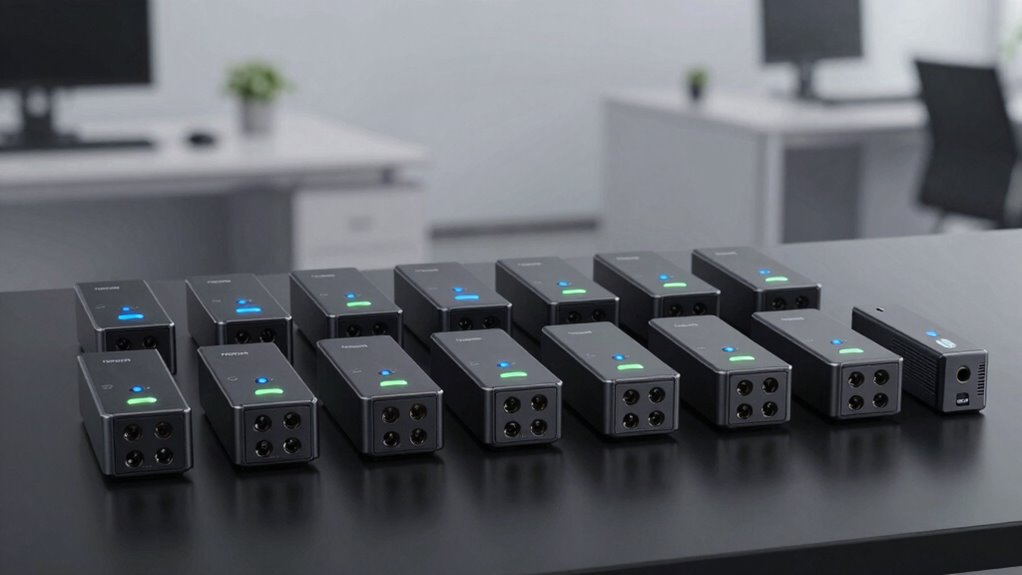

For a versatile starting point, I’d choose the TP-Link Omada PoE+ Injector POE160S: its 30W 802.3at output suits many access points and cameras while keeping gigabit data speeds. The TP-Link Omada POE170S stands out when a device needs up to 60W, while the PROCET 48V 15W is a simpler fit for lower-power 802.3af equipment. The main tradeoff is matching the injector’s standard and available wattage to the device, since a gigabit data link alone does not guarantee power compatibility. Passive PoE models need extra care because their voltage and pinout must match the device. Read on for the full comparison and guidance on choosing safely.

Get privacy and security gear delivered free with Prime
- Fast, free delivery on millions of items
- Prime Video, Amazon Music and more included
- Member-only deals all year
Key Takeaways
- POE160S is the balanced pick: its 30W PoE+ rating addresses a broad set of 802.3at devices without stepping up to a 60W injector.
- 60W models serve a narrower need: POE170S, TRENDnet TPE-117GI and TPE-119GI, and ThePoEstore’s PoE++ model are aimed at equipment that requires higher power.
- 802.3af injectors suit modest loads: PROCET’s 15W and iCreatin’s 15.4W options are candidates for compatible lower-power devices, not a safe default for every access point.
- Passive PoE is a separate compatibility decision: the TL-POE4824G’s 24V passive output requires a device that explicitly supports that voltage and pinout.
- Compatibility listings can narrow the search: iCreatin’s 30W model names several access point and injector equivalents, but buyers should still check the exact device’s power specification.
| PROCET Gigabit PoE Injector, 48V 15W, IEEE 802.3af |  | Best for Basic 802.3af Devices | PoE standard: IEEE 802.3af | Maximum power: 15 W | Voltage: 48 V | VIEW ON AMAZON | See Our Full Breakdown |
| iCreatin Gigabit PoE+ Injector Adapter 30W (IEEE 802.3af/at) |  | Best for Protected PoE+ Installs | PoE standards: IEEE 802.3af/at | Maximum output: 30 W | Output voltage: 48 V typical; supports 44–54 V | VIEW ON AMAZON | See Our Full Breakdown |
| TRENDnet TPE-115GI Gigabit PoE+ Injector |  | Best for Wall-Mounted Setups | Model: TPE-115GI | PoE standards: IEEE 802.3at and 802.3af | Maximum PoE power: 30 W | VIEW ON AMAZON | See Our Full Breakdown |
| DVIOIOASC POE30 30W Gigabit PoE+ Injector Adapter |  | Best for a Simple 30W Replacement | PoE standards: IEEE 802.3af/at | Maximum output: 30 W | Data rate: 10/100/1000 Mbps | VIEW ON AMAZON | See Our Full Breakdown |
| TP-Link Omada PoE++ Injector, 60W, Gigabit, UL Certified (POE170S) |  | Best for High-Power PoE++ | Model: POE170S | PoE standards: IEEE 802.3af/at/bt | Maximum power: 60 W | VIEW ON AMAZON | See Our Full Breakdown |
| TRENDnet Gigabit PoE++ Injector (TPE-117GI) |  | Best for High-Power Flexibility | Model: TPE-117GI | Ports: 1 Gigabit data-in port and 1 Gigabit PoE++ out port | Maximum power: 60W | VIEW ON AMAZON | See Our Full Breakdown |
| BV-Tech 30W Gigabit PoE+ Injector (Level VI Efficiency, 328ft Range) |  | Best for Organized Multi-Unit Installs | Model: POE-I100 | Power output: 30W (54V DC) | Network speed: 10/100/1000 Mbps | VIEW ON AMAZON | See Our Full Breakdown |
| TP-Link Omada TL-POE4824G 48V Gigabit Passive PoE Injector, 24W |  | Best for Compatible TP-Link Passive-PoE Gear | Model: TL-POE4824G | PoE type: Passive | Output voltage: 48V | VIEW ON AMAZON | See Our Full Breakdown |
| ThePoEstore Gigabit PoE+ Injector, IEEE 802.3af/at |  | Best for a Longer Warranty | Ethernet ports: 1 Gigabit input and 1 PoE+ Gigabit output | Standards: IEEE 802.3af/at | Output power: 15.4W PoE or up to 30W PoE+ | VIEW ON AMAZON | See Our Full Breakdown |
| iCreatin Gigabit PoE Injector, 48V 15.4W, IEEE 802.3af |  | Best for Basic 802.3af Devices | Ethernet speed: 10/100/1000 Mbps | Ports: 1 Gigabit Ethernet input and 1 PoE Gigabit Ethernet output | PoE standard: IEEE 802.3af | VIEW ON AMAZON | See Our Full Breakdown |
| iCreatin Gigabit PoE Injector Adapter, IEEE 802.3af Compliant, 10/100/1000Mbps | | Best for Basic PoE Devices | PoE standard: IEEE 802.3af | Data rate: 10/100/1000Mbps | Maximum power: 15.4W | VIEW ON AMAZON | See Our Full Breakdown |
| TRENDnet Gigabit PoE++ Injector (TPE-119GI) |  | Best for High-Power Devices | Model: TPE-119GI | Power standards: PoE 15.4W, PoE+ 30W, PoE++ 95W | Ports: 1 Gigabit Data In, 1 Gigabit PoE++ Out | VIEW ON AMAZON | See Our Full Breakdown |
| TP-Link Omada PoE+ Injector, 30W Gigabit, PoE160S |  | Best for Straightforward PoE+ Setup | Model: PoE160S | PoE standards: IEEE 802.3at/af | Maximum power output: 30W | VIEW ON AMAZON | See Our Full Breakdown |
| ThePoEstore Gigabit PoE++ Injector (60W) |  | Best for Midrange PoE++ | Model: M921-E-60W | PoE standards: IEEE 802.3af/at/bt | Maximum power output: 60W | VIEW ON AMAZON | See Our Full Breakdown |
| TP-Link TL-PI30G, Gigabit PoE+ Injector, Non-PoE to PoE Adapter |  | Best for Flexible Placement | Model: TL-PI30G | PoE standards: IEEE 802.3at/af | Maximum power: 30W | VIEW ON AMAZON | See Our Full Breakdown |
| poe injector gigabit | Maximum distance | Warranty | Model | Ports |
|---|---|---|---|---|
| PROCET Gigabit PoE Injector | 100 m (328 ft) | — | — | 1 Gigabit Ethernet input, 1 Gigabit Ethernet output |
| iCreatin Gigabit PoE+ Injector | 100 m (328 ft) | — | — | 1 Gigabit Ethernet input, 1 PoE+ Gigabit output |
| TRENDnet TPE-115GI Gigabit PoE | 100 m (328 ft) | 3 years | TPE-115GI | 1 Gigabit Ethernet port, 1 PoE+ Gigabit Ethernet port |
| DVIOIOASC POE30 30W Gigabit Po | 100 m (325 ft) | — | — | — |
| TP-Link Omada PoE++ Injector | 100 m (328 ft) | — | POE170S | 1 Gigabit Ethernet input, 1 Gigabit Ethernet output |
| TRENDnet Gigabit PoE++ Injecto | 100 m (328 ft) | 3-year limited | TPE-117GI | 1 Gigabit data-in port and 1 Gigabit PoE++ out port |
| BV-Tech 30W Gigabit PoE+ Injec | 328 ft (100 m) | 1 year on parts and labor | POE-I100 | — |
| TP-Link Omada TL-POE4824G 48V | — | 2 years | TL-POE4824G | — |
| ThePoEstore Gigabit PoE+ Injec | — | 3 years | — | — |
| iCreatin Gigabit PoE Injector | — | — | — | 1 Gigabit Ethernet input and 1 PoE Gigabit Ethernet output |
| iCreatin Gigabit PoE Injector | 328 ft (100 meters) | 1 year | — | 2 Gigabit Ethernet ports |
| TRENDnet Gigabit PoE++ Injecto | 100 meters (328 ft) | 3 years | TPE-119GI | 1 Gigabit Data In, 1 Gigabit PoE++ Out |
| TP-Link Omada PoE+ Injector | 100 meters (328 feet) | 2 years | PoE160S | — |
| ThePoEstore Gigabit PoE++ Inje | 100 meters (328 ft) | 1 year | M921-E-60W | — |
| TP-Link TL-PI30G | Up to 328 ft (100 meters) | 2 years | TL-PI30G | — |
More Details on Our Top Picks
PROCET Gigabit PoE Injector, 48V 15W, IEEE 802.3af
I’d choose the PROCET 15W48V when a camera, phone, or access point needs standard 802.3af power and nothing more. Its gigabit ports keep the data link from becoming a speed bottleneck, while plug-and-play setup avoids configuration work. Like the iCreatin 48V 15.4W injector elsewhere in this roundup, it targets lower-power devices; the iCreatin lists slightly more output, while this PROCET specifies a metal case and a 100-meter cable run. The main limit is its 15W maximum, which rules it out for devices that require PoE+ or higher. It also has just one powered output, so it suits a single endpoint rather than an expanding group of devices.
Pros:- Supports gigabit Ethernet data
- Provides power and data over one cable
- Plug-and-play installation
- Metal case and stated 100-meter transmission distance
Cons:- 15W maximum output excludes higher-power PoE+ devices
- Only one PoE output port
Best for: Buyers powering one 802.3af camera, IP phone, or access point from a nearby non-PoE gigabit connection.
Not ideal for: Installers with PoE+ or PoE++ devices, or anyone who needs to power multiple Ethernet endpoints.
- PoE standard:IEEE 802.3af
- Maximum power:15 W
- Voltage:48 V
- Ports:1 Gigabit Ethernet input, 1 Gigabit Ethernet output
- Data rate:1000 Mbps
- Maximum distance:100 m (328 ft)
- Case material:Metal
- Weight:0.23 kg
Our verdict“Choose the PROCET for one standard 802.3af device on a gigabit link; step up to a 30W injector for PoE+ equipment.”
iCreatin Gigabit PoE+ Injector Adapter 30W (IEEE 802.3af/at)
The iCreatin 30W PoE+ injector pairs broad device compatibility with several stated electrical protections, including 1.5kV lightning protection. It supports both 802.3at and backward-compatible 802.3af equipment, so it can serve a PoE+ access point while remaining usable with a lower-power device. Compared with the TRENDnet TPE-115GI, it offers more detailed protection specifications and names compatible Ubiquiti, TP-Link, and TRENDnet models; TRENDnet, in turn, specifies wall mounting and a metal housing. The iCreatin’s 30W ceiling still excludes devices requiring more power, and its listed operating range ends at 40°C. I’d leave it out of hot or poorly ventilated enclosures, where those limits may be a poor fit.
Pros:- Supports 802.3af and 802.3at devices up to 30W
- Lists over-current, overload, and over-voltage protections
- Includes stated 1.5kV lightning protection
- Gigabit input and PoE+ output with plug-and-play setup
Cons:- 30W maximum does not cover higher-power PoE++ devices
- Specified operating temperature is limited to 0–40°C
- Requires a separate non-PoE Gigabit network connection
Best for: Home and small-office network owners powering a compatible PoE+ access point or camera who value listed surge and overload protections.
Not ideal for: Buyers powering 60W-class devices or installing the injector in hot, enclosed, or outdoor locations.
- PoE standards:IEEE 802.3af/at
- Maximum output:30 W
- Output voltage:48 V typical; supports 44–54 V
- Ports:1 Gigabit Ethernet input, 1 PoE+ Gigabit output
- Maximum distance:100 m (328 ft)
- Lightning protection:1.5 kV
- Operating temperature:0–40°C
- Dimensions:5.6 × 3.6 × 2.6 in
Our verdict“Pick the iCreatin when a 30W PoE+ device needs a gigabit feed and the listed electrical protections matter to your installation.”
TRENDnet TPE-115GI Gigabit PoE+ Injector
The TRENDnet TPE-115GI is a practical fit when an injector needs a fixed place near a switch or cable route. Its wall-mountable metal housing and integrated power supply make a more orderly installation than a loose adapter, and it can deliver up to 30W for 802.3at devices while supporting 802.3af. Like the iCreatin 30W injector, it covers both PoE generations and a 100-meter run. The iCreatin lists specific electrical protections; TRENDnet’s distinguishing details are its mounting design, metal case, and three-year warranty. This is still a single-device injector, and it needs a separate non-PoE gigabit switch or router port for network data. Its 30W limit also makes the TP-Link POE170S a better match for devices needing more power.
Pros:- Supports 802.3at up to 30W and 802.3af devices
- Wall-mountable metal housing
- Integrated power supply
- Specified network reach up to 100 meters
Cons:- Requires a separate non-PoE Gigabit network connection
- 30W ceiling is below the TP-Link POE170S’s 60W capacity
Best for: Installers who want a fixed, wall-mounted injector for one PoE or PoE+ device connected to a non-PoE gigabit switch.
Not ideal for: Buyers powering devices above 30W or looking for a multiport PoE switch replacement.
- Model:TPE-115GI
- PoE standards:IEEE 802.3at and 802.3af
- Maximum PoE power:30 W
- Ports:1 Gigabit Ethernet port, 1 PoE+ Gigabit Ethernet port
- Maximum distance:100 m (328 ft)
- Ethernet speed:Full-duplex 2 Gbps
- Mounting:Wall-mountable
- Housing:Metal
- Warranty:3 years
Our verdict“Choose the TRENDnet for a tidy, fixed PoE+ installation up to 30W, especially when wall mounting is useful.”
DVIOIOASC POE30 30W Gigabit PoE+ Injector Adapter
The DVIOIOASC POE30 covers the core job: adding up to 30W of PoE+ power to a gigabit Ethernet connection, with stated support for 802.3af and 802.3at. Its 100-meter reach and surge protection give it the basic capabilities needed for a remote camera or access point. Compared with the TRENDnet TPE-115GI, the supplied information describes a compact adapter and included AC cord, while TRENDnet provides a named model, wall-mountable metal housing, and a three-year warranty. That makes this DVIOIOASC a simpler spec-led choice, but there is less product support information to weigh. Its 30W ceiling also falls well short of the TP-Link POE170S for higher-power PoE++ devices. I’d match it to a straightforward single-device replacement where the power requirement is known.
Pros:- Supports 802.3af and 802.3at devices up to 30W
- Gigabit RJ-45 interface supports 10/100/1000Mbps
- Lists surge protection
- Includes an AC power cord
Cons:- No manufacturer warranty is specified in the supplied product data
- 30W output does not support higher-power PoE++ devices
- Product information gives fewer details than the TRENDnet TPE-115GI
Best for: Buyers replacing a basic injector to power one known 802.3af or 802.3at device over a gigabit link.
Not ideal for: Installers who need a stated warranty, detailed environmental specifications, or power above 30W.
- PoE standards:IEEE 802.3af/at
- Maximum output:30 W
- Data rate:10/100/1000 Mbps
- Maximum distance:100 m (325 ft)
- Interface:RJ-45
- Dimensions:4.76 × 1.96 × 1.41 in
- Included items:AC power cord, instruction manual, box
Our verdict“Consider the POE30 for a simple, single-device 30W gigabit replacement when its limited support details fit your needs.”
TP-Link Omada PoE++ Injector, 60W, Gigabit, UL Certified (POE170S)
The TP-Link Omada POE170S takes the highest-power role in this group, supporting 802.3af, 802.3at, and 802.3bt with up to 60W available. That headroom suits equipment that would exceed the 30W limit of the TRENDnet TPE-115GI or iCreatin injector, while its gigabit ports preserve the data link and its 100-meter specification matches their stated reach. It also installs without software, though it still needs a nearby power outlet and only provides one powered output. The metal case adds a sturdier enclosure, but at 0.77 kg and over six inches long it is less convenient to tuck away than a compact 30W adapter. I’d pick it when device power requirements justify the larger, heavier injector; for ordinary PoE+ endpoints, the TRENDnet is a more modest fit.
Pros:- Supports 802.3af, 802.3at, and 802.3bt standards
- Provides up to 60W for higher-power endpoints
- Gigabit input and output with a stated 100-meter reach
- Metal casing and plug-and-play setup
Cons:- Requires a nearby power outlet
- Heavier and larger than the listed 30W TRENDnet injector
- One PoE output port serves only one endpoint
Best for: Network installers powering one 802.3bt device or another endpoint whose draw exceeds the 30W ceiling of PoE+ injectors.
Not ideal for: Buyers with standard PoE or PoE+ devices who want a lightweight, compact injector or lack a nearby outlet.
- Model:POE170S
- PoE standards:IEEE 802.3af/at/bt
- Maximum power:60 W
- Ports:1 Gigabit Ethernet input, 1 Gigabit Ethernet output
- Maximum distance:100 m (328 ft)
- Data rate:1000 Mbps
- Casing:Metal
- Dimensions:6.1 × 2.76 × 1.65 in
- Weight:0.77 kg
Our verdict“Choose the POE170S when a single gigabit-connected device needs more than 30W and supports one of its listed PoE standards.”
TRENDnet Gigabit PoE++ Injector (TPE-117GI)
Up to 60W and support for three PoE standards make the TPE-117GI the flexible choice when a device may need more power than a typical PoE+ injector can provide. It can connect a non-PoE Gigabit switch port to compatible 802.3af, 802.3at, or 802.3bt equipment, with auto-sensing and no configuration required. Compared with the BV-Tech 30W Gigabit PoE+ Injector, it offers twice the stated maximum output and support for PoE++, which suits higher-draw hardware. The tradeoff is that many cameras and access points need less power, so buyers of standard 802.3af/at gear may not need its extra capacity. Its metal, wall-mountable enclosure and three-year limited warranty add practical appeal, while NDAA compliance is specified only for the U.S. and Canada.
Pros:- Supports IEEE 802.3af, 802.3at, and 802.3bt devices
- Provides up to 60W of power
- Auto-sensing, plug-and-play setup
- Wall-mountable metal enclosure and three-year limited warranty
Cons:- Requires an available Gigabit Ethernet switch port
- NDAA compliance is specified for the U.S. and Canada only
Best for: Installers powering a PoE++ device or several types of standards-compliant equipment from a Gigabit switch
Not ideal for: Owners of standard 802.3af devices who only need a basic injector and do not need PoE++ capacity
- Model:TPE-117GI
- Ports:1 Gigabit data-in port and 1 Gigabit PoE++ out port
- Maximum power:60W
- PoE standards:IEEE 802.3af, 802.3at, and 802.3bt
- Maximum distance:100 m (328 ft)
- Enclosure:Metal, wall-mountable
- Warranty:3-year limited
Our verdict“Choose the TPE-117GI when your Gigabit PoE setup may require up to 60W or PoE++ compatibility.”
BV-Tech 30W Gigabit PoE+ Injector (Level VI Efficiency, 328ft Range)
30W output, Gigabit data, and interlocking design give this BV-Tech injector a practical role in installations that need several individual power injectors kept tidy. Its wall-mountable slots and interlocking features help organize units, while Level VI efficiency and protection for non-standard terminals add useful installation details. Compared with the ThePoEstore Gigabit PoE+ Injector, it calls out a specific arrangement feature for grouping injectors; both are 30W-class PoE+ choices for compatible devices. It supports IEEE 802.3af/at, so it can serve equipment such as cameras, access points, and VoIP phones, but it cannot cover PoE++ devices like the 60W TRENDnet TPE-117GI. The one-year parts-and-labor warranty is also shorter than ThePoEstore’s three-year term, and each unit powers only one device.
Pros:- Up to 30W output for compatible PoE+ devices
- Gigabit Ethernet at 10/100/1000 Mbps
- Interlocking and wall-mounting features support organized installs
- Level VI efficiency and intelligent terminal protection
Cons:- Single-port design powers one device per injector
- One-year parts-and-labor warranty is shorter than the three-year ThePoEstore warranty
- Ethernet cable is not included
Best for: Installers deploying multiple 30W PoE+ cameras or access points who want wall-mounted injectors arranged together
Not ideal for: Buyers powering PoE++ hardware or seeking a longer stated warranty
- Model:POE-I100
- Power output:30W (54V DC)
- Network speed:10/100/1000 Mbps
- Standards:IEEE 802.3at/af
- Maximum distance:328 ft (100 m)
- Dimensions:5.2 × 2.74 × 1.6 in
- Warranty:1 year on parts and labor
Our verdict“Pick the BV-Tech when you need several individually powered PoE+ devices and want a way to arrange the injectors neatly.”
TP-Link Omada TL-POE4824G 48V Gigabit Passive PoE Injector, 24W
Passive 48V output sets the TL-POE4824G apart from standards-based injectors such as the iCreatin 48V 15.4W IEEE 802.3af Injector. It can be a straightforward fit for select TP-Link access points and CPE devices designed for passive PoE, with Gigabit data and no configuration needed. That fit is also its main limitation: passive power does not offer the standards-based compatibility of 802.3af/at models, so the connected device must explicitly support this power type and voltage. Its 24W maximum sits between the iCreatin’s 15.4W and 30W options such as the ThePoEstore Gigabit PoE+ Injector, but wattage alone does not make those models interchangeable. TP-Link includes wall-mounting hardware and a power cord, making this a tidy choice when the target device is confirmed compatible.
Pros:- Gigabit Ethernet data rate
- Supplies up to 24W at 48V
- Plug-and-play operation
- Includes power cord and wall-mounting hardware
Cons:- Passive PoE limits use to devices specifically designed for it
- 24W maximum is below the 30W PoE+ injectors in this roundup
Best for: Owners of select TP-Link access points or CPE devices that explicitly require 48V passive PoE
Not ideal for: Buyers seeking a broadly compatible standards-based injector for mixed-brand 802.3af/at equipment
- Model:TL-POE4824G
- PoE type:Passive
- Output voltage:48V
- Maximum power:24W
- Data transfer rate:1000 Mbps
- Dimensions:4.33 × 2.24 × 1.41 in
- Warranty:2 years
Our verdict“Choose this TP-Link when your device specifically calls for 48V passive PoE and you want a wall-mountable Gigabit adapter.”
ThePoEstore Gigabit PoE+ Injector, IEEE 802.3af/at
IEEE 802.3af/at support, Gigabit data, and a three-year warranty make ThePoEstore a well-rounded option for a single compatible device. Its stated output covers standard PoE at 15.4W and PoE+ up to 30W, so buyers can match it to cameras, phones, or access points without stepping up to a 60W injector. Compared with the BV-Tech 30W Gigabit PoE+ Injector, it offers the same broad 30W ceiling and 100-meter cable range, while listing a longer warranty; BV-Tech instead highlights interlocking slots for arranging multiple units. ThePoEstore includes an AC cord and supports plug-and-play setup, but it only suits devices that take power through PoE. Equipment with separate data and power connections is outside its use, and devices needing more than 30W call for a higher-capacity model such as the TRENDnet TPE-117GI.
Pros:- Supports IEEE 802.3af and 802.3at
- Gigabit input and PoE+ Gigabit output
- Up to 30W PoE+ output over 100 meters
- Three-year warranty and AC cord included
Cons:- Cannot power equipment that uses separate data and power connections
- 30W ceiling excludes devices with higher power requirements
Best for: Small office or home network owners powering one standards-compliant PoE camera, phone, or access point who value a longer warranty
Not ideal for: Installers with non-PoE devices, separate power and data connections, or equipment requiring over 30W
- Ethernet ports:1 Gigabit input and 1 PoE+ Gigabit output
- Standards:IEEE 802.3af/at
- Output power:15.4W PoE or up to 30W PoE+
- Power supply:Integrated 48V
- Data transfer rate:1000 Mbps
- Maximum cable range:100 m (328 ft)
- Warranty:3 years
Our verdict“Choose ThePoEstore for a single Gigabit PoE+ device when 30W is sufficient and the three-year warranty suits your priorities.”
iCreatin Gigabit PoE Injector, 48V 15.4W, IEEE 802.3af
IEEE 802.3af support and Gigabit data make this iCreatin a focused match for standard-power devices such as compatible IP cameras, VoIP phones, and access points. It adds power to an existing non-PoE Ethernet connection and lists overload, overcurrent, overvoltage, and short-circuit protection. Compared with the ThePoEstore Gigabit PoE+ Injector, it has a lower 15.4W ceiling and does not list 802.3at support, so it is a better fit for basic PoE equipment than for devices that may need 30W. The 100-meter reach matches the other injectors here, but the product details specify a US wall plug and only one injector in the box. That makes it a limited choice for higher-power gear or buyers needing a different plug format.
Pros:- Supports Gigabit Ethernet at 10/100/1000 Mbps
- Works with compatible IEEE 802.3af devices
- Listed overload, overcurrent, overvoltage, and short-circuit protection
- Supports a cable run up to 100 meters
Cons:- Limited to IEEE 802.3af and 15.4W
- US wall plug may not suit other regional outlets
- Only one injector is listed in the box contents
Best for: Buyers powering one standard IEEE 802.3af camera, VoIP phone, or access point on a Gigabit network
Not ideal for: Owners of PoE+ or PoE++ equipment, devices above 15.4W, or installations requiring a non-US plug
- Ethernet speed:10/100/1000 Mbps
- Ports:1 Gigabit Ethernet input and 1 PoE Gigabit Ethernet output
- PoE standard:IEEE 802.3af
- Output voltage:48–52V
- Maximum cable distance:100 m (328 ft)
- Input voltage:100–240V
- In the box:1 US wall-plug Gigabit PoE injector
Our verdict“Pick this iCreatin for a basic 802.3af device when its 15.4W limit and US plug match your setup.”
iCreatin Gigabit PoE Injector Adapter, IEEE 802.3af Compliant, 10/100/1000Mbps
For a gigabit link to a standard 802.3af camera, phone, or access point, this iCreatin keeps the job simple: it adds up to 15.4W of PoE power while passing data at 10/100/1000Mbps. Its over-current, over-voltage, and short-circuit protections add useful safeguards when connecting equipment to an existing network cable. Compared with the TP-Link Omada PoE160S, though, it has less power headroom: the TP-Link supports 802.3at devices up to 30W, so it is a better fit if your device needs PoE+. That makes this iCreatin a sensible single-device choice when you have confirmed 802.3af compatibility and want a compact, plug-and-play injector. Skip it for newer or higher-draw equipment, since its power ceiling is the main limit.
Pros:- Passes data at 10/100/1000Mbps
- Supports standard IEEE 802.3af devices with up to 15.4W output
- Over-current, over-voltage, and short-circuit protections are specified
- Plug-and-play setup avoids injector configuration
Cons:- Does not support 802.3at PoE+ devices that need more than 15.4W
- Maximum stated cable distance is 100 meters
- One-year warranty is shorter than the two-year coverage listed for the TP-Link Omada PoE160S
Best for: Home or small-office users powering one confirmed 802.3af camera, VoIP phone, or access point over an existing Ethernet run
Not ideal for: Installers powering 802.3at or higher-demand devices, since its maximum output is 15.4W
- PoE standard:IEEE 802.3af
- Data rate:10/100/1000Mbps
- Maximum power:15.4W
- Output voltage:48–52V
- Maximum distance:328 ft (100 meters)
- Ports:2 Gigabit Ethernet ports
- Input voltage:100–240V
- Warranty:1 year
Our verdict“Choose this iCreatin for a basic 802.3af gigabit device when its 15.4W limit is sufficient.”
TRENDnet Gigabit PoE++ Injector (TPE-119GI)
The TPE-119GI has the widest power range in this group, supplying up to 95W under 802.3bt while also supporting PoE and PoE+ devices. Auto-sensing selects power for compatible equipment, so one injector can suit a mixed deployment as devices are upgraded. Against the ThePoEstore M921-E-60W, its 95W ceiling gives it more room for demanding endpoints, though both are single-output injectors with a 100-meter stated reach. The tradeoff is a separate power-cord connection, which can make placement less tidy, and its metal unit needs room for mounting. This is the strongest fit when a device explicitly calls for high-power PoE++ and enterprise or government compliance matters; for ordinary cameras or phones, its extra capacity may go unused.
Pros:- Supplies up to 95W for compatible PoE++ equipment
- Supports PoE, PoE+, and PoE++ standards
- Auto-sensing adjusts power for compatible connected devices
- NDAA and TAA compliant, with a three-year warranty
Cons:- Requires a separate power-cord connection
- Provides only one Gigabit data input and one PoE++ output
- The listed maximum distance is 100 meters
Best for: Enterprise and public-sector installers powering an 802.3bt access point or other high-draw device from a non-PoE gigabit port
Not ideal for: Buyers powering only standard 802.3af cameras or phones, who may not need its 95W capacity or larger installation footprint
- Model:TPE-119GI
- Power standards:PoE 15.4W, PoE+ 30W, PoE++ 95W
- Ports:1 Gigabit Data In, 1 Gigabit PoE++ Out
- Maximum distance:100 meters (328 ft)
- Compliance:NDAA and TAA compliant
- Enclosure:Metal
- Dimensions:6 × 2.9 inches
- Warranty:3 years
Our verdict“Pick the TPE-119GI when a single endpoint needs up to 95W and compliance requirements make its higher-capacity design worthwhile.”
TP-Link Omada PoE+ Injector, 30W Gigabit, PoE160S
The PoE160S is a clear step up from basic 802.3af injectors: its 30W output supports 802.3at PoE+ as well as af devices, while the Gigabit input and output preserve a fast wired connection. Automatic PoE detection and plug-and-play installation make it a practical choice when you need to power one compatible access point, camera, or phone without configuring a switch. Compared with the TP-Link TL-PI30G, it offers the same stated 30W ceiling and 100-meter reach, so device needs and installation fit matter more than raw output. This model’s main drawback is its need for a nearby power outlet; the Ethernet cable carries power onward, but the injector itself still needs mains power. Choose it for a simple PoE+ run, not a multi-device expansion.
Pros:- Provides up to 30W for compatible 802.3at and 802.3af devices
- Gigabit input and output support 1000Mbps data transfer
- Automatic PoE detection supports plug-and-play setup
- Specified for cable runs up to 100 meters
Cons:- Requires a nearby power outlet
- Offers one Gigabit input and one Gigabit output rather than multiple powered ports
- Its 30W ceiling does not suit devices requiring PoE++ power
Best for: Small-office network owners adding one 802.3at access point or camera to an existing Gigabit Ethernet connection
Not ideal for: Installers who need to power several endpoints from one unit or place the injector where no mains outlet is available
- Model:PoE160S
- PoE standards:IEEE 802.3at/af
- Maximum power output:30W
- Ethernet ports:1 Gigabit input, 1 Gigabit output
- Data transfer rate:1000Mbps
- Maximum distance:100 meters (328 feet)
- Dimensions:4.9 × 2.3 × 1.4 inches
- Warranty:2 years
Our verdict“Choose the PoE160S for a simple single-device PoE+ installation that needs Gigabit data and up to 30W.”
ThePoEstore Gigabit PoE++ Injector (60W)
The M921-E-60W fills the gap between 30W PoE+ injectors and the 95W TRENDnet TPE-119GI. Its 60W output and stated 802.3af/at/bt compliance suit compatible devices that exceed ordinary PoE+ needs but do not call for the TRENDnet’s full capacity. An internal AC/DC converter keeps the unit self-contained, and automatic device detection is intended to guard connected non-PoE equipment. It also supports Gigabit data and runs up to 100 meters, matching the reach listed for the TP-Link PoE160S. The tradeoff is a single input and output, so it adds power to one Ethernet path rather than expanding port count. Since there is no external power brick, the injector itself still needs to sit near an outlet.
Pros:- Provides up to 60W for compatible higher-power PoE devices
- Lists IEEE 802.3af, 802.3at, and 802.3bt compliance
- Internal AC/DC converter avoids a separate external power brick
- Automatic device detection and LED indicators support straightforward installation
Cons:- One input and one output support only a single powered Ethernet run
- The unit must be installed near an outlet
- One-year warranty is shorter than the three-year warranty listed for the TRENDnet TPE-119GI
Best for: Installers powering one compatible 60W endpoint who want PoE++ capacity without stepping up to a 95W injector
Not ideal for: Buyers needing multiple powered ports, or deployments where the injector cannot be mounted close to a power outlet
- Model:M921-E-60W
- PoE standards:IEEE 802.3af/at/bt
- Maximum power output:60W
- Voltage:48V
- Data speed:10/100/1000Mbps
- Interface:Shielded RJ-45
- Maximum distance:100 meters (328 ft)
- Warranty:1 year
Our verdict“Pick the M921-E-60W when one compatible device needs more than 30W but not the TRENDnet injector’s 95W ceiling.”
TP-Link TL-PI30G, Gigabit PoE+ Injector, Non-PoE to PoE Adapter
With 802.3at/af support, up to 30W, and Gigabit Ethernet, the TL-PI30G covers the common PoE+ range without requiring a switch replacement. Its plug-and-play setup and automatic detection suit a single camera, access point, or phone on an existing cable run. Compared with TP-Link’s PoE160S, it has the same stated power ceiling and 100-meter range, but the listing highlights desktop or wall mounting and a compact white body, which may fit better where the injector needs to be tucked near an endpoint. The published specs do not give it more power or reach than the PoE160S, so the choice is largely about placement and installation fit. At 30W, it also falls short for PoE++ devices, and it still needs a separate power connection.
Pros:- Converts an existing non-PoE Gigabit connection for compatible devices
- Supports up to 30W and IEEE 802.3at/af equipment
- Plug-and-play setup with automatic detection
- Desktop or wall-mount installation is listed
Cons:- 30W maximum excludes devices needing higher PoE++ output
- Requires a separate power connection
- Provides one injector path rather than several powered Ethernet ports
Best for: Home and small-office installers adding one PoE+ camera or access point where desktop or wall mounting helps with placement
Not ideal for: Users powering PoE++ equipment or seeking a multi-port unit, since it provides up to 30W on one Ethernet path
- Model:TL-PI30G
- PoE standards:IEEE 802.3at/af
- Maximum power:30W
- Data link:Gigabit Ethernet
- Data transfer rate:1Gbps
- Maximum distance:Up to 328 ft (100 meters)
- Dimensions:2.1 × 1.1 × 3.9 inches
- Warranty:2 years
Our verdict“Choose the TL-PI30G for one 30W PoE+ device when its listed desktop or wall-mount format suits the installation.”

How We Picked
I ranked these injectors by how clearly their stated power standard and output match common gigabit network devices, then weighed the usefulness of their wattage, named compatibility, and intended role. IEEE 802.3af and 802.3at models are easier to match to compliant equipment; higher-output 802.3bt or PoE++ choices make sense when the endpoint calls for more power, but add no benefit to a device with a lower limit. I treated passive PoE as a specialized option because matching voltage and pinout is essential.
That puts the TP-Link Omada POE160S first as a broadly useful 30W PoE+ choice, with the higher-power POE170S ahead of niche low-wattage models for buyers with demanding endpoints. I gave distinct places to compact, named-compatibility, compliance-oriented, and passive options rather than ranking all products by maximum wattage. Where product details are limited to a model name or a general standard, I avoid assuming features such as surge protection, mounting hardware, or included cables.
| poe injector gigabit | PoE standards |
|---|---|
| PROCET Gigabit PoE Injector | — |
| iCreatin Gigabit PoE+ Injector | IEEE 802.3af/at |
| TRENDnet TPE-115GI Gigabit PoE | IEEE 802.3at and 802.3af |
| DVIOIOASC POE30 30W Gigabit Po | IEEE 802.3af/at |
| TP-Link Omada PoE++ Injector | IEEE 802.3af/at/bt |
| TRENDnet Gigabit PoE++ Injecto | IEEE 802.3af, 802.3at, and 802.3bt |
| BV-Tech 30W Gigabit PoE+ Injec | — |
| TP-Link Omada TL-POE4824G 48V | — |
| ThePoEstore Gigabit PoE+ Injec | — |
| iCreatin Gigabit PoE Injector | — |
| iCreatin Gigabit PoE Injector | — |
| TRENDnet Gigabit PoE++ Injecto | — |
| TP-Link Omada PoE+ Injector | IEEE 802.3at/af |
| ThePoEstore Gigabit PoE++ Inje | IEEE 802.3af/at/bt |
| TP-Link TL-PI30G | IEEE 802.3at/af |
Factors to Consider When Choosing Poe Injector Gigabit
I’d start with the endpoint’s power label or manufacturer specifications, then work outward to the injector and cable run. These checks help avoid buying a unit that passes gigabit data but cannot power the device safely or reliably.
Match the PoE Standard Before Comparing Wattage
Check whether the endpoint calls for 802.3af, 802.3at, 802.3bt, or passive PoE. A higher-standard injector may support backward compatibility when both products follow IEEE negotiation rules, but the exact specifications should confirm that. Passive injectors do not negotiate power in the same way, so a voltage mismatch can damage equipment. Do not assume that a connector fitting the port means the power standard is right. For mixed installations, standard-compliant injectors usually reduce guesswork. Reserve passive models for a device whose documentation explicitly names the required voltage and pinout.
Leave Headroom for the Endpoint’s Real Power Draw
Compare the injector’s available output with the endpoint’s maximum power requirement, not just its typical draw. Cameras can need more power when infrared illumination or other features are active, and access points may draw more under demanding operation. The injector rating also describes what it can supply, not what the device will consume. A 60W PoE++ model is useful when the endpoint needs that capacity, but it does not make a low-power device perform better. For a device near the injector’s limit, check the manufacturer’s power budget and any conditions that reduce available output. This avoids both underpowering and buying excess capacity without a clear need.
Treat Gigabit Data and PoE as Separate Checks
Gigabit describes the Ethernet data link; it does not identify the injector’s power standard or wattage. Confirm that the injector specifies 10/100/1000Mbps when the network depends on gigabit throughput. Then verify its power compatibility separately. A fast injector cannot compensate for a slower switch port, endpoint, or cable. This matters for high-resolution cameras and access points where buyers may focus on power while overlooking the data path. Check every link between the switch and endpoint if gigabit speed is a requirement.
Account for Cable Length and Installation Conditions
Long Ethernet runs can reduce the power that reaches an endpoint, and cable quality affects both power delivery and data reliability. A stated maximum distance is not a guarantee that every device will receive its full power at that distance. Use suitable copper Ethernet cable and check the endpoint’s draw against the injector’s limits over the planned run. For outdoor cameras or access points, also review weather exposure, grounding, and surge protection needs; those protections are not established by a PoE wattage rating alone. If the route is unusually long or exposed, consider the whole installation rather than choosing an injector from its range claim in isolation. Keep the injector itself in a location that meets its operating requirements.
Choose Extra Power Only When the Device Needs It
Moving from 15W-class 802.3af to 30W PoE+ or 60W PoE++ can widen device compatibility, but it is only useful when the endpoint supports the relevant standard and needs the available power. Extra capacity does not automatically provide better protection, longer cable reach, or faster networking. If you are adding a single device, compare an injector with a PoE switch: an injector can be a simple way to power one endpoint, while a switch may fit a growing installation with several PoE devices. Think about placement and outlet access as well as the device count. This keeps the choice tied to the network you are actually building.
Frequently Asked Questions
Can I use a PoE++ injector with a device that only needs PoE+?
It depends on whether the injector and device follow compatible IEEE standards. Standard-compliant PoE systems negotiate power, so higher-capacity equipment can often serve lower-power endpoints, but you should confirm the injector’s compatibility with the device. Do not apply this assumption to passive PoE, which may put a fixed voltage on the cable. Check the endpoint’s power requirements and the injector specification before connecting them. The injector’s maximum wattage alone does not confirm compatibility.
Will a gigabit PoE injector make my connection run at gigabit speed?
Only if the injector, switch, endpoint, and Ethernet cabling all support gigabit. The injector’s gigabit rating indicates its data pass-through capability, while PoE describes power delivery. A 10/100 endpoint or switch port will still limit the link even with a gigabit injector. Check the negotiated link speed after installation if throughput matters. Also verify the cable condition, since a faulty or unsuitable run can affect link performance.
How do I know whether my camera needs 802.3af, PoE+, or PoE++?
Look up the camera’s exact model specification and check both its required PoE standard and maximum power draw. Features such as infrared lighting, pan and tilt, heaters, or accessories can increase its demand. A device that lists 802.3at should not be paired with an 802.3af injector just because both use Ethernet. If the documentation lists a wattage but no standard, ask the manufacturer or consult its installation guide before choosing. Match the injector to the documented requirement rather than estimating from the camera’s size.
Is a passive 24V injector interchangeable with an 802.3af injector?
No. Passive 24V equipment supplies fixed voltage, while 802.3af uses a standardized negotiation process. A device designed for passive 24V may not accept 802.3af, and a device expecting 802.3af may be damaged by an incompatible passive output. Confirm both voltage and pinout in the endpoint documentation. The TL-POE4824G is only a fit for devices explicitly compatible with its 24V passive output. When specifications are unclear, choose a confirmed standard match rather than testing by connection.
Should I buy an injector or replace my switch with a PoE switch?
An injector is often a straightforward fit when you need to power one endpoint and your existing switch already provides the needed data connection. A PoE switch can be more convenient as several powered devices are added, since it combines switching and power distribution in one unit. Compare the total number of endpoints, their standards, and their combined power demand before deciding. Also consider where the devices and outlets are located, since an injector needs its own power connection. For a small installation, a single injector may avoid replacing working network equipment; for a growing one, a PoE switch may simplify cabling.
Conclusion
I’d make the TP-Link Omada POE160S my best overall choice for a typical 30W PoE+ endpoint, and the PROCET 48V 15W my value-oriented pick for a confirmed 802.3af device with modest power needs. Beginners can start with the POE160S when their equipment supports 802.3at, since its clearly stated standard and output are easier to match than a passive injector. For higher-demand equipment, the POE170S is my premium pick among the listed options, with other 60W PoE++ models serving similar needs. Choose the TL-POE4824G only for a device that specifically calls for 24V passive PoE, and look at the iCreatin 30W if its named compatibility matches your access point. The right choice follows the endpoint’s documented standard, wattage, and data speed.
Columbus Day / Indigenous Peoples' Day Picks
long weekend sales
As an affiliate, we earn on qualifying purchases.