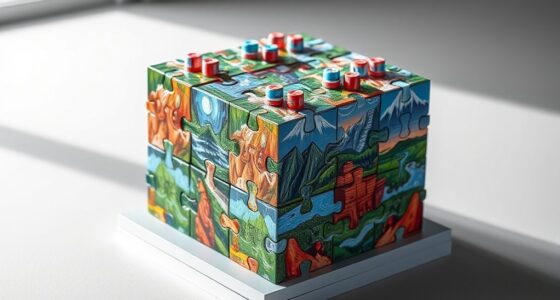
The future of smart puzzles and IoT integration will transform how you play and interact with puzzles by blending physical and digital worlds seamlessly. Expect immersive experiences with augmented reality overlays, personalized challenges, and adaptive difficulty that responds to your skills. Connected sensors and smart devices will create a cohesive environment, encouraging social collaboration across distances. As technology advances, these innovations will make puzzle-solving more engaging, intuitive, and tailored to your preferences—so keep exploring to discover more.
Key Takeaways
- Smart puzzles will become highly personalized, adapting difficulty and content based on user preferences and skill levels through AI.
- Integration with IoT will enable seamless environmental interactions, such as lighting and sound changes, enhancing immersion.
- Augmented reality will transform traditional puzzles into immersive, layered experiences that blend physical and digital elements.
- Connected ecosystems will support multi-user collaboration, allowing players in different locations to solve puzzles together in real-time.
- Continuous data collection will drive adaptive learning, making puzzle experiences more engaging, challenging, and tailored to individual development.

As technology continues to evolve, smart puzzles are transforming from simple entertainment into immersive, connected experiences. You’ll find yourself engaged in puzzles that not only challenge your mind but also interact seamlessly with your environment through augmented reality. This integration allows you to see virtual elements overlaid onto the real world, creating a layered experience that’s both engaging and intuitive. Imagine pointing your device at a physical puzzle piece and having it come alive with digital clues or hints, guiding you toward the solution. Augmented reality elevates traditional puzzles into dynamic, interactive adventures where the boundaries between the physical and digital blur.
Smart puzzles blend physical and digital worlds through augmented reality, creating immersive, interactive, and intuitive gaming experiences.
This evolution also paves the way for personalized gaming experiences. As you solve more puzzles, the system learns your preferences, strengths, and weaknesses, tailoring future challenges specifically for you. Instead of generic puzzles that anyone can solve, you get customized content that keeps you motivated and continuously engaged. For example, if you excel at pattern recognition but struggle with riddles, the game adjusts to present more of what you enjoy and less of what frustrates you. This personalized approach not only enhances enjoyment but also accelerates your learning process, helping you develop new skills in a way that feels natural and rewarding.
Furthermore, the integration of IoT devices into smart puzzles amplifies this personalized experience. Smart sensors embedded within puzzles can track your progress, record your moves, and even adapt the difficulty in real-time. Your smart home devices may also interact with the puzzle, creating a cohesive environment where your entire space responds to your gaming activity. For example, solving a puzzle might trigger lighting changes, sound effects, or even temperature adjustments, making the experience more immersive. These connected systems foster a sense of continuity, so your puzzle-solving sessions become part of a larger, interconnected ecosystem that adapts to your preferences. Additionally, security vulnerabilities in IoT devices demand careful management to prevent potential breaches that could compromise your data and privacy.
In addition, as these technologies advance, you’ll see more multi-user experiences that encourage collaboration. Augmented reality can bring friends together in shared virtual spaces, allowing you to work on puzzles collectively from different locations. IoT connectivity ensures everyone’s devices stay synchronized, making teamwork seamless and more engaging. The future of smart puzzles isn’t just about individual entertainment; it’s about creating social, personalized adventures that adapt to your lifestyle and environment. In short, as augmented reality, personalized gaming, and IoT integration mature, your puzzle-solving experiences will become more immersive, tailored, and connected than ever before.

Project Genius Grecian Computer Mechanical Math Puzzle, Wooden Brainteaser Gift for History Buffs and Smart Kids, Teens, and Adults – True Genius Series Inspired by The Ancient Antikythera Mechanism
MECHANICAL MATH PUZZLE: This diabolical math brainteaser requires you to spin each of the layered gears until every…
As an affiliate, we earn on qualifying purchases.
As an affiliate, we earn on qualifying purchases.
Frequently Asked Questions
How Secure Are Iot-Connected Smart Puzzles Against Hacking?
IoT-connected smart puzzles face cybersecurity risks, but manufacturers implement security measures to protect your data privacy. While no device is completely hack-proof, they often use encryption and secure protocols to guard against hacking attempts. To stay safe, you should keep firmware updated and avoid insecure networks. Being cautious helps reduce vulnerabilities, ensuring your smart puzzle remains a fun and secure experience against potential cybersecurity threats.
What Age Group Benefits Most From Iot-Integrated Puzzles?
You’ll find that children and early teens benefit most from IoT-integrated puzzles, as these tools boost their cognitive development like a spark igniting a fire. Imagine a young learner solving a puzzle that adapts to their skill level, sharpening critical thinking and problem-solving skills. Different age groups respond uniquely, but younger users gain the most, as these puzzles help develop foundational skills while keeping them engaged and motivated.
Can Smart Puzzles Be Customized for Educational Purposes?
Yes, smart puzzles can be customized for educational purposes. You can tailor the puzzle’s content to suit specific learning goals, promoting interactive learning and engaging students more effectively. By incorporating educational customization, you enable learners to explore topics actively, making the experience more meaningful. These puzzles adapt to different skill levels, ensuring that learners stay challenged and motivated while gaining new knowledge through an interactive, hands-on approach.
How Durable Are Iot-Enabled Puzzle Components Over Time?
Imagine your favorite toy, once shiny and new, now showing signs of wear—that’s how IoT-enabled puzzle components fare over time. Durability testing shows they withstand daily use, but material degradation can occur with prolonged exposure to moisture or extreme temperatures. With proper care, these components remain functional for years, but neglect accelerates wear, making durability a key factor in maintaining your smart puzzle’s longevity.
Are There Environmental Impacts of Manufacturing Iot Puzzle Devices?
Yes, manufacturing IoT puzzle devices impacts the environment. You might notice higher energy consumption during production, which contributes to greenhouse gases. To minimize this, manufacturers are increasingly using sustainable materials and eco-friendly processes. By choosing devices made with recycled or biodegradable components, you help reduce waste. Supporting companies that prioritize sustainable materials and energy-efficient manufacturing ultimately lessens the environmental footprint of IoT puzzle devices.

SmartGames IQ Love Travel Puzzle Game with 120 Challenges for Ages 7 – Adult
Travel-Friendly Educational Toys: IQ Love features 120 challenges in a compact size and portable travel case.
As an affiliate, we earn on qualifying purchases.
As an affiliate, we earn on qualifying purchases.
Conclusion
As you embrace the future of smart puzzles and IoT integration, remember that you’re stepping into a new era reminiscent of Da Vinci’s ingenious designs—where innovation and creativity intertwine seamlessly. With every connected device and clever challenge, you’re opening possibilities once thought impossible. So, keep pushing boundaries, because just like the greatest inventors of the past, you’re shaping a world where puzzles and technology fuse into a harmonious symphony of discovery.

VAOWO Custom Puzzles from Photos Personalized Puzzle 1000/500/300/200 Pieces Picture Puzzles Customized Photo Personalized Gifts for Adults Family Couple Birthday
Make your own puzzles – forget boring and ordinary puzzles! Create your own puzzle with pictures of your…
As an affiliate, we earn on qualifying purchases.
As an affiliate, we earn on qualifying purchases.

ESP32 IoT STEM Kit for Arduino/Acecode, 3D Wooden Puzzles Smart Home Learner Kit for Kids Age 10+, Educational STEM Toy House DIY Sensor Coding Set, Voice/APP Control, Gift for Adults Teens Boys Girl
MULTI-FUNCTIONAL SMART HOME KIT – The coding kit is based on the ESP32 Internet of Things and integrates…
As an affiliate, we earn on qualifying purchases.
As an affiliate, we earn on qualifying purchases.