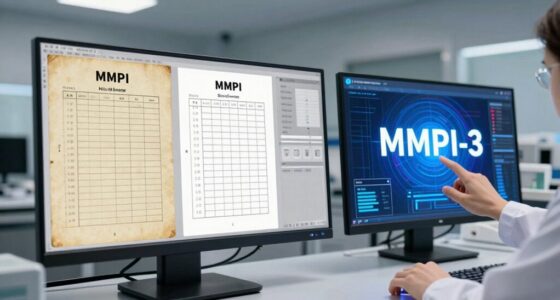

When trained professionals interpret MMPI reports, they analyze the various clinical and validity scales to identify patterns and assess emotional functioning. They carefully review elevated scores, compare them to normative data, and check validity indicators for response accuracy. By recognizing relationships across scale profiles, they gain insights into underlying traits, symptoms, and coping mechanisms. This thorough process helps inform diagnosis and treatment planning. If you want to understand how they connect all these details, keep exploring further.
Key Takeaways
- Trained professionals analyze multiple scale patterns to assess personality traits and emotional functioning comprehensively.
- They evaluate validity scales first to ensure the test results are reliable and accurate.
- Professionals interpret elevated scores as indicators of specific psychological issues or traits.
- They consider contextual background and clinical history alongside MMPI patterns for holistic understanding.
- Interpretation involves integrating scale interactions and recognizing complex psychological profiles for diagnosis and treatment planning.

Interpreting MMPI reports can seem complex at first, but understanding the key components makes the process much clearer. When a trained professional reviews these reports, they’re conducting a detailed personality assessment that goes beyond surface-level observations. The goal is to gather clinical insights that inform diagnosis, treatment planning, or understanding a person’s mental health profile. You should know that MMPI results aren’t just numbers; they’re a window into underlying psychological patterns and traits.
Interpreting MMPI reports reveals deep psychological insights that guide diagnosis and treatment.
The report typically contains several scales, each measuring different aspects of personality and psychopathology. The clinical scales, for example, highlight areas that might indicate emotional distress or mental health issues, such as depression, anxiety, or paranoia. When interpreting these, professionals look for elevated scores that suggest the presence of specific symptoms or traits. These scores aren’t interpreted in isolation—they’re compared to normative data to determine whether they reflect significant concerns or typical variations.
The validity scales are equally *essential* because they assess whether the results are accurate and reliable. These scales help clinicians identify if someone might be exaggerating symptoms, minimizing issues, or not responding consistently. If the validity scales suggest the data is compromised, the entire interpretation might need to be revisited or approached with caution. Once validity is established, the professional maps out the profile, noting patterns across multiple scales that reveal the person’s personality structure, emotional functioning, and potential areas of vulnerability.
Trained professionals also consider the individual’s background, history, and context while interpreting MMPI reports. They don’t just look at raw scores but analyze the broader picture—how different scores interact and what that combination suggests for clinical insights. For example, a high score on certain scales might point toward specific personality traits or coping mechanisms. These insights can help identify underlying issues that may not be immediately obvious through interviews alone.

A Beginner's Guide to the MMPI-2
Used Book in Good Condition
As an affiliate, we earn on qualifying purchases.
As an affiliate, we earn on qualifying purchases.
Frequently Asked Questions
How Long Does It Take to Interpret an MMPI Report?
Interpreting an MMPI report typically takes about 1 to 2 hours, depending on its complexity. Your trained professional needs sufficient time for thorough analysis, ensuring interpretation accuracy. They review the results carefully, considering your responses and patterns, which helps provide meaningful insights. Rushing this process can compromise accuracy, so expect a detailed, thoughtful interpretation that accurately reflects your psychological profile within this timeframe.
Can MMPI Results Predict Future Mental Health Issues?
You might wonder if MMPI results can predict future mental health issues, and they can, to some extent. The test’s predictive validity helps assess potential risks, aiding mental health prognosis. While it offers valuable insights, it doesn’t guarantee outcomes. Instead, it guides professionals in understanding patterns, preparing for possible challenges, and creating tailored interventions, ultimately helping you anticipate and manage future mental health needs more effectively.
Are MMPI Interpretations Affected by Cultural Differences?
Yes, MMPI interpretations can be affected by cultural differences. When trained professionals assess your results, they need to apply cultural sensitivity to avoid interpretation bias. Without considering your cultural background, test responses might be misinterpreted, leading to inaccurate conclusions. As a result, experienced clinicians adapt their analysis to account for cultural nuances, ensuring a fair and accurate understanding of your personality and mental health, regardless of your cultural context.
How Often Should Someone Retake the MMPI?
About 10-15% of people retake the MMPI within a year. You should consider retaking the test based on assessment timing, such as significant life changes or when previous results no longer reflect your current state. Usually, professionals recommend retaking the MMPI every 2-5 years if ongoing assessment is needed. Keep in mind, retake frequency depends on your unique circumstances and the purpose of the evaluation.
What Training Is Required to Become an MMPI Interpreter?
To become an MMPI interpreter, you need specific training requirements and interpreter qualifications. Typically, you must hold a relevant advanced degree in psychology or a related field, then complete specialized training in psychological assessment and MMPI interpretation. Many professionals pursue certification or supervised experience to guarantee competence. This training equips you with the skills to accurately analyze MMPI results, ensuring reliable and ethical assessments for clients.
Essentials of Cross-Battery Assessment (Essentials of Psychological Assessment)
As an affiliate, we earn on qualifying purchases.
As an affiliate, we earn on qualifying purchases.
Conclusion
Interpreting MMPI reports isn’t just about analyzing numbers; it’s about understanding the person behind them. You see the raw data, yet it’s their stories, struggles, and strengths that truly matter. While the test reveals vulnerabilities, it also highlights resilience. As a trained professional, you hold the power to turn clinical insights into hope. In this delicate balance, you transform cold data into compassionate understanding, making a profound difference in someone’s life.

Clinical Neuropsychology: A Pocket Handbook for Assessment
As an affiliate, we earn on qualifying purchases.
As an affiliate, we earn on qualifying purchases.
professional MMPI report interpretation software
As an affiliate, we earn on qualifying purchases.
As an affiliate, we earn on qualifying purchases.