
A marketing site available in 27 languages would normally arrive with a familiar collection of third-party services. Gewerkton takes a different route: zero trackers, no cookie banner and a fully egress-free architecture. That combination makes the site more than a multilingual shop window. It is a compact privacy-engineering case study for a platform built around construction evidence and the question of who controls it.

Get privacy and security gear delivered free with Prime
- Fast, free delivery on millions of items
- Prime Video, Amazon Music and more included
- Member-only deals all year
Cybersecurity & Privacy · Architecture as evidence
Privacy engineered into the route data can take
Gewerkton’s marketing site, deployment model and regional AI choice express one position: a platform built to turn construction events into evidence must make data custody a first-class feature.
A policy describes intended behaviour. Architecture determines what the system is built to do.
01 · The public proof
No cookie banner · fully egress-free · more than 51 self-produced clips and posters
02 · Data residency
Two stated deployment paths
Coordination does not require every project to accept one universal hosting model.
03 · Regional AI choice
AI providers
Bring your own key, select by project region and avoid a single permanent vendor.
04 · Decisions kept separate
Language is not residency
Teams choose how each member works, where the platform runs and which AI provider—and provider region—the project uses. Cross-border evidence can remain unambiguous without collapsing those choices into one route.
EU, US and APAC teams may participate in the same project while using their own languages.
05 · One evidence flow
“On site, what counts is what’s proven.” The architecture decides where that proof is captured, coordinated and held.
The wider product follows the same logic. Gewerkton is a voice-first construction documentation and defect management platform for global markets. It was born in the German market, where it has its deepest commercial integration through GAEB, REB, XRechnung and DATEV, but its scope extends across 27 content languages and multiple regions. Customers can choose an EU cloud or run the platform on their own infrastructure. They can also select AI providers by region, including providers in the EU, the US and Asia, including mainland China.
These are not separate talking points. The marketing site, deployment choices and AI-provider model all express the same architectural position: a platform whose job is to turn events on site into evidence must treat data custody as a first-class feature.
Gewerkton is in beta now. A public beta is planned for fall 2026.
privacy-focused web hosting services
As an affiliate, we earn on qualifying purchases.
As an affiliate, we earn on qualifying purchases.
A privacy position expressed through architecture
Privacy claims are easy to place in a footer. Architecture is harder to fake. The Gewerkton marketing site makes its position unusually visible by keeping the proposition simple: 27 languages, zero trackers, no cookie banner and a fully egress-free architecture.
The absence of a cookie banner matters because it is not presented as a cosmetic exercise. There are no trackers to explain away through layers of consent choices. The fully egress-free design takes the idea further by making the site’s lack of outward data traffic an architectural property rather than merely a promise about how collected data might later be handled.
That distinction is central to privacy engineering. A policy describes intended behaviour. An architecture determines what the system is built to do. Gewerkton’s site uses the second approach to communicate the first. Visitors encounter the company’s material without being asked to navigate a consent interface before they can read it.
The multilingual scale makes the choice more notable. This is not a sparse holding page. The site carries content in 27 languages and is supported by a media bank containing more than 51 self-produced clips and posters. Gewerkton is therefore presenting a substantial international marketing operation without falling back on trackers or a cookie banner.
The result is restraint made visible. The site does not need to turn privacy into a warning or a fear-driven pitch. Its architecture simply demonstrates that a global, media-rich presence can be designed around strict limits on egress.
As an affiliate, we earn on qualifying purchases.
Why evidence changes the data question
Gewerkton’s marketing line is direct: “On site, what counts is what’s proven.” That premise shapes more than the product interface. If a platform exists to capture and coordinate evidence, then the location, movement and custody of its data cannot be treated as secondary deployment details.
Construction records arise in practical, sometimes difficult conditions. A site team may be working across a wind farm with dead zones, coordinating many trades inside a data centre, recording a change instruction in a tunnel or completing a handover on a housing project. Gewerkton’s voice-first approach is intended to move from spoken input to structured project material, while the three product lines coordinate capture, plans, models and operations.
The evidence may include defects with a photo and deadline, dictated daywork reports, signatures on the device at handover, field-acceptance material or instructions backed by original audio. Meeting decisions can become trade-sorted task lists. Cross-border teams can work in their own languages while the evidence original remains unambiguous.
In that setting, data architecture is part of the product’s core function. The question is not only whether information can be captured, translated or coordinated. It is also where the platform operates, which infrastructure holds the project data and which AI provider is involved. Gewerkton exposes those decisions through its residency and provider choices rather than collapsing them into a single mandatory route.
As an affiliate, we earn on qualifying purchases.
Data residency by choice
The residency proposition is concise: EU cloud or your own infrastructure — your choice. That gives projects two clearly stated deployment paths without pretending that one arrangement will suit every market, company or job.
An EU cloud option provides a defined regional route. Running Gewerkton on the organisation’s own infrastructure places the deployment in its own house. The significance lies in retaining the choice. A construction platform may serve teams spread across regions, but that does not require every project to accept one universal hosting model.
This is where Gewerkton Cloud carries the architecture story. Cloud handles operations and model/data coordination between Gewerkton Field, Gewerkton Studio and third parties. It therefore sits at the point where information captured on site meets plans, models, operational workflows and outside participants.
Coordination can easily become shorthand for centralising everything under one provider’s terms. Gewerkton’s stated approach is different: coordinate the work while preserving a choice between an EU cloud and the organisation’s own infrastructure. The platform’s cloud layer is consequently not just about access to project data. It is about deciding the environment in which that coordination takes place.

As an affiliate, we earn on qualifying purchases.
Regional AI choice instead of a single gatekeeper
The same principle extends to AI. Gewerkton supports 13 AI providers through a bring-your-own-key model. Providers can be selected by region across the EU, the US and Asia, including mainland China. The stated result is no vendor lock-in.
This matters for a platform operating in 27 content languages and serving projects across Europe, the US and APAC. A multilingual product is not automatically a regionally adaptable one. Language support answers how people interact with the system. Provider selection answers a different question: which AI service the deployment uses and in which region that choice is made.
Gewerkton keeps those decisions distinct. Teams can bring their own provider keys and select a provider that fits the project’s region. That is especially relevant to projects in Asia, where Chinese, Korean and Vietnamese crews may work multilingual from capture to report while data residency remains a choice.
Regional selection also avoids treating “AI” as a single opaque dependency. The platform supports 13 providers rather than requiring one permanent vendor. That does not remove the need for a deployment decision; it makes the decision explicit. The organisation chooses the provider, supplies its own key and can align that choice with the region in which the project operates.
The architecture therefore separates several questions that are often bundled together:
- Which language does each team member use?
- Where does the platform run: an EU cloud or the organisation’s own infrastructure?
- Which AI provider is selected?
- Which provider region is appropriate: EU, US or Asia, including mainland China?
For cross-border construction, those are practical configuration questions. EU, US and APAC teams may participate in the same project, each using their own language, while the evidence original remains unambiguous. The ability to choose residency and an AI-provider region lets the project’s data stance be configured alongside its working language rather than being dictated by it.
One evidence flow across Field, Studio and Cloud
Gewerkton is one branded house with three product lines. Each covers a different part of the evidence and coordination process, and none requires the addition of a separate product family to explain the platform.
Field: capture where the work happens
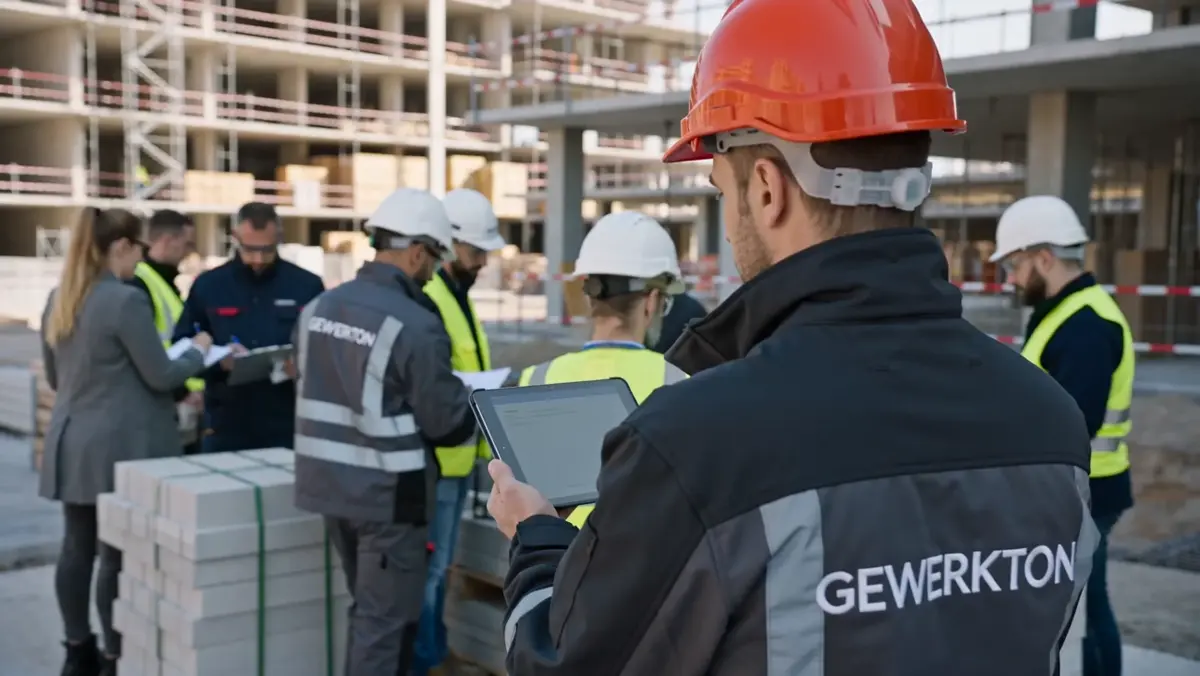
Gewerkton Field is the voice-first construction site app. It covers dictation to evidence, defects, daywork reports, takt and a portal. Its role begins at the point where a crew observes, says or confirms something on site.
That has different expressions across deployment types. Wind farms and renewable-energy projects may involve distributed sites, rotating crews, field acceptance and offline capture in dead zones. Housing and building construction may require defects with a photo and deadline, dictated daywork reports and a signature on the device during handover. Infrastructure and tunnel work can span long durations, carry many change orders and rely on instructions backed by original audio.
The consistent element is the move from activity in the field to a documented evidence trail. Voice is not merely an input convenience in that model. It is the starting point for information that must remain usable across later coordination.
Studio: plans, models and browser-based creation
Gewerkton Studio is the browser workspace for plans and models. Where no model exists, the site team can create one in the browser.
This closes a practical gap between projects that arrive with a model and those that do not. Site evidence still needs a place within the project’s visual and operational context. Studio provides the workspace for that context and allows the team to establish it when it is missing.
Cloud: the coordination layer
Gewerkton Cloud connects the operational picture. It coordinates models and data between Field, Studio and third parties. That makes it the natural focus for the platform’s privacy and custody choices: it is where distributed capture and browser-based project context meet broader operations.
Data centres and industrial plants illustrate the need. Many trades may work in parallel under tight deadlines, while decisions made in meetings become trade-sorted task lists. Cloud’s role is to coordinate the resulting information across the platform and relevant third parties. The residency choice determines whether that environment is the EU cloud or infrastructure operated by the organisation itself.
The same arrangement supports global projects without erasing regional differences. Cross-border teams can work in their own languages. Asian crews can move from capture to report in Chinese, Korean or Vietnamese. AI providers can be selected across the EU, US and Asia, including mainland China. The coordination layer remains common, but the data and provider choices are not forced into one global default.
Automation behind the build
Gewerkton is being built by a solo founder directing a fleet of coding agents using Codex and Claude. In one night, that fleet shipped 21 software packages, verified with negative controls and mutation tests.
That development model is striking, but the relevant point for this architecture story is not speed alone. The product combines a tracker-free, egress-free marketing site with a platform that spans field capture, browser-based plans and models, operational coordination, 27 content languages, 13 bring-your-own-key AI providers and two stated residency paths.
The use of coding agents sits behind that breadth. Verification through negative controls and mutation tests is part of the same reported package delivery. The fact that a solo founder directs the fleet also makes the architectural coherence easier to see: the marketing site’s stance on egress, the platform’s hosting choice and the regional AI-provider model all point in the same direction.
Privacy without theatre
There is no need to dramatise construction data to understand the design requirement. A system built around evidence should make custody visible and configurable. Gewerkton does this through concrete architectural choices rather than a fear-based message.
At the public edge, its 27-language site has zero trackers, no cookie banner and a fully egress-free architecture. At the platform layer, organisations choose between an EU cloud and their own infrastructure. At the AI layer, they bring their own keys and choose among 13 providers across the EU, US and Asia, including mainland China.
Field captures what happens on site. Studio gives plans and models a browser workspace and lets the site team create a model where none exists. Cloud coordinates operations and model/data flows between those products and third parties. Together, the three lines form an evidence platform whose data stance follows the work from capture through coordination.
Gewerkton remains in beta, with public beta planned for fall 2026. Even at this stage, its architecture makes the central proposition clear. “On site, what counts is what’s proven.” For a platform built around that idea, proof is not only about recording the event. It is also about giving the organisation a meaningful choice over where the resulting data resides and which providers participate in processing it.
Columbus Day / Indigenous Peoples' Day Picks
long weekend sales
As an affiliate, we earn on qualifying purchases.