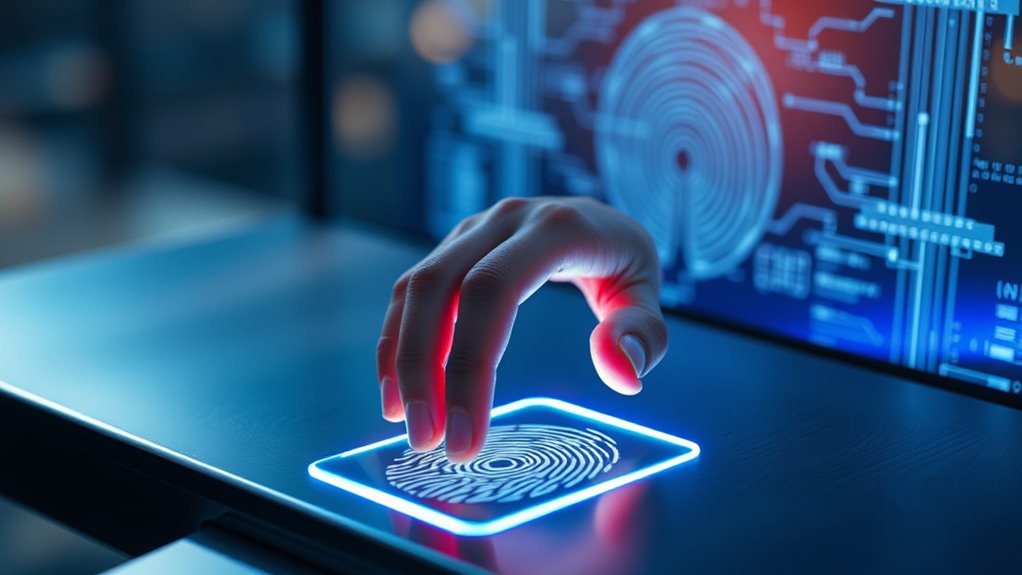
Innovations in biometric authentication are revolutionizing how you secure your digital and physical access. New methods like voice recognition analyze your speech patterns, pitch, and tone for seamless, contactless verification. Behavioral biometrics monitor your interactions, such as typing rhythm or mouse movements, providing passive, ongoing security. Combining these techniques creates multi-factor, continuous verification that’s hard to deceive. If you keep exploring, you’ll discover how these advancements are shaping a faster, more intuitive, and safer future for you.
Key Takeaways
- Integration of voice recognition and behavioral biometrics provides contactless, seamless, and more secure authentication methods.
- Advanced voice biometrics differentiate genuine voices from impersonators, enhancing security in various applications.
- Behavioral biometrics monitor ongoing user interactions like typing and mouse patterns for continuous verification.
- Multi-factor biometric systems combine voice and behavioral data for higher accuracy and resistance to fraud.
- Innovations aim to eliminate passwords and physical tokens, enabling faster, more intuitive, and secure user experiences.
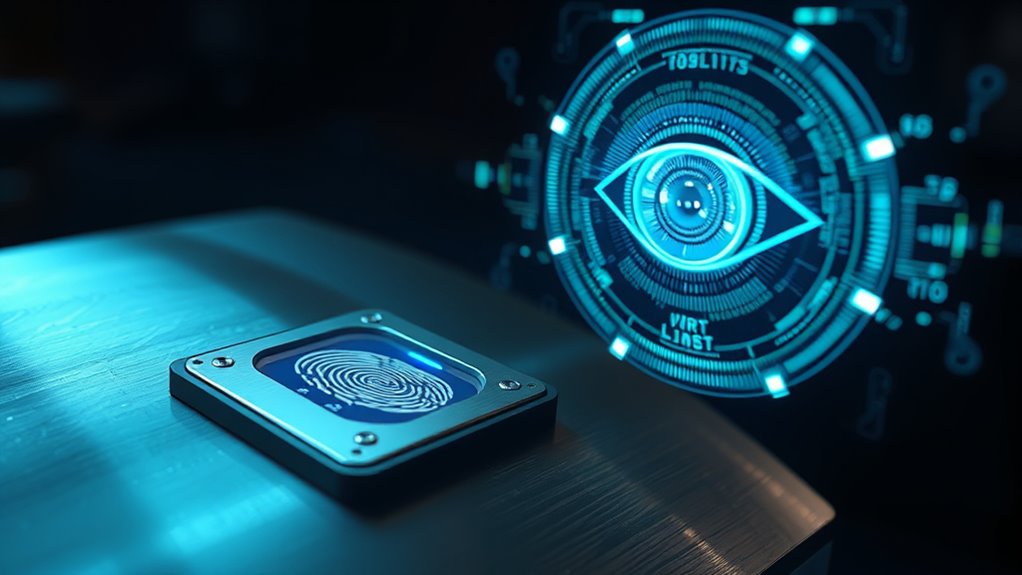
Biometric authentication has rapidly evolved, transforming the way we secure digital and physical access. Today, you can rely on advanced methods like voice recognition and behavioral biometrics to verify your identity seamlessly. Voice recognition technology analyzes the unique characteristics of your voice, such as pitch, tone, and speech patterns, making it a convenient and contactless way to authenticate yourself. This method works well in diverse environments, from unlocking smartphones to securing access to smart home devices or even authenticating customer service calls. As voice biometrics become more sophisticated, they offer a high level of security by differentiating between genuine voices and potential impersonators, reducing fraud risks substantially.
Biometric authentication, like voice recognition and behavioral biometrics, offers seamless, contactless security for digital and physical access.
Alongside voice recognition, behavioral biometrics are gaining prominence as a dynamic form of authentication that continuously monitors how you interact with devices and systems. Instead of relying on static data like passwords or fingerprints, behavioral biometrics analyze habits such as typing rhythm, mouse movements, swipe patterns, and device handling. This approach offers a passive, frictionless experience because it doesn’t require you to perform specific actions like entering a PIN or scanning a fingerprint. Instead, the system learns your unique behavioral traits over time, creating a behavioral profile that can verify your identity in real time. If your behavior unexpectedly changes—say, you’re typing differently or using the device in an unusual manner—the system flags it for further verification, adding an extra layer of security without inconveniencing you.
The combination of voice recognition and behavioral biometrics is particularly powerful because it leverages multiple factors to authenticate you more reliably. For example, when you access a secure app, the system might analyze your voice during the call and monitor your interaction patterns in the background. This multi-factor approach makes it more difficult for malicious actors to bypass security measures, as they would need to mimic both your voice and your behavioral traits convincingly. Moreover, these biometric methods are continually improving through machine learning algorithms that adapt to your changing behaviors, ensuring a high accuracy rate over time. Advancements in biometric technologies are driving the integration of these methods into mainstream security solutions.
Incorporating voice recognition and behavioral biometrics into everyday security systems not only enhances protection but also improves user experience. You no longer need to remember complex passwords or carry physical tokens. Instead, your natural voice and behavioral patterns serve as your unique identifiers, making authentication faster, more intuitive, and more secure. As technology advances, expect these innovations to become even more integrated into our daily lives, shaping a future where seamless, secure access is the standard.

Mantra MFS 110 L1 Biometric Single Fingerprint Scanner | Aadhaar Authentication Device | Latest Updated RD Service | High Securety and Fast scanning | Reliable and Durable
- Model and Type: MFS110 L1 USB Fingerprint Scanner
- Compatibility: Supports Windows, Android, Linux
- Registration: Includes 1 Year RD Service Registration
As an affiliate, we earn on qualifying purchases.
As an affiliate, we earn on qualifying purchases.
Frequently Asked Questions
What Are the Privacy Concerns Associated With Biometric Data?
You should be aware that biometric data raises privacy concerns, like data breach risks where your sensitive info could be stolen or misused. Also, consent management is vital—it’s important to know how your biometric info is collected, stored, and used, ensuring you’re in control. Without proper safeguards, your biometric data could be vulnerable, making it essential to demand transparency and secure handling from organizations that collect it.
How Do Biometric Systems Perform in Diverse Environmental Conditions?
Biometric systems generally perform well across diverse environmental conditions thanks to their environmental adaptability. Modern technologies enhance system robustness, allowing accurate authentication despite factors like lighting, temperature, or humidity. You’ll find that these systems often incorporate advanced sensors and algorithms to adjust to changing surroundings, ensuring reliable performance. While no system is perfect, ongoing innovations continue to improve their resilience, making biometric authentication more dependable in real-world, variable environments.
Can Biometric Authentication Be Easily Spoofed or Hacked?
You might worry about biometric systems being easily spoofed, and it’s true that about 20% of fake fingerprint attempts succeed if not properly secured. While facial spoofing and fake fingerprints pose risks, advanced techniques like liveness detection reduce these threats markedly. You should stay cautious, but modern biometric systems incorporate multi-layered security to protect against hacking and spoofing, making them more resilient than ever.
What Are the Costs Involved in Implementing Biometric Solutions?
You’ll find that implementing biometric solutions involves various costs, including hardware, software, and ongoing maintenance. Conducting a thorough cost analysis helps you understand the financial investment required. Deployment challenges, such as integrating biometric systems with existing infrastructure and ensuring user acceptance, can add to costs. Planning carefully helps you manage these expenses effectively, ensuring a smoother implementation process and better long-term value for your organization.
How Do Biometric Systems Handle Data Storage and Encryption?
You might think biometric data is stored plainly, but it’s protected with cryptographic protocols and data anonymization. These systems encrypt your information, making it unreadable without proper keys, and anonymize data to prevent identity leaks. While storage keeps your biometric templates secure, encryption ensures that even if data is accessed unlawfully, it remains indecipherable, safeguarding your privacy in a digital landscape where security is paramount.

GW Security 8 Channel 4K NVR 8MP Smart AI Face Recognition Surveillance Security Camera System with 4 Super HD 8MP IP PoE Microphone Dome Security Cameras, Human & Vehicle Detection
- High-Resolution Recording: 12MP 6K real-time video capture
- Weatherproof Dome Cameras: 4 x 8MP IP PoE cameras
- Built-in Microphone: Audio recording capability
As an affiliate, we earn on qualifying purchases.
As an affiliate, we earn on qualifying purchases.
Conclusion
As you step into the future, these biometric innovations act like your personal keys, revealing a world of seamless security. With each breakthrough, you’re carving a path through a digital landscape where your identity is your strongest shield. Imagine a world where your traits are the keys to endless possibilities—secure, swift, and smart. Embrace these advancements, and watch your digital life become a fortress built just for you, unbreakable and uniquely yours.

The 2027-2032 World Outlook for Behavioral Biometrics Software
As an affiliate, we earn on qualifying purchases.
As an affiliate, we earn on qualifying purchases.

Yubico – YubiKey Bio C (FIDO Edition) – Basic Compatibility – Multi-Factor authentication (MFA) Security Key and passkey, Connect via USB-C, Biometric, FIDO Certified – Protect Your Online Accounts
- FIDO-ONLY Protocol Support: Supports FIDO2 and U2F protocols
- Biometric Authentication: Fingerprint-based MFA with PIN fallback
- USB-C Connectivity: Connects via USB-C port
As an affiliate, we earn on qualifying purchases.
As an affiliate, we earn on qualifying purchases.