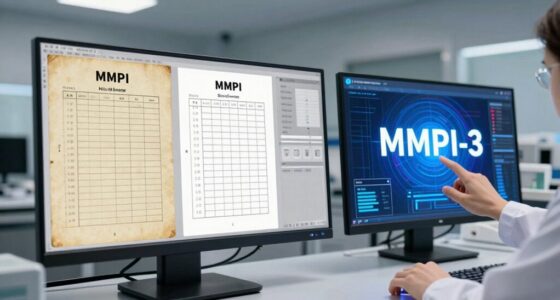

Many myths about the MMPI persist, like claims it’s overly simplistic or culturally biased. However, the test is one of the most researched personality assessments, backed by scientific validation. Developers continually update it to reduce bias and improve accuracy across diverse populations. When administered by professionals, it offers reliable, meaningful insights into psychological conditions. If you want to uncover the truth behind these misconceptions, keep exploring what makes the MMPI a respected tool in psychology today.
Open a free Amazon Business account
Business pricing, bulk buying and tax-exempt orders.
As an affiliate, we earn on qualifying purchases.
Key Takeaways
- The MMPI is often unfairly criticized as culturally biased, but ongoing updates and diverse normative data improve its fairness.
- Many believe the MMPI lacks validity, despite extensive scientific research confirming its accuracy in assessing psychological conditions.
- Critics claim the test is overly simplistic, yet it is a rigorously validated and widely used instrument in clinical and forensic settings.
- Misconceptions persist that the MMPI cannot adapt to different populations, though continuous efforts enhance its cultural sensitivity.
- The idea that the MMPI is outdated ignores ongoing research and refinements that maintain its relevance and reliability today.

Have you ever wondered if the MMPI is just a flawed or overly simplistic psychological test? Many people believe so, but the truth is more nuanced. The MMPI, or Minnesota Multiphasic Personality Inventory, is one of the most extensively researched personality assessments available. Yet, myths persist that it lacks test validity or is riddled with cultural bias. These misconceptions can make you question whether the test genuinely measures what it claims to or unfairly disadvantages certain groups. In reality, the MMPI has a strong foundation of scientific support that affirms its test validity, meaning it accurately assesses various psychological conditions when used appropriately. While no test is perfect, the MMPI’s structure and rigorous validation process make it a reliable tool for clinicians. Critics often argue that cultural bias skews results, but the developers of the MMPI recognized the importance of cultural sensitivity. They have worked continuously to adapt and update the instrument, incorporating diverse normative data to improve its fairness across different populations. This ongoing refinement aims to minimize cultural bias and guarantee that the test remains valid for individuals from various backgrounds. It’s important to understand that test validity isn’t just about whether a test works in theory but whether it produces consistent, meaningful results in practice. The MMPI’s extensive research and validation studies support its use across different clinical and forensic settings. Although some critics claim the questions are culturally biased or irrelevant, these concerns are often based on outdated information or misunderstandings about the test’s development. Modern versions of the MMPI have been carefully designed to address these issues, including cultural sensitivity initiatives that improve its applicability. It’s true that cultural bias can influence any psychological assessment, but dismissing the MMPI as inherently flawed ignores the efforts made to improve its fairness and accuracy. When administered by trained professionals, the MMPI offers valuable insights into mental health, personality structure, and psychological functioning. Its widespread acceptance and continued research demonstrate that it remains a robust, scientifically supported tool. The scientific validation behind the MMPI underscores its reliability and ongoing relevance in the field. Additionally, ongoing research continually refines and enhances the test’s accuracy, demonstrating a commitment to scientific integrity. Recognizing the rigorous validation process behind the MMPI can help dispel misconceptions about its reliability. For example, ongoing efforts to address cultural bias are part of a broader movement within psychological testing to ensure fairness and accuracy across diverse populations. So, rather than dismissing the MMPI as just another flawed test, it’s worth recognizing the rigorous scientific work behind it. The myths around test validity and cultural bias often overshadow the test’s proven reliability and ongoing improvements. As long as you understand its limitations and proper application, the MMPI can be a powerful instrument in psychological assessment, not a symbol of failure or bias.
MMPI psychological assessment kit
As an affiliate, we earn on qualifying purchases.
As an affiliate, we earn on qualifying purchases.
Frequently Asked Questions
Can the MMPI Diagnose Specific Mental Disorders?
The MMPI can’t diagnose specific mental disorders directly because it’s a personality assessment tool, not a diagnostic instrument. It helps identify patterns of thoughts, feelings, and behaviors that suggest certain issues, but it has diagnostic limitations. You should interpret MMPI results alongside other assessments and clinical interviews. So, while it offers valuable insights, it doesn’t replace thorough evaluations for diagnosing particular mental health conditions.
Is the MMPI Used for Employment Screening?
Imagine walking into an office, your future employer peering over an extensive test like the MMPI. While it’s not typically used for employment screening, some companies might employ it to assess workplace suitability or evaluate emotional stability. However, most organizations rely on interviews and background checks. The MMPI’s primary purpose remains clinical, not a standard tool for employee screening, so don’t expect it to be part of your job application process.
How Long Does It Take to Complete the MMPI?
The test duration for the MMPI typically ranges from 60 to 90 minutes, depending on your pace and the specific version administered. The completion time varies because some individuals take longer to answer, especially if they need to reflect more on certain questions. It’s important to stay focused and answer honestly. Planning for about an hour and a half guarantees you have enough time to complete the test thoroughly.
Are There Cultural Biases in the MMPI?
Think of the MMPI as a map steering through diverse cultural terrains; it does carry some cultural biases that can steer results off course. To counter this, professionals focus on cultural sensitivity and bias mitigation, ensuring the assessment respects different backgrounds. While not perfect, ongoing efforts aim to refine its fairness, making it a more reliable tool across varied populations. Your awareness helps in understanding and addressing these subtle biases.
Can the MMPI Predict Future Criminal Behavior?
The MMPI cannot reliably predict future criminal behavior due to its predictive limitations. While it assesses mental health and personality traits, using it to forecast criminal acts raises ethical concerns, as it may lead to unfair judgments or stigmatization. You should understand that the test’s primary purpose is clinical assessment, not forensic prediction, making it unsuitable for predicting specific future behaviors like criminality.
Minnesota Multiphasic Personality Inventory test
As an affiliate, we earn on qualifying purchases.
As an affiliate, we earn on qualifying purchases.
Conclusion
Don’t let myths cloud your understanding of the MMPI. Remember, the truth often lies beyond misconceptions, and “a lie can travel halfway around the world before the truth has a chance to put on its shoes.” By questioning myths and seeking accurate information, you empower yourself to make informed decisions. Keep learning, stay curious, and trust the process—because knowledge is the best tool to see through misconceptions.
professional MMPI testing materials
As an affiliate, we earn on qualifying purchases.
As an affiliate, we earn on qualifying purchases.
cultural bias reduction in psychological tests
As an affiliate, we earn on qualifying purchases.
As an affiliate, we earn on qualifying purchases.
Fall Picks
fall essentials
As an affiliate, we earn on qualifying purchases.