
To measure and report your security posture effectively, focus on key cybersecurity metrics like incident response times, vulnerability management, and overall threat detection. Use indicators such as Mean Time to Detect (MTTD) and Mean Time to Respond (MTTR) to gauge your team’s responsiveness. Regularly track vulnerabilities and remediation efforts to identify areas for improvement. Monitoring these metrics helps you make data-driven decisions, strengthen defenses, and demonstrate progress. Keep exploring to uncover more ways to enhance your cybersecurity strategy.
Key Takeaways
- Cybersecurity metrics track incident response times, vulnerability management, and overall security effectiveness to assess organizational posture.
- Key metrics like MTTD and MTTR reveal detection and response efficiency during security incidents.
- Regular vulnerability scans and remediation times measure proactive threat mitigation capabilities.
- Monitoring combined incident and vulnerability metrics supports continuous security improvement and resource allocation.
- Reporting these metrics to stakeholders enables informed decision-making and strategic cybersecurity planning.
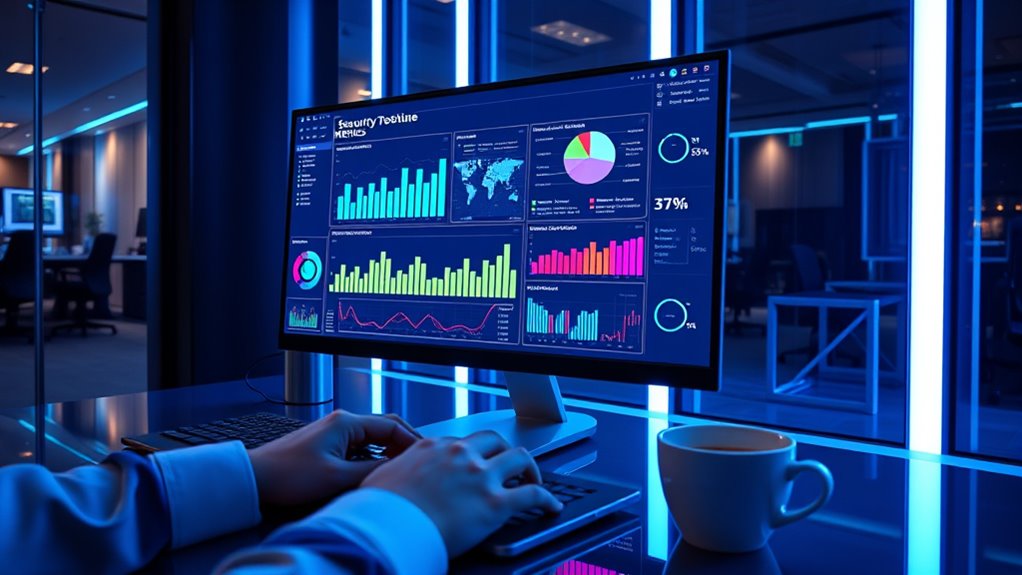
Have you ever wondered how organizations measure the effectiveness of their cybersecurity efforts? It’s a essential question because understanding your security posture isn’t just about having the right tools in place; it’s about knowing how well those tools work and where improvements are needed. One of the key ways to gauge this is through well-defined cybersecurity metrics. These metrics help you track progress, identify weaknesses, and justify security investments to stakeholders. When it comes to measuring effectiveness, two critical areas stand out: incident response and vulnerability assessment.
Measuring cybersecurity effectiveness involves tracking incident response and vulnerability assessment metrics to improve defenses.
Incident response metrics are indispensable because they reveal how quickly and efficiently your team reacts to security incidents. For example, tracking the mean time to detect (MTTD) and mean time to respond (MTTR) provides insights into your organization’s agility. A shorter MTTD indicates that your tools and processes are effective at spotting threats early, while a swift MTTR shows that your team can contain and remediate incidents rapidly. These metrics not only reflect your current capabilities but also help you prioritize resources to improve response times. Additionally, analyzing the number and types of incidents over time can indicate whether your security posture is strengthening or if new vulnerabilities are emerging.
Vulnerability assessment plays a complementary role in measuring security effectiveness. Regular vulnerability scans and assessments reveal weaknesses before attackers exploit them. You should track the number of vulnerabilities identified, the severity levels, and how quickly they’re remediated. A decreasing number of high-severity vulnerabilities over time suggests that your vulnerability management program is working well. Conversely, if vulnerabilities persist or remediation times increase, it’s a sign you need to revisit your processes. Incorporating metrics like patch deployment times and the percentage of systems up-to-date helps you assess how proactive and efficient your vulnerability management efforts are. Monitoring your security tools’ performance ensures that your defenses remain reliable and effective.
Together, incident response and vulnerability assessment metrics give you a complete picture of your cybersecurity health. They enable you to establish benchmarks, set realistic improvement goals, and measure progress over time. Reporting these metrics regularly to your team and leadership keeps everyone aligned and emphasizes the importance of continuous improvement. By actively monitoring these indicators, you’re better equipped to adapt your strategies, allocate resources wisely, and ultimately strengthen your organization’s defense against cyber threats. Remember, cybersecurity is a dynamic field, and the metrics you choose should evolve as your environment changes. Staying vigilant and data-driven ensures you’re not just reacting to incidents but proactively reducing risks and enhancing your security posture.

Digital Forensics and Incident Response: Incident response tools and techniques for effective cyber threat response
As an affiliate, we earn on qualifying purchases.
As an affiliate, we earn on qualifying purchases.
Frequently Asked Questions
How Do We Prioritize Which Metrics to Track?
You should prioritize metrics based on your risk assessment, focusing on areas with the highest vulnerabilities. Use metric alignment to guarantee each measurement directly supports your security goals. Track key indicators like incident response times, vulnerability patch rates, and user awareness levels. By aligning metrics with your organization’s risk profile, you can effectively monitor your security posture and make informed decisions to strengthen your defenses.
What Tools Are Best for Real-Time Cybersecurity Reporting?
Think of your cybersecurity dashboard as a vigilant lighthouse guiding ships through stormy seas. Tools like Splunk, IBM QRadar, and SolarWinds Security Event Manager excel at real-time threat detection and compliance tracking. They provide instant alerts and extensive dashboards, helping you respond swiftly to threats. By choosing these, you guarantee your security posture stays visible and resilient, much like a lighthouse illuminating safe passage amid turbulent waters.
How Often Should Security Metrics Be Reviewed?
You should review security metrics regularly, ideally weekly, to stay ahead of threats. Incorporate security training and compliance audits into your review cycle to make certain your organization adheres to standards and identifies vulnerabilities early. Frequent reviews help you adjust security measures promptly, maintaining a strong security posture. Consistent monitoring also reinforces a security-aware culture, making it easier to respond effectively to incidents and stay compliant with evolving regulations.
How Can Metrics Improve Incident Response Strategies?
Metrics improve your incident response strategies by highlighting weaknesses in threat detection and helping you meet compliance benchmarks. When you track response times, false positives, and attack patterns, you can identify areas for improvement. This proactive approach enables you to refine your response plans, reduce damage, and respond faster to threats. Ultimately, using clear metrics guarantees your team stays prepared and adapts quickly to evolving cybersecurity challenges.
What Challenges Exist in Standardizing Cybersecurity Metrics?
Imagine trying to build a sturdy bridge using different, inconsistent blueprints—you’d struggle to guarantee stability. Standardizing cybersecurity metrics faces similar challenges, as security benchmarks and compliance standards vary widely across organizations. You might find it difficult to compare data or set universal benchmarks, leading to gaps in security. Without clear, unified metrics, it’s tough to measure progress and enforce consistent security practices effectively across all teams.

DATA ENGINEERING DEVSECOPS AUTOMATION SYSTEMS: Secure CI/CD Pipelines Vulnerability Scanning and Automated Security Compliance
As an affiliate, we earn on qualifying purchases.
As an affiliate, we earn on qualifying purchases.
Conclusion
By tracking key cybersecurity metrics, you gain a clearer picture of your security posture. For instance, organizations that regularly monitor their threat detection and response times are 30% more likely to prevent breaches. Incorporating these metrics into your reporting helps you identify vulnerabilities and prioritize improvements. Embrace continuous measurement, and you’ll be better equipped to defend against evolving cyber threats, ensuring your security strategies are both proactive and effective.

Executive Cybersecurity & IT Risk Dashboard Workbook: 130+ Templates for Cyber Risk Management, Governance, Compliance & CISO Reporting: Board-Level … (Executive Project Governance Series)
As an affiliate, we earn on qualifying purchases.
As an affiliate, we earn on qualifying purchases.
Security Information And Event Management SIEM A Complete Guide
As an affiliate, we earn on qualifying purchases.
As an affiliate, we earn on qualifying purchases.