

To create your own cipher, start by understanding basic encryption methods like substitution and shift ciphers. Decide whether to use a simple shift (like Caesar) or design a custom substitution pattern, possibly with a keyword for added security. Make sure your cipher is consistent and easy to decode with the proper key. If you keep exploring, you’ll discover how to develop more complex and secure encryption techniques tailored to your needs.
Key Takeaways
- Decide on the type of cipher, such as substitution or transposition, based on your security needs.
- Create a unique cipher alphabet using a keyword or randomization to personalize your cipher.
- Develop clear, consistent rules for encoding and decoding messages to ensure accuracy.
- Test your cipher with different messages to identify weaknesses and refine the encryption process.
- Keep your cipher method and key secret, and consider adding error detection for enhanced security.

Confederate Army Cipher Disk – Civil War Encryption Wheels
A precision laser engraved wood version of this famous cipher which was used for the encryption of secret…
As an affiliate, we earn on qualifying purchases.
As an affiliate, we earn on qualifying purchases.
Understanding the Basics of Ciphers
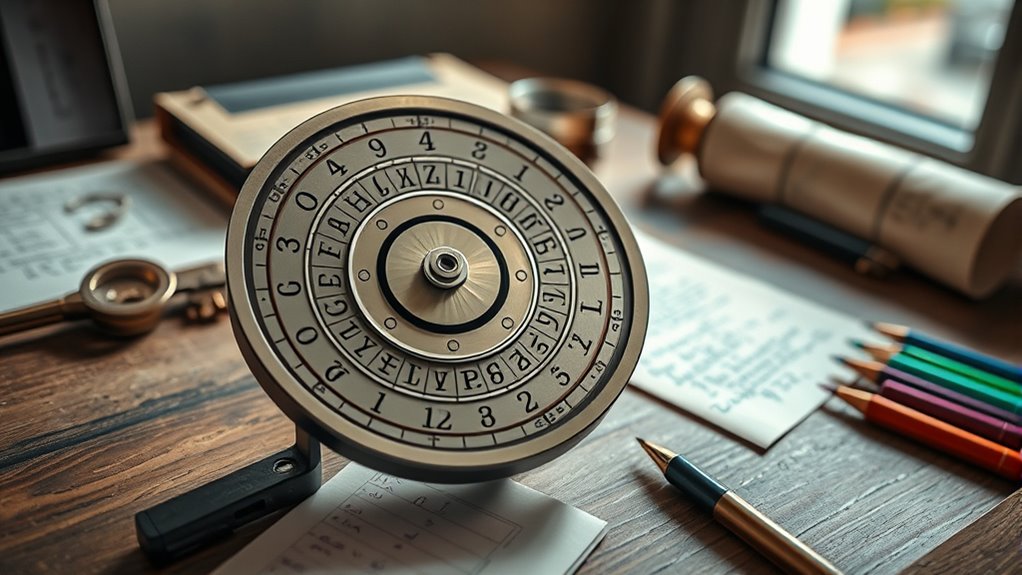
Have you ever wondered how messages can stay secret even when they’re sent over public channels? That’s where understanding ciphers comes in. Cryptography history shows that ciphers are ancient tools used to hide information, dating back to Roman times with simple substitution methods. Modern cipher applications include encrypting sensitive data like passwords, emails, and financial transactions, ensuring only authorized parties can read them. Ciphers are fundamentally algorithms that transform plain text into unreadable code, providing confidentiality. They can be as simple as shifting letters or as complex as advanced encryption standards. Grasping these basics helps you appreciate how encryption keeps your digital communications secure, laying the foundation for creating your own cipher that can protect your messages from prying eyes. Additionally, understanding the evolution of ciphers highlights the importance of security protocols in safeguarding modern communications.

KEYESTUDIO Microbit Basic Starter Kit for BBC Micro:bit V2 Accessories STEM Kit Coding for Beginners (Micro:bit V2.21 Included)
Microbit controller V2.21 is included!onboard comes with BLE, accelerometer, electronic compass, three buttons, 5 x 5 LED dot…
As an affiliate, we earn on qualifying purchases.
As an affiliate, we earn on qualifying purchases.
Choosing Your Cipher Type

When choosing your cipher type, consider whether you want symmetric or asymmetric encryption—symmetric uses the same key for locking and opening, while asymmetric uses a pair of keys. You should also decide between substitution ciphers, which replace elements, or transposition ciphers, which rearrange the order of data. Your choice depends on your security needs and how complex you want your cipher to be. Additionally, understanding the security implications of each cipher type can help you select the most effective method for your purpose.
Symmetric vs. Asymmetric
Choosing the right cipher type depends on your specific security needs and operational context. Symmetric ciphers use a single key for both encryption and decryption, offering faster processing but demanding secure key management. They tend to have lower cipher complexity, making them easier to implement but riskier if the key is compromised. Asymmetric ciphers, on the other hand, employ a public key for encryption and a private key for decryption, enhancing security by reducing key distribution concerns. However, they involve higher cipher complexity and slower performance. Your choice hinges on balancing these factors: symmetric ciphers are ideal for speed and simplicity, while asymmetric ciphers suit situations requiring secure key exchange and robust protection. Consider your security environment carefully before selecting the cipher type. Additionally, understanding encryption algorithms can help inform your decision based on their specific features and strengths.
Substitution vs. Transposition
After understanding the differences between symmetric and asymmetric ciphers, it’s important to contemplate how your cipher manipulates the message itself. Substitution ciphers replace each letter with another, creating a straightforward but potentially less secure method—think of the Caesar cipher or historical examples like the substitution cipher used in World War II. Transposition ciphers, on the other hand, reorder the letters without changing them, increasing cipher complexity and making patterns harder to detect. Choosing between the two depends on your security needs; substitution ciphers are easier to implement but less secure, while transposition ciphers add complexity. Combining both techniques can enhance security, as seen in complex historical ciphers like the double transposition cipher. Your choice shapes your cipher’s strength and resilience. Additionally, understanding the encryption methods involved can help you better evaluate the security level of your cipher.

Retroworks Secret Cipher Decoder Wheel – Jefferson Wheel
Solid Wood Craftmanship
As an affiliate, we earn on qualifying purchases.
As an affiliate, we earn on qualifying purchases.
Creating a Simple Substitution Cipher
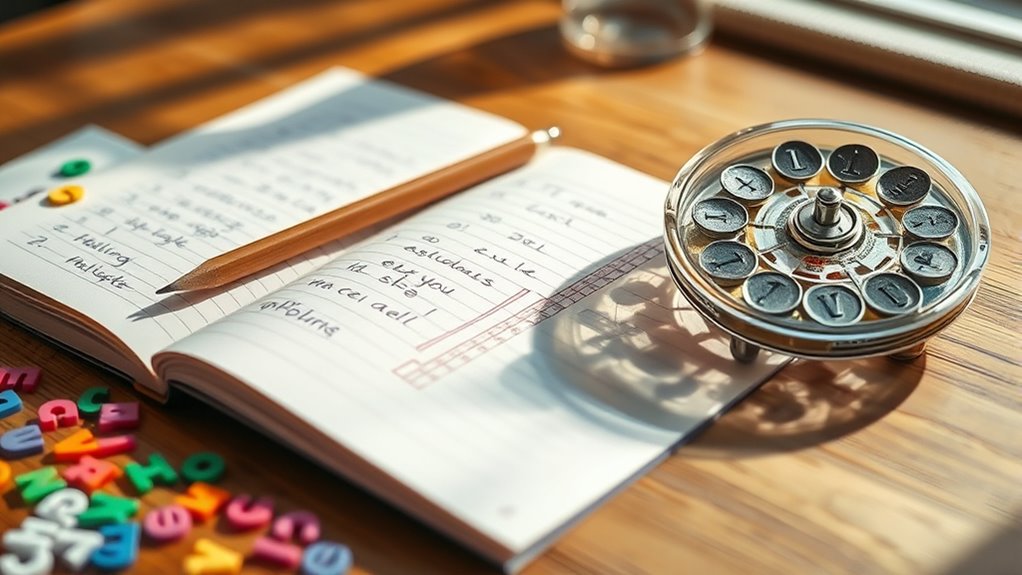
To create a simple substitution cipher, you need to decide how you’ll replace each letter. Think about the best way to map letters so your cipher remains consistent and easy to decode later. Choosing an effective substitution method is key to making your cipher both secure and manageable. Incorporating a consistent mapping ensures that the same plaintext letter is always replaced with the same ciphertext letter throughout your cipher.
Choosing the Substitution Method
A simple substitution cipher replaces each letter of the alphabet with another letter, creating a scrambled alphabet that only you know. When choosing your substitution method, consider how complex you want your cipher to be. For a basic cipher, use straightforward substitution patterns like shifting letters consistently (Caesar cipher). If you aim for more cipher complexity, create irregular patterns that vary throughout the alphabet. This not only enhances security but also makes decryption harder for others. Additionally, understanding the nutritional power of chia seeds can inspire creative ways to incorporate healthy ingredients into your diet, much like how varied substitution patterns can strengthen your cipher.
Mapping Letters Effectively
Mapping letters effectively is the key to creating a strong simple substitution cipher. To do this, you need to consider letter frequency, which reveals how often each letter appears in typical text. By analyzing letter frequency, you can make smarter choices when creating your alphabet mapping, ensuring common letters like E and T are replaced with less predictable ones. Start by listing the alphabet and assigning each letter a substitute, avoiding obvious patterns. Mix high-frequency letters with less common ones to reduce the risk of easy decryption. Remember, effective alphabet mapping balances randomness with letter frequency insights. This makes your cipher harder to crack, as it mimics natural language patterns, increasing encryption strength without complex algorithms. Incorporating Design Thinking principles can help you systematically refine your cipher for better security.
Cryptography ; Encryption and Decryption Software
As an affiliate, we earn on qualifying purchases.
As an affiliate, we earn on qualifying purchases.
Developing a Shift Cipher (Caesar Cipher)

Have you ever wondered how simple ciphers hide messages? Developing a shift cipher, also known as the Caesar cipher, is a great starting point. It involves shifting each letter by a fixed number, creating a basic level of cipher complexity. Historically, Julius Caesar used this technique to communicate secretly with his generals, making it one of the earliest examples of encryption. To create your own shift cipher:
- Choose a shift number between 1 and 25.
- Shift each letter in your message accordingly.
- Keep track of your shift to decode the message later.
This method offers a straightforward way to understand the fundamentals of encryption while appreciating its historical significance. Keep in mind, the simplicity of the Caesar cipher also means it’s vulnerable, highlighting the importance of more complex cipher designs later on. Additionally, understanding relationships and communication can help in sharing and decoding messages more effectively, especially when working with more advanced encryption methods.
Designing a Keyword-Based Cipher
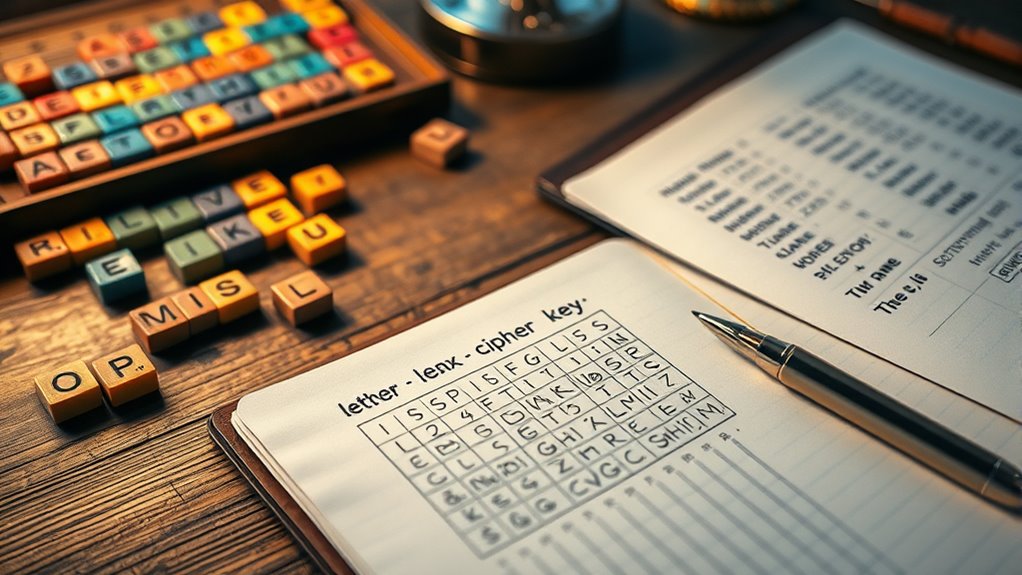
Ever wondered how to create a cipher that adds a personalized touch? Designing a keyword-based cipher allows you to customize your encryption by incorporating a secret keyword. You start by writing your keyword, then remove duplicate letters to keep it unique. Next, fill the remaining alphabet after your keyword, creating a mixed alphabet. This forms the basis of your cipher alphabet. The cipher complexity depends on your keyword choice; a more unpredictable keyword increases security. However, security considerations are vital—using common words or predictable keywords weakens your cipher. Keep your keyword secret and avoid patterns. A well-chosen keyword creates a more secure, personalized cipher, making it harder for others to decode your messages without knowing your keyword. Incorporating concepts like sound vibrations can inspire more complex encryption methods.
Encoding and Decoding Your Messages

To encode and decode your messages effectively, you need to understand how to apply your cipher alphabet to your plaintext. The process involves substituting each letter or symbol based on your cipher, balancing cipher complexity with encryption speed. Higher complexity can make your cipher more secure but may slow down encoding and decoding. To optimize your process, consider these key points: 1. Keep your cipher manageable to ensure quick encryption and decryption. 2. Use a systematic method for substituting characters to avoid errors. 3. Test different cipher complexities to find the best trade-off between security and speed. Additionally, understanding cipher strength can help you develop more robust encryption methods.
Testing and Refining Your Cipher

How can you guarantee your cipher works effectively and remains secure? Testing and refining are essential steps. You need to evaluate cipher strength by trying different message types and lengths, ensuring it resists attacks. Error correction also plays a role; incorporate mechanisms to detect and fix mistakes during encoding or decoding. Use the table below to compare aspects of your cipher:
| Aspect | What to Check | How to Improve |
|---|---|---|
| Cipher Strength | Resistance to brute-force or pattern analysis | Add complexity, more key options |
| Error Correction | Ability to detect and fix errors | Implement redundancy or checksums |
| Usability | Ease of encoding and decoding | Simplify instructions or steps |
| Security | Safeguarding against interception | Regularly update keys and methods |
Refining iteratively guarantees your cipher is both robust and practical.
Sharing and Using Your Secret Messages

Sharing your secret messages securely is crucial to maintaining their confidentiality. Throughout cryptography history, secure communication relied on simple ciphers, but modern encryption techniques now protect data more effectively. When sharing your ciphered messages, consider these key points:
- Use trusted channels to prevent interception.
- Regularly update your cipher method to stay ahead of potential threats.
- Share keys securely, avoiding exposure to unintended recipients.
Frequently Asked Questions
How Secure Are Homemade Ciphers Against Modern Cryptanalysis Techniques?
Your homemade cipher’s security largely depends on its cipher strength and the complexity you build into it. Modern cryptanalytic methods are highly advanced, often able to crack simple or poorly designed ciphers quickly. If your cipher lacks sufficient complexity, it won’t stand up against these techniques. To improve security, you should incorporate proven cryptographic principles, use long keys, and regularly assess its resilience against current cryptanalytic methods.
Can I Combine Multiple Cipher Types for Enhanced Security?
Yes, combining multiple cipher types can enhance security by increasing cipher complexity, making it harder for attackers to crack your code. However, you need to manage keys carefully, ensuring each cipher’s key remains secure and synchronized. This layered approach adds complexity but also requires diligent key management. Use strong, unique keys for each cipher, and keep track of them securely to prevent vulnerabilities.
What Are Common Mistakes to Avoid When Creating My Own Cipher?
Imagine building a fortress with open gates—your cipher faces the same risk if you ignore common pitfalls. You might overlook security oversights, making your cipher vulnerable. Avoid relying on obvious patterns, weak keys, or predictable methods. Test thoroughly, keep it simple yet secure, and don’t assume that complexity equals safety. By spotting these mistakes early, you strengthen your defenses, ensuring your secret remains safe from prying eyes.
How Do I Ensure My Cipher Is Easy for Others to Decode?
You want your cipher to be user-friendly and easy to decode intuitively. To do this, keep the design simple, avoiding complex symbols or patterns that confuse users. Provide clear instructions or hints where needed, and test it with others to guarantee they can decode it quickly. Focus on intuitive decoding, so users don’t struggle, making your cipher accessible and enjoyable to solve.
Are There Tools or Software to Help Design Custom Ciphers?
When it comes to cipher design, you don’t have to reinvent the wheel. Plenty of encryption tools are available online to help you craft custom ciphers easily. These software programs offer user-friendly interfaces, guiding you through the process and ensuring your cipher is both secure and understandable. Using these tools is like having a trusty sidekick, making the complex task of creating your own cipher much more manageable.
Conclusion
Now that you’ve built your own cipher, think of it as your secret key to a hidden world. You’ve crafted a lock only you can open, guarding your messages like a treasure chest. Keep experimenting and refining your code, turning it into a fortress that keeps prying eyes at bay. With each tweak, you’re sharpening your skills, transforming simple symbols into a powerful shield. Your secret messages are now your personal vault—secure, private, and uniquely yours.