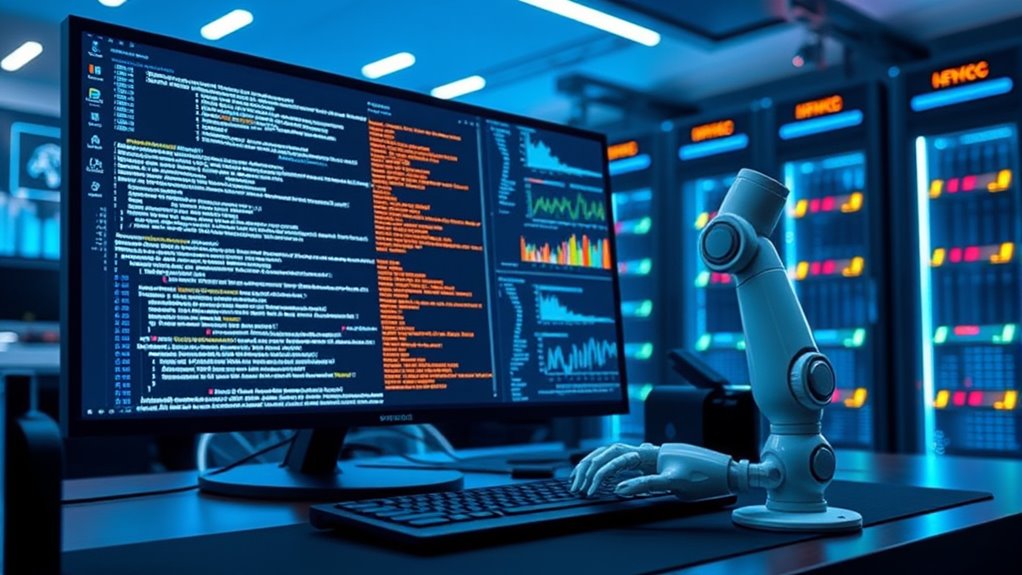

AI transforms automated code auditing by quickly detecting vulnerabilities with greater accuracy than manual reviews. It analyzes vast codebases using machine learning, recognizing subtle security issues that humans might miss. AI’s consistency ensures reliable and repeatable results, reducing errors. It continuously learns and adapts to evolving threats, providing ongoing security assessments. If you want to understand how AI can further enhance your software security processes, keep exploring the details below.
Key Takeaways
- AI accelerates vulnerability detection, enabling faster and more accurate code audits than manual reviews.
- Machine learning models adapt to new threats, improving detection of subtle or emerging security issues.
- Automated systems analyze vast codebases efficiently, reducing manual effort and human error.
- AI ensures consistent, repeatable security assessments, maintaining high standards across all codebases.
- Continuous monitoring and learning allow AI to adapt to evolving attack techniques and enhance ongoing security.

Artificial intelligence is transforming how we approach automated code auditing, making it faster and more accurate than ever before. With AI-powered tools, you can now identify vulnerabilities in your code more efficiently, reducing the risk of security breaches and ensuring higher quality software. At the core of this transformation is machine learning, which allows systems to learn from vast amounts of code and improve their detection capabilities over time. Instead of relying solely on predefined rules, these intelligent systems analyze patterns, recognize anomalies, and adapt to new threats, making vulnerability detection more robust and all-encompassing.
AI revolutionizes code auditing with faster, more accurate vulnerability detection through adaptive machine learning.
When you use AI in code auditing, you benefit from its ability to scan through millions of lines of code quickly and accurately. Traditional methods often require manual review, which is time-consuming, prone to human error, and limited by the reviewer’s expertise. AI-driven tools, however, can automate large portions of this process, flagging potential security issues almost instantaneously. They do so by leveraging machine learning algorithms trained on extensive datasets of secure and insecure code, enabling them to identify subtle signs of vulnerabilities that might escape human eyes. This proactive approach means you catch issues early, before they can be exploited by malicious actors.
Vulnerability detection becomes more precise with AI because it continually learns from new data and evolving attack techniques. As new vulnerabilities are discovered and feeding into the training data, the system’s ability to recognize similar patterns improves. This dynamic learning process ensures that your code is scrutinized against the latest security threats, providing a level of protection that static, rule-based tools can’t match. Furthermore, AI can prioritize detected issues based on their severity, helping you focus on fixing the most critical vulnerabilities first, which optimizes your development workflow.
You’ll also find that AI enhances the consistency of vulnerability detection. Human reviewers, no matter how diligent, can miss issues or interpret code differently. AI systems, once trained, apply the same standards uniformly across all code bases, reducing the chance of oversight. This consistency means you get reliable, repeatable results every time you run an audit. Additionally, as your codebase grows and evolves, AI tools adapt, providing ongoing, real-time security assessments without requiring extensive manual intervention. Moreover, ongoing monitoring of AI behavior is crucial to ensure safety and reliability in sensitive applications.

XTOOL Advancer AD20 Pro AI-Assisted Wireless OBD2 Scanner Diagnostic Tool, Car Code Reader for iPhone&Android, All System Scan Tool with Free Updates -Check Engine, Oil Reset, Performance/Battery Test
【NO Subscriptions & Wide Vehicle Support】 AD20PRO OBD2 Scanner is built for simple, long-term ownership with no ongoing…
As an affiliate, we earn on qualifying purchases.
As an affiliate, we earn on qualifying purchases.
Frequently Asked Questions
How Does AI Handle False Positives in Code Audits?
AI handles false positives in code audits through false positive mitigation techniques that refine its detection process. It learns from past errors, continuously improving accuracy, so you get fewer false alerts over time. By analyzing patterns and context, AI reduces unnecessary flags, allowing you to focus on genuine issues. This ongoing accuracy improvement helps streamline your auditing process, saving you time and increasing confidence in the results.
Can AI Identify All Types of Security Vulnerabilities?
AI can’t identify all types of security vulnerabilities because machine learning models focus on patterns and known issues. While vulnerability detection improves with AI, some vulnerabilities remain undetected due to limited training data or novel attack methods. You should combine AI tools with manual reviews to maximize coverage. This way, you reduce the risk of missing critical security flaws that could compromise your system.
What Are the Limitations of AI in Code Review Processes?
You should know that AI in code reviews isn’t perfect; it struggles with bias mitigation and contextual understanding. Studies show that AI tools can miss nuanced security issues or generate false positives, especially when code context is complex. While AI accelerates reviews, it can’t fully grasp developer intent or adapt seamlessly to new coding patterns, meaning human oversight remains essential for thorough, accurate assessments.
How Does AI Evolve With New Programming Languages?
You see AI evolves with new programming languages through continuous learning and adaptation. As you introduce fresh code, AI systems face programming language adaptation challenges, requiring updates to understand syntax and patterns. Over time, AI learning curves improve as models are retrained with new language data, enabling more accurate code reviews. This ongoing process guarantees AI remains effective and relevant, keeping pace with the rapid evolution of programming languages.
What Are the Ethical Considerations in Automated Code Auditing?
You might believe AI removes human responsibility, but ethical concerns highlight that developer accountability remains essential. Automated code auditing must mitigate biases that can unfairly target certain groups or overlook vulnerabilities. You should ensure transparency in AI decision-making processes and regularly review algorithms to prevent bias. By doing so, you uphold fairness, trust, and responsibility while leveraging AI’s efficiency, emphasizing that technology complements human judgment rather than replaces it entirely.
Doxie Go SE – The Intuitive Portable Document Scanner with Rechargeable Battery and Easy Software for Home, Office, or Work from Home
【Go Paperless】Doxie Go SE delivers smart, simple scanning that you can take anywhere – no computer required. Doxie's…
As an affiliate, we earn on qualifying purchases.
As an affiliate, we earn on qualifying purchases.
Conclusion
As you leverage AI for automated code auditing, you’ll find it substantially boosts efficiency and accuracy. Studies show AI can detect vulnerabilities up to 60% faster than traditional methods, saving you time and reducing risks. Embracing this technology means you stay ahead in maintaining secure, high-quality code. So, don’t wait—integrate AI into your workflow and experience the transformative impact it can have on your development process.

Machine Learning for High-Risk Applications: Approaches to Responsible AI
As an affiliate, we earn on qualifying purchases.
As an affiliate, we earn on qualifying purchases.

Development Board Iot Security Tool with 64 Scripts Fix System Vulnerabilities for Users
[Robust Offensive Capabilities] Capable of executing multiple attacks including password cracking and malware propagation for enhanced security testing.
As an affiliate, we earn on qualifying purchases.
As an affiliate, we earn on qualifying purchases.