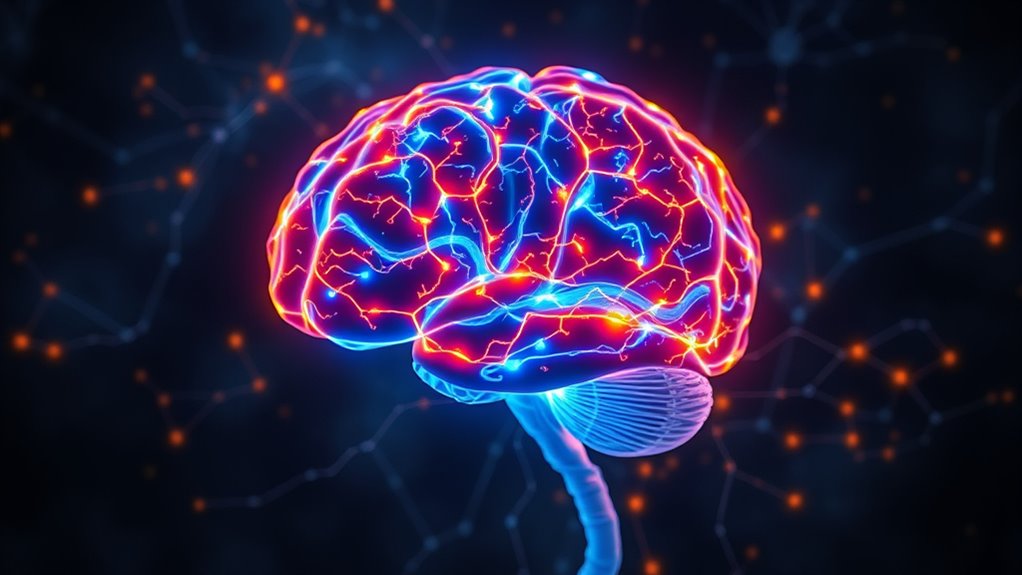

Your brain’s neuroplasticity allows you to adapt and strengthen neural pathways that promote resilience against stress. By consistently practicing emotional regulation tools like mindfulness and deep breathing, you shape your brain to respond more calmly over time. This ongoing rewiring helps you perceive stressors as manageable, making your responses more flexible and resilient. If you want to understand how this process works in detail, there’s more to explore about the science behind cognitive resilience and stress.
Key Takeaways
- Neuroplasticity allows the brain to rewire neural pathways, enhancing resilience to stress through repeated emotional regulation practices.
- Strengthening circuits associated with calmness and pruning maladaptive pathways improves stress response flexibility.
- Techniques like mindfulness and cognitive reframing reinforce neural responses that promote emotional stability under stress.
- The brain’s capacity for adaptation supports ongoing development of automatic, resilient responses to stressors.
- Regular mental and physical activities facilitate neural rewiring, making stress management more effective over time.

Have you ever wondered why some people handle stress better than others? The answer often lies in their brain’s ability to adapt through neuroplasticity. Neuroplasticity adaptation is your brain’s way of reshaping itself in response to experiences, including stressors. When you face stressful situations, your brain doesn’t just react instinctively; instead, it can rewire itself over time to manage future challenges more effectively. This process involves strengthening certain neural pathways and pruning others, making your responses more resilient and adaptable. The more you practice emotional regulation—controlling your emotional responses— the better your brain becomes at managing stress. Emotional regulation isn’t just about suppressing feelings; it’s about understanding and redirecting them in a healthy way. When you learn to regulate your emotions, you’re fundamentally training your brain to respond more calmly and thoughtfully, which enhances your overall cognitive resilience.
Your brain’s capacity for neuroplasticity means that even if you’ve struggled with stress in the past, you can still improve. This improvement hinges on consistent practice of emotional regulation techniques, such as mindfulness, deep breathing, or cognitive reframing. These strategies help you create new neural pathways, reinforcing healthy responses and diminishing the impact of stress. As your brain adapts through neuroplasticity, you become more skilled at perceiving stressors as manageable rather than overwhelming. This shift doesn’t happen overnight, but with deliberate effort, your brain rewires itself to handle stress more efficiently, making you more resilient in the face of future challenges.
Furthermore, neuroplasticity adaptation supports the development of emotional regulation by enabling your brain to modify its responses based on experience. For example, if you’ve learned to pause and breathe during stressful moments, your neural circuits associated with calmness become stronger. Over time, these responses become automatic, helping you stay composed even in high-pressure situations. This process illustrates how your brain’s flexibility allows for continuous growth and resilience, regardless of past struggles. It’s empowering to realize that your capacity for emotional regulation isn’t fixed but can be cultivated through intentional effort. By embracing neuroplasticity, you’re actively shaping how your brain reacts to stress, ultimately boosting your cognitive resilience and your ability to thrive despite adversity. Additionally, engaging in regular mental and physical activities can further promote brain adaptability, supporting your overall resilience and well-being.

Retrospec Sedona Zafu Meditation Cushion Filled w/Buckwheat Hulls – Yoga Pillow for Meditation Practices – Machine Washable 100% Cotton Cover & Durable Carry Handle, Crescent, Black
NATURAL COMFORT & SUPPORT: Filled with sustainable buckwheat hulls, this meditation cushion elevates your practice by aligning your…
As an affiliate, we earn on qualifying purchases.
As an affiliate, we earn on qualifying purchases.
Frequently Asked Questions
Can Cognitive Resilience Be Improved With Specific Training?
Yes, you can improve cognitive resilience with specific training. Engaging in mindfulness training helps you stay present and manage stress better, boosting resilience. Additionally, cognitive exercises like puzzles or memory games challenge your brain, strengthening its ability to adapt under pressure. Regular practice of these activities can make your mind more resilient, helping you bounce back faster from stress and maintain focus in difficult situations.
How Does Chronic Stress Impact Brain Structure Over Time?
Chronic stress can reshape your brain more dramatically than a hurricane hits a coastline. Over time, it hampers neuroplasticity, making it harder for your brain to adapt and recover. This ongoing stress can lead to stress-related neurodegeneration, shrinking critical areas like the hippocampus and prefrontal cortex. The long-term impact is a decline in cognitive resilience, leaving you more vulnerable to mental health issues and cognitive decline as your brain’s structure weakens.
Are There Genetic Factors Influencing Stress Response and Resilience?
Genetic predispositions play a significant role in your stress response and resilience. Variations in stress gene regulation can make some individuals more susceptible to stress and less resilient, while others naturally handle stress better. Your genes influence how your body and brain react to stressors, impacting hormone release and neural pathways. Understanding these genetic factors helps explain why some people bounce back quickly, and others struggle under pressure.
What Are the Most Effective Lifestyle Changes to Boost Resilience?
Think of resilience as a muscle you can strengthen. You should practice mindfulness regularly to stay grounded amid chaos and build mental stamina. Maintaining strong social support networks acts like a safety net, catching you when stress levels rise. Prioritize sleep, exercise, and healthy eating to fuel your resilience. These lifestyle changes empower you to bounce back faster from challenges and keep stress in check.
How Does Sleep Quality Affect Stress Management and Cognitive Function?
Good sleep quality directly impacts your stress management and cognitive function. Prioritizing sleep hygiene, such as maintaining a consistent sleep schedule and creating a calming bedtime routine, helps you fall asleep faster and improves sleep quality. Dream patterns, especially REM sleep, support emotional regulation and memory consolidation. When you get restful sleep, your brain can better handle stress and perform cognitive tasks efficiently, making resilience stronger overall.

Breathing Exercise Cards for Kids, Deck for Classroom, Calm Down Corner Kit, Sensory Room, Social Emotional Yoga Games for Kids, Mindfulness Tools for Play Therapy, or Relaxation
*Award-Winning* 34 Colorful and Beautifully Poses Illustrated Cards: You can use this yoga for kids cards during brain…
As an affiliate, we earn on qualifying purchases.
As an affiliate, we earn on qualifying purchases.
Conclusion
Understanding the science behind cognitive resilience helps you see stress as a storm you can weather. By nurturing your brain’s flexibility and adopting healthy habits, you build a sturdy ship that’s ready for turbulent seas. Remember, resilience isn’t just a shield—it’s a muscle that grows stronger with use. So, keep learning, stay adaptable, and face challenges head-on. Your mind is a garden; tend it well, and you’ll flourish even in the harshest conditions.

Worry for Nothing: Guided Anxiety Journal, Cognitive Behavioral Therapy Mental Health Journal, Anxiety Relief & Self Care, Journal for Men & Women, Mental Health Gifts
IMPROVES MENTAL HEALTH: Use this journal to improve mindfulness, uncover triggers, track physical and emotional sensations, document your…
As an affiliate, we earn on qualifying purchases.
As an affiliate, we earn on qualifying purchases.

Brain Jump – Brain training and education for kids with Ned the Neuron. Games focus on cognitive skills including memory, attention, and concentration.
** Full Version Features **
As an affiliate, we earn on qualifying purchases.
As an affiliate, we earn on qualifying purchases.