
TL;DR

Get privacy and security gear delivered free with Prime
- Fast, free delivery on millions of items
- Prime Video, Amazon Music and more included
- Member-only deals all year
Anthropic’s $965 billion valuation and $65 billion raise aren’t just hype—they signal a focus on expanding compute capacity. This move aims to outpace competitors by investing heavily in infrastructure to meet soaring demand for Claude.
When a startup hits a $965 billion valuation, most people think about hype or market mania. But behind Anthropic’s eye-popping numbers is a story about infrastructure—more chips, more servers, more capacity. This isn’t just a funding round; it’s a strategic leap to dominate the compute landscape that fuels AI’s future.
Imagine trying to build a skyscraper without enough steel or concrete. That’s what AI companies face today: a bottleneck in compute capacity. Anthropic’s latest round is a clear sign that the real game isn’t just about product features or brand names—it’s about owning enough raw power to train and serve the next wave of giant models, which requires significant compute infrastructure.
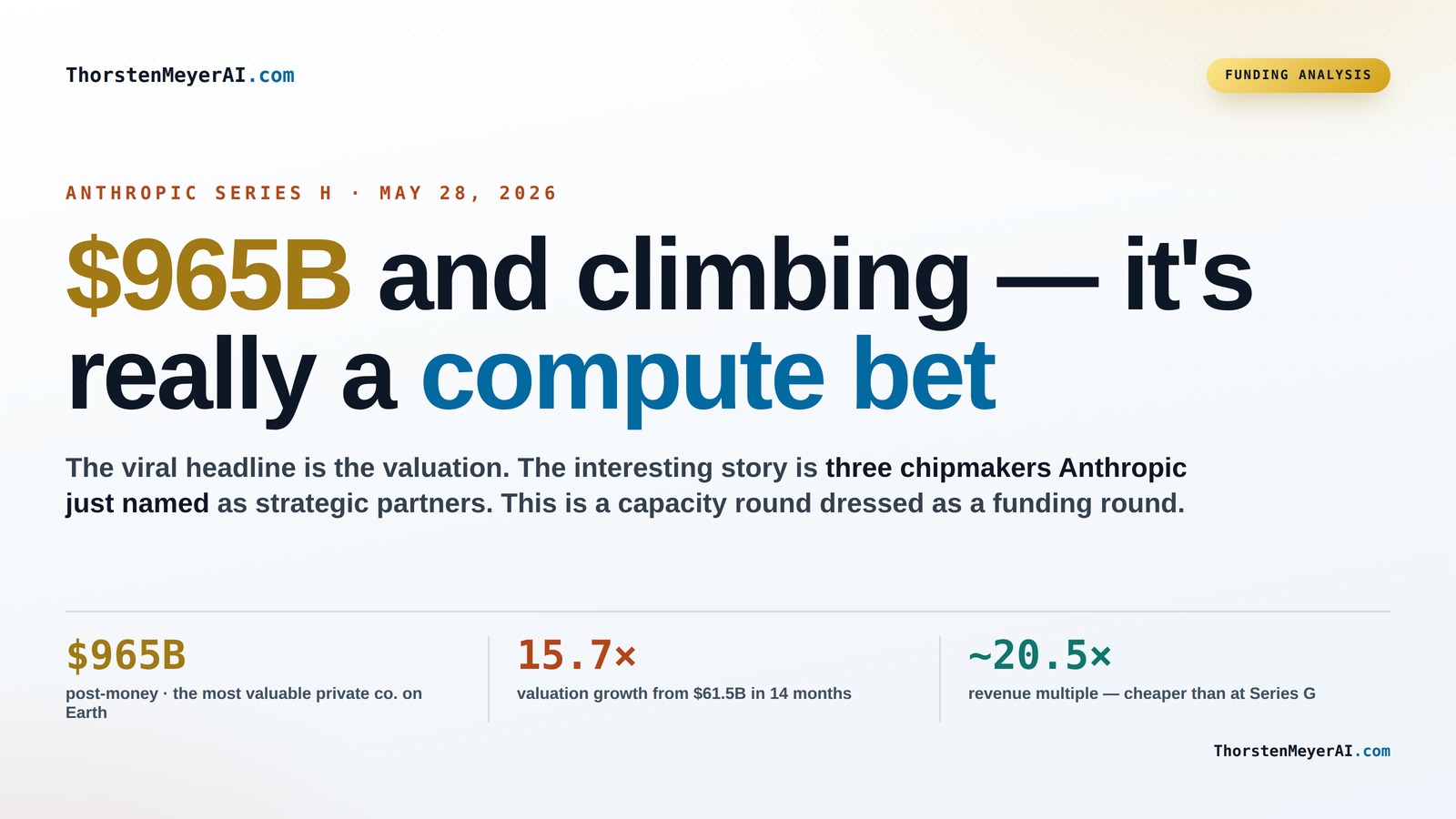
$965B and climbing — it’s really a compute bet
The viral headline is the valuation. The interesting story is in the press release’s middle paragraphs — and in three chipmakers Anthropic just named as strategic partners. This is a capacity round dressed as a funding round.
The numbers nobody can quite parse in sequence
Read together they describe a trajectory with no precedent in enterprise software. Read individually, each looks like a typo.
From $61.5B to $965B in fourteen months
Salesforce took roughly two decades to reach revenue numbers Anthropic just blew past. The sequence below is the part most coverage skips — it’s not the size, it’s the shape.
Anthropic’s valuation ladder · Mar 2025 → May 2026
Five rounds, fourteen months. Bar height is the valuation; the climb itself is the story. Tap any milestone for context.
The multiple actually got cheaper
Bubbles look like multiples expanding while revenue lags. Anthropic’s pattern is the inverse — the valuation tripled, but revenue grew faster, and the multiple compressed.
Revenue-to-valuation multiple · Series G → Series H
Same company, three months apart. The denominator (revenue) is outrunning the numerator (valuation) — exactly the opposite of what a bubble narrative predicts.
10+ gigawatts and three chipmakers
When you name Micron, Samsung & SK hynix alongside your equity backers, you’re saying the binding constraint isn’t demand or model quality — it’s the physical supply of memory chips. The Series H is a capacity round.
Compute commitments backing Anthropic’s capacity bet
$200B+ in announced compute spend across multi-year contracts. The $65B Series H raise has to be read against that bill, not against operating losses.
A genuinely durable bet — or a structural exposure?
Both readings can be true at once. The answer arrives over the next 18–24 months as the gigawatts come online and either fill with paying demand or don’t.
Revenue growth has no precedent in B2B software ($1B → $47B in 17 months). The multiple is compressing, not expanding. Claude is the only frontier model on all 3 major clouds. Enterprise AI spend share went from ~10% to >65% in a year. Compute commitments are tied to specific contracts with capacity dates.
20× revenue is not cheap by any historical software-investing standard. Revenue is reported gross of cloud-reseller pass-throughs, which inflates the top line. Profitability is 2 years out. Amodei’s own warning: a 12-month delay in AI progress “would make him bankrupt” — the compute commitments are a structural exposure to demand persistence.
The valuation race — and the IPO context
Anthropic shipped Opus 4.8 the same morning as Series H — not a coincidence. One week after OpenAI filed confidentially for IPO. The late-2026 frame is set: two frontier AI companies racing to public markets, each pitching durability.
Key Takeaways
- Anthropic’s $65 billion raise is primarily a capacity bet, aimed at expanding compute infrastructure, not just a valuation play.
- Rapid revenue growth—surging from $9 billion to over $30 billion in months—shows commercialization is accelerating faster than many expected.
- The multiple compression from 27x to 20.5x demonstrates that scale and infrastructure are more critical than ever, challenging traditional valuation metrics.
- Partnerships with chipmakers and hyperscalers reveal that owning physical compute resources is now a strategic competitive advantage.
- This infrastructure focus signals a shift in AI funding: the race for raw power may determine who leads the next era of AI dominance.
As an affiliate, we earn on qualifying purchases.
Why ‘compute’ is the secret fuel behind Anthropic’s huge valuation
Anthropic’s valuation is less about how much revenue it makes today and more about how much raw compute power it can access tomorrow. Think of it like owning the land and materials needed to build a city. The more chips and servers you have, the bigger your future empire.
Recently, Anthropic announced a $65 billion raise, but the real takeaway is its focus on expanding compute capacity. The company has lined up chipmakers like Micron, Samsung, and SK Hynix as strategic partners, pledging over 10 gigawatts of compute capacity. That’s enough to run thousands of massive models simultaneously, a true game-changer.
Why does this matter? Because in AI development, compute isn’t just a resource—it’s the foundation for innovation. The ability to quickly train larger, more complex models depends on having vast, scalable infrastructure. Without it, progress stalls, and the competitive edge diminishes. The tradeoff, however, is substantial; investing in this capacity requires enormous capital and long-term commitment, which can strain financials but is essential for staying ahead.

high performance GPU for AI training
As an affiliate, we earn on qualifying purchases.
As an affiliate, we earn on qualifying purchases.
How Anthropic’s revenue growth rewrote the valuation story
Anthropic’s revenue skyrocketed from about $9 billion at the end of 2025 to over $30 billion in 2026, a nearly 3.5x jump in just a few months. That’s faster growth than most public tech giants see over years. It’s a sign that demand for Claude is exploding, and that scaling compute is the key to unlocking even bigger revenue.
In fact, their revenue growth is so rapid that the valuation multiple has actually shrunk—despite the price tag soaring. At $965 billion valuation and $47 billion in run-rate revenue, their multiple is around 20.5x—lower than before, and cheaper than OpenAI’s estimated 30x. This indicates that investors are increasingly valuing the company’s infrastructure potential over current size. The implication? Rapid revenue growth, fueled by aggressive infrastructure scaling, can lead to a more sustainable and attractive valuation multiple, as it signals future capacity to dominate the market. However, it also underscores the risk: if infrastructure investments don’t keep pace with revenue, the valuation could become unsustainable, making continuous capital infusion critical for maintaining growth momentum.

AI compute infrastructure hardware
As an affiliate, we earn on qualifying purchases.
As an affiliate, we earn on qualifying purchases.
What a $65 billion investment actually buys in AI hardware and cloud capacity
It’s easy to think of $65 billion as just a big number, but in the world of AI infrastructure, it’s actual physical hardware and cloud capacity. Imagine thousands of high-performance GPUs—each costing hundreds of thousands—spinning in data centers. That’s what this money will fund.
For example, if you buy a top-tier GPU server, you spend around $150,000. With $65 billion, you could theoretically buy hundreds of thousands of these servers—enough to run some of the most demanding AI models in the world. Plus, this includes the costs of data centers, cooling, and power infrastructure.
Why is this important? Because the scale of hardware and cloud capacity directly correlates with the ability to train larger models faster and more efficiently, which is a key focus in AI infrastructure development. The tradeoff lies in the enormous capital expenditure and operational complexity. Building this infrastructure requires careful planning, long-term investment, and strategic partnerships, but it’s the only way to sustain the rapid growth needed to stay competitive in AI. The implications are clear: those who control vast compute resources will have a decisive advantage, enabling them to push the boundaries of AI capabilities and accelerate innovation cycles.

As an affiliate, we earn on qualifying purchases.
The chipmakers and cloud giants: the real players behind the scenes
Anthropic’s strategic partners—Micron, Samsung, SK Hynix—are not just suppliers; they’re co-players in this infrastructure race. These chipmakers are ramping up production of high-performance memory and processors that power the world’s largest AI models.
Meanwhile, hyperscalers like Amazon, Microsoft, and Google are providing cloud capacity that acts as the backbone for training and serving models. The round includes over $15 billion of committed hyperscaler money, showing how critical cloud infrastructure is for AI growth.
Why does this matter? Because it highlights that AI’s future isn’t just about the models or algorithms—it’s about the underlying hardware and cloud ecosystem. These components are the enablers of scale, and their availability determines how quickly and efficiently AI companies can grow. The tradeoff? Dependence on these giants means strategic partnerships are crucial, and any disruption in supply or capacity can slow down progress. The ecosystem’s complexity underscores that success depends not only on innovation but also on securing reliable, scalable infrastructure supply chains.

Does size really matter? Comparing Anthropic and OpenAI’s valuation and revenue
| Aspect | Anthropic | OpenAI |
|---|---|---|
| Valuation | $965 billion | $852 billion (March 2026) |
| Run-rate revenue | $47 billion | $13 billion (2025) |
| Revenue multiple | 20.5x | ~65x |
| Growth rate | Explosive, 5.4x in 14 weeks | Steady, but slower |
Despite being valued higher, Anthropic trades at a lower multiple than OpenAI, thanks to its rapid revenue growth and focus on scaling infrastructure. This comparison demonstrates that raw size alone doesn’t determine leadership; speed of growth, capacity, and strategic investments in infrastructure are equally, if not more, important. The tradeoff is that a larger valuation can sometimes mask underlying risks—if infrastructure investments don’t keep pace, the perceived advantage diminishes. Conversely, a focus on scalable infrastructure can provide a sustainable competitive edge, allowing faster expansion and more resilient valuation metrics.

What does all this mean for Claude users and AI’s future?
For Claude users, this massive funding means faster updates, more features, and better safety controls. But more importantly, it signals that the infrastructure behind Claude is expanding rapidly, enabling more robust and accessible AI services. For the industry, it underscores that the true battleground isn’t just the models themselves but the underlying compute capacity that makes these models possible. This shift could lead to more democratized AI, with greater availability and lower costs, but it also raises questions about the concentration of power among a few infrastructure giants. The tradeoff is that as infrastructure becomes more critical, smaller players may struggle to keep up, potentially consolidating power and slowing innovation at the edges.
Looking ahead, the future of AI hinges on how effectively these infrastructure investments translate into real-world capabilities. As compute capacity grows, models like Claude could become embedded in everyday life, from personalized assistants to autonomous systems. The key question remains: who will control the most powerful compute resources that determine AI’s trajectory?

The big picture: AI’s infrastructure arms race is just getting started
This isn’t just about one company’s valuation. It’s a signal that AI’s future depends on who controls the most compute. As Anthropic and others pour billions into chips and cloud capacity, the winners will be those who can sustain rapid scaling and continuously innovate their infrastructure. This ongoing arms race will shape the entire AI ecosystem, with the most capable players gaining a decisive advantage.
It’s like a high-stakes game of chess, with each move aimed at capturing more territory—more compute, more data, more models. The real prize? Dominance in the AI economy of the coming decades, where the ability to rapidly scale and adapt will determine market leaders. The implications extend beyond technology, influencing geopolitics, economics, and societal power structures, as control over AI infrastructure becomes a strategic asset.
Frequently Asked Questions
Why is Anthropic valued at $965 billion?
The valuation reflects expectations of massive future revenue driven by expanding AI demand, especially as they massively scale compute infrastructure to support models like Claude.Why does an AI company need $65 billion?
Because AI models require immense compute power—thousands of high-end GPUs, vast data centers, and cutting-edge chips—costing billions just to build and operate at scale.What does ‘compute’ mean in this context?
It refers to the hardware—GPUs, TPUs, memory chips, data centers—that powers training, fine-tuning, and deploying large AI models. More compute means bigger models and faster growth.How much of this money goes to chips and cloud infrastructure?
A significant portion—potentially over half—funds chip manufacturing and cloud capacity, enabling rapid scaling and deployment of AI services on a global scale.Is Anthropic profitable, or is revenue growth masking losses?
While revenue is soaring, the company’s focus on infrastructure and safety likely means heavy investments are still underway. Profitability isn’t the primary goal yet—scaling is.Conclusion
What you’re seeing isn’t just a valuation headline—it’s a blueprint for AI’s future. Building massive compute capacity will decide who leads in the AI economy, and Anthropic’s move marks a clear shift toward infrastructure dominance.
Think of it as laying the foundation for a new skyscraper—without enough steel and concrete, no matter how tall the design, it’s doomed to fall. In AI, compute is that steel. The question is: how much are you willing to invest in the backbone of tomorrow’s intelligence?

Fall Picks
fall essentials
As an affiliate, we earn on qualifying purchases.