
TL;DR
Prime for Young Adults — start your free trial
Fast free delivery, streaming and member deals for eligible 18–24 year olds.
Try it freeAs an affiliate, we earn on qualifying purchases.
Mistral’s focus on sovereignty, open weights, and full-stack control suggests it’s playing a different game—targeting European enterprises and regulated markets—rather than chasing model size or raw performance. Its real strength may lie in strategic independence and trust.
Some startups chase the latest AI model leaderboard. Others, like Mistral, seem to be playing a different game entirely. At its recent AI Now Summit in Paris, Mistral didn’t unveil a groundbreaking new model but shifted focus toward sovereignty, control, and full-stack deployment. That’s a bold move, and it raises a critical question: is Mistral truly ahead with a strategic insight, or is it already behind in the race for frontier AI?
In this article, we’ll unpack what Mistral is really doing—its push for European independence, open weights, and enterprise control—and whether those moves position it for long-term success or just a different kind of fallback.
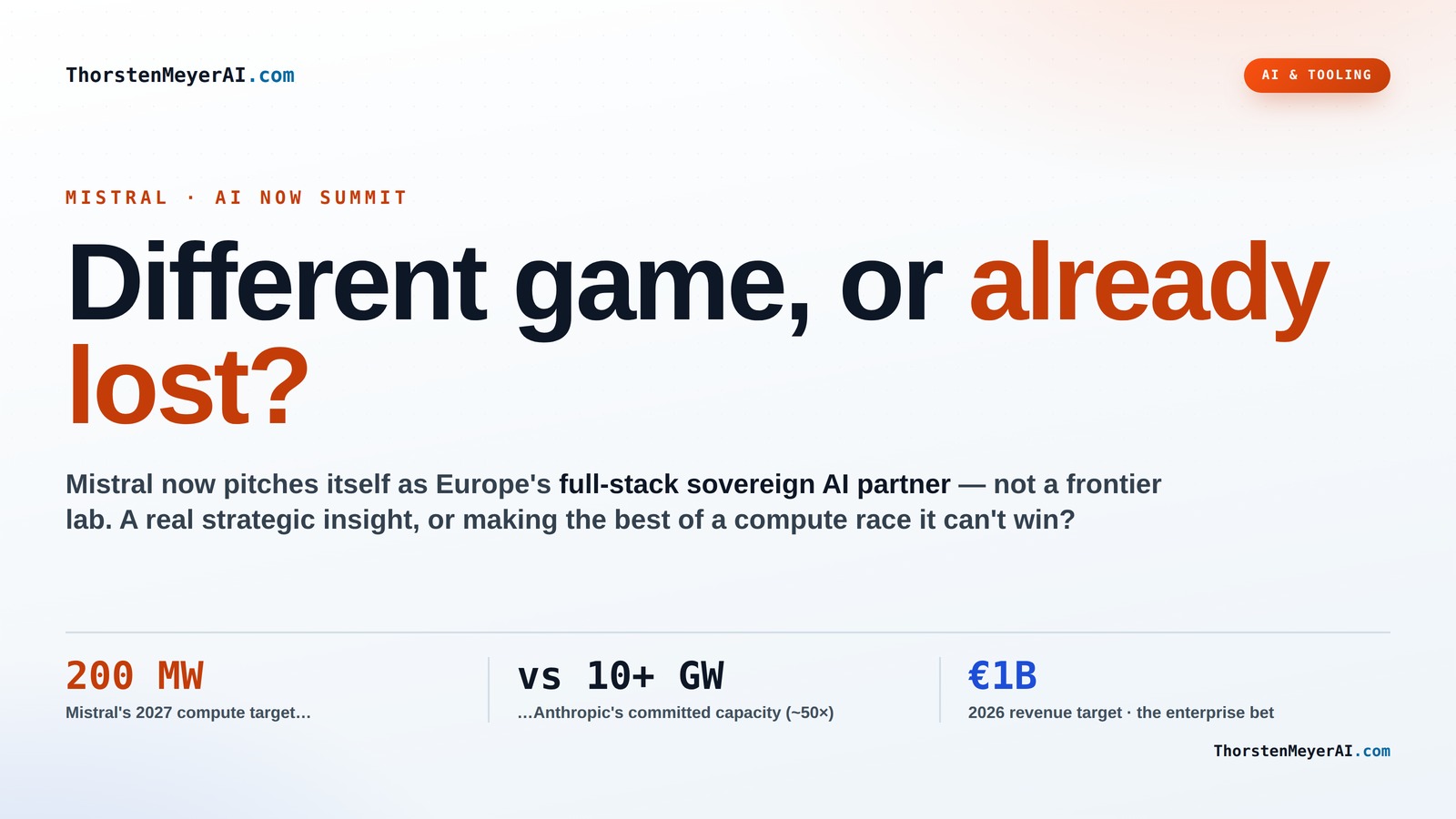
Different game, or already lost?
Mistral now pitches itself as Europe’s full-stack AI provider — compute, models, platform, consultancy — not a frontier-model lab. Is that a real strategic insight, or making the best of a race it can’t win? Both readings fit the same facts.
From model lab to full-stack provider
The clearest signal from the summit wasn’t a model — it was a posture. Heavy on enterprise logos and partnerships (ASML, BNP Paribas, Alexa+), light on new-model announcements. That absence is exactly what skeptics seized on.
Compute
40MW Paris DC + Sweden build · 200MW target by 2027
Models
Open & custom · efficient · you own and run them
Platform
Forge for custom models · Vibe for Work agent
Consultancy
Sales teams, integrators, EU provenance & support
Small & focused, or large & general?
Mistral bets on specialized small models. The claim isn’t that they win a reasoning leaderboard — they don’t. It’s that on the metrics that matter in production agent systems, a purpose-built small model wins. Flip the metric to see the case reverse.
Small specialized vs large general — by what you measure
In token-heavy agentic apps making hundreds of calls, speed/energy/cost compound. Toggle the metric.
Narrow models doing real work
Each is one model doing one thing efficiently — the tangible version of the strategy. Strong on their own terms; the open question is whether the bundle beats a free Chinese open-weight download.
On-prem KYC compliance
Mistral models run inside the bank’s walls for know-your-customer checks. Sensitive financial data never leaves. (BNP was Mistral’s first customer, 2023.)
Voxtral multilingual voice
A focused voice model powering Alexa+ across Europe — speed and efficiency over raw size.
Robostral industrial robotics
Plus a “physics AI” push (via the Emmi acquisition) into aerospace, automotive & semiconductor design and simulation.
Document AI / OCR at scale
Large-scale text extraction — the unglamorous, high-volume enterprise work small models excel at.
The strategy is downstream of the compute gap
Once you see the raw numbers, “why is Mistral behind?” answers itself — and the specialized-small-model strategy starts looking partly like a smart adaptation to a binding constraint, not a pure philosophical choice.
Compute & capital · Mistral vs a frontier leader, this same week
Not a knock — it’s the constraint that forces the efficiency-first, sovereignty-wedge strategy. Adapting intelligently to your position is what good strategy is.
“I want them to win, but I’m worried”
That ambivalence is the most accurate read of where Mistral sits. The enterprise pivot gets read two opposite ways — and both deserve airing.
On-prem, real sales teams, the Koyeb deployment acquisition, EU provenance — exactly what regulated enterprises want, and stickier than consumer mindshare. Targeting €1B revenue in 2026 with 1,000 staff, up from 15 people and one customer in 2023. US closed-API labs structurally can’t match the sovereignty axis.
“Software consultancy with a data center,” not a foundation-model moat. Enterprise B2B is where European startups go when they can’t win consumer or world-scale SaaS. Why pay Mistral on-prem when you could run Qwen free? One paying Le Chat Pro user said the quality gap with frontier labs is now hard to ignore.
Key Takeaways
- Mistral’s focus on sovereignty and open weights aims to build trust and control for European enterprises, not just chase AI size or accuracy.
- The European market’s demand for data privacy and regulation makes local, self-hosted AI models a strategic advantage—Mistral leverages this to differentiate.
- Small, purpose-built models can outperform large models in production environments where speed, cost, and control matter most.
- Mistral’s long-term strength might be in creating a resilient, sovereignty-focused ecosystem rather than competing directly with giants on reasoning benchmarks.
- Choosing Mistral means prioritizing control, compliance, and independence—valuable assets in regulated industries, but with tradeoffs in raw model performance.
As an affiliate, we earn on qualifying purchases.
What ‘Sovereign AI’ Means in Practice — And Why It Matters
Sovereign AI isn’t just a buzzword. It’s about owning your AI’s weights, keeping data within borders, and controlling how models are upgraded and audited. For example, BNP Paribas runs Mistral models on-prem in Belgium, ensuring sensitive financial data stays inside its servers, not in the cloud. This isn’t merely a compliance measure; it’s a strategic shield against both regulatory and geopolitical risks that could threaten data security or lead to restrictions on data flow. Such control becomes especially critical in times of geopolitical tension, where reliance on foreign infrastructure might expose enterprises to vulnerabilities or sanctions.
This control matters most in heavily regulated sectors—banks, defense, healthcare—where data sovereignty isn’t optional. It’s a decisive factor shaping enterprise choices. Mistral’s focus on sovereignty is a strategic move to win trust in these markets, especially in Europe, where strict data laws like GDPR and a cultural emphasis on independence mean that enterprises are increasingly wary of over-reliance on foreign cloud providers. This focus on sovereignty could give Mistral a competitive edge by aligning with regulatory trends and fostering loyalty among risk-averse clients.

As an affiliate, we earn on qualifying purchases.
Why European Buyers Care About Non-U.S. Infrastructure — And How Mistral Fits In
European enterprises and governments often prefer non-U.S. infrastructure due to data privacy laws, export restrictions, and geopolitical concerns. Mistral’s Paris-based roots give it a natural advantage, positioning as a local, trusted player. Think of it as buying from a neighbor rather than a giant faceless cloud provider. This local presence isn’t just about geographic convenience; it’s about reducing exposure to risks associated with U.S. policies, such as data access restrictions or potential sanctions that could jeopardize operations.
This local angle isn’t just branding. It’s strategic. Mistral’s plans for a 200MW European data center network by 2027 aim to reduce reliance on U.S. cloud giants, aligning with EU policies aiming for digital sovereignty. This infrastructure independence can be a key differentiator, enabling enterprises to operate with greater autonomy and compliance, especially in sensitive sectors like defense or finance.
For instance, a French defense contractor might prefer running models on European soil to meet strict audit and security standards, rather than outsourcing to American cloud providers whose data policies might be opaque or subject to external legal pressures. Mistral’s positioning directly taps into this demand, offering a strategic pathway for European institutions to maintain control over their data and AI assets, fostering trust and reducing geopolitical risk exposure.

As an affiliate, we earn on qualifying purchases.
Open Weights vs. Closed APIs — How Control Changes the Game
Open weights are Mistral’s signature move. Unlike OpenAI or Anthropic, which lock users into API access, Mistral offers models you can download, fine-tune, and run on your own hardware. This isn’t just a technical feature—it’s a fundamental shift in control and trust. Enterprises gain the ability to tailor models precisely to their needs, audit and modify them for compliance, and keep sensitive data within their own secure environments. This level of control can significantly reduce the risks associated with vendor lock-in and data breaches, providing peace of mind for regulated sectors where oversight and auditability are paramount.
This approach appeals to enterprises that need full control over their data, compliance, and upgrade paths. For example, BNP Paribas or Abanca can keep financial or customer data inside their secure networks while still leveraging advanced AI models. The tradeoff, however, is that open weights require more technical expertise and infrastructure investment, and scaling them to compete with giants on raw performance remains a challenge. Yet, the strategic value lies in independence—being less dependent on external API providers and more in control of your AI ecosystem.
It’s a strategic difference that shifts the power dynamic—users can trust their models more and avoid vendor lock-in. But it also raises questions: can open weights compete on scale? Will they be enough to outpace giants on performance? The answer depends on the specific enterprise needs: for many, control and trust outweigh sheer size, especially in sensitive or regulated contexts.

As an affiliate, we earn on qualifying purchases.
Is Mistral Winning with Small, Focused Models or Falling Behind on Large-Scale AI?
Mistral champions small, purpose-built models optimized for speed, energy efficiency, and specific tasks. For instance, it uses a 22B model for OCR and voice, rather than pushing a 200B giant. This isn’t about beating GPT-4 on reasoning; it’s about delivering reliable, fast, and cost-effective solutions tailored to particular use cases. In many enterprise scenarios—such as document processing, voice assistants, or specialized analytics—smaller models can outperform larger, more generalized models because they are optimized for the task, require less infrastructure, and are easier to deploy securely.
This focus on efficiency and specialization can be a strategic advantage. Smaller models are quicker to fine-tune, easier to update, and less resource-intensive, which aligns well with enterprise needs for agility and compliance. Moreover, they reduce dependency on massive cloud infrastructure, making them more suitable for on-prem deployments, especially in regulated sectors where data locality is critical.
However, some skeptics argue that to stay competitive on frontier tasks—such as reasoning, multi-modal understanding, or complex problem-solving—bigger models are necessary. The tradeoff is clear: focusing on small, efficient models may limit the scope of what Mistral can achieve on the most advanced AI benchmarks. Whether this is a strategic restraint or a missed opportunity depends on how well the market values specialization versus general intelligence, and how effectively Mistral can scale its smaller models for broader tasks.

The Big Question: Is Mistral Playing a Different Game or Already Lost?
The core question is whether Mistral is building a unique niche or just a stopgap. Its emphasis on sovereignty, open weights, and European control hints at a longer-term vision—less about beating OpenAI now, more about creating a trusted, independent AI ecosystem that can serve local markets and regulated industries effectively. This approach prioritizes strategic independence, resilience, and compliance, which could foster a loyal customer base that values control over raw performance. Such an ecosystem might grow steadily, emphasizing trust and sovereignty as core values.
For example, by enabling governments and regulated industries to keep data in-house, Mistral addresses a pain point that pure API providers can’t match. This could lead to a resilient, loyal customer base that values control and security over chasing the latest model benchmarks. However, the risk is that if the market shifts decisively towards large, reasoning-focused models—like GPT-4 or its successors—Mistral’s approach might struggle to keep pace on the frontier. Its niche could become more about trust and control than about leading-edge AI performance, which could limit its influence in the broader AI arms race.
Ultimately, the decision hinges on market evolution. If trust, sovereignty, and compliance become the dominant factors, Mistral’s strategy could prove prescient. If, however, the race for reasoning and scale accelerates beyond its reach, it might find itself playing a different game—one that’s less about leading and more about serving a specific segment.

What Success Looks Like for a Sovereignty-Focused AI Player
Success isn’t just about model size or accuracy. For Mistral, it’s about becoming the trusted provider for Europe’s regulated industries. Imagine a future where French, German, or Scandinavian firms run their AI models locally, fully in control, with Mistral’s open weights as the backbone. This vision emphasizes resilience, control, and compliance, enabling enterprises to operate independently of external cloud providers and reducing exposure to geopolitical risks.
This could mean steady growth in enterprise contracts, government partnerships, and a reputation as Europe’s AI champion—building a resilient ecosystem that’s less reliant on U.S. giants. Such a focus on sovereignty aligns with broader geopolitical trends favoring data localization and strategic independence, positioning Mistral as a key enabler of European digital autonomy.
In this vision, the real victory is strategic independence—being less vulnerable to external control, more adaptable to local regulations, and trusted by institutions that prioritize security and compliance over raw performance. This approach could foster loyalty and long-term relationships, creating a sustainable and resilient ecosystem that withstands market and geopolitical fluctuations.
Frequently Asked Questions
What does ‘sovereign AI’ really mean for enterprises?
Sovereign AI means owning your models’ weights, hosting data locally, and maintaining control over updates and compliance. It’s about reducing reliance on external cloud providers and building trust, especially in regulated sectors.Is Mistral trying to beat OpenAI or serve a different market?
Mistral is focusing on a different game—serving European enterprises that prioritize control, data sovereignty, and local deployment. It’s not just about model prowess but about strategic independence.Why do governments and companies prefer open weights?
Open weights allow full control over the AI models, enabling organizations to keep data in-house, customize models, and avoid vendor lock-in—crucial for privacy, security, and compliance.Can small, focused models really compete on real tasks?
Yes. Small models optimized for specific tasks can outperform larger, general models in speed, cost, and reliability—especially when the goal is local, secure, and efficient AI.What’s the biggest risk for Mistral’s approach?
If the market shifts heavily toward large reasoning models for broader AI capabilities, Mistral’s sovereignty-focused niche might struggle to keep pace on the frontier, risking obsolescence in some areas.Conclusion
Mistral’s strategy underscores an important shift: in a world obsessed with size and speed, control and sovereignty can become your most valuable assets. For European enterprises, trusting a local, open-weight AI provider could become the new gold standard—less flashy, but more resilient.
If you’re evaluating AI options, ask yourself: how much do you value independence and control? Sometimes, grabbing a smaller, smarter piece of the puzzle beats chasing the biggest model in the room.

Fall yard work Picks
leaf blowers
As an affiliate, we earn on qualifying purchases.