
TL;DR

Get privacy and security gear delivered free — and shop member deals
- Fast, free delivery on millions of items
- Access to Prime Big Deal Days deals on October 6–7
- Prime Video, Amazon Music and more included
IdeaClyst is a local-first, AI-powered war room that helps founders quickly validate, critique, and refine ideas. It combines structured AI debates and discovery tools to cut through uncertainty and focus on what really matters. The result: smarter decisions, faster.
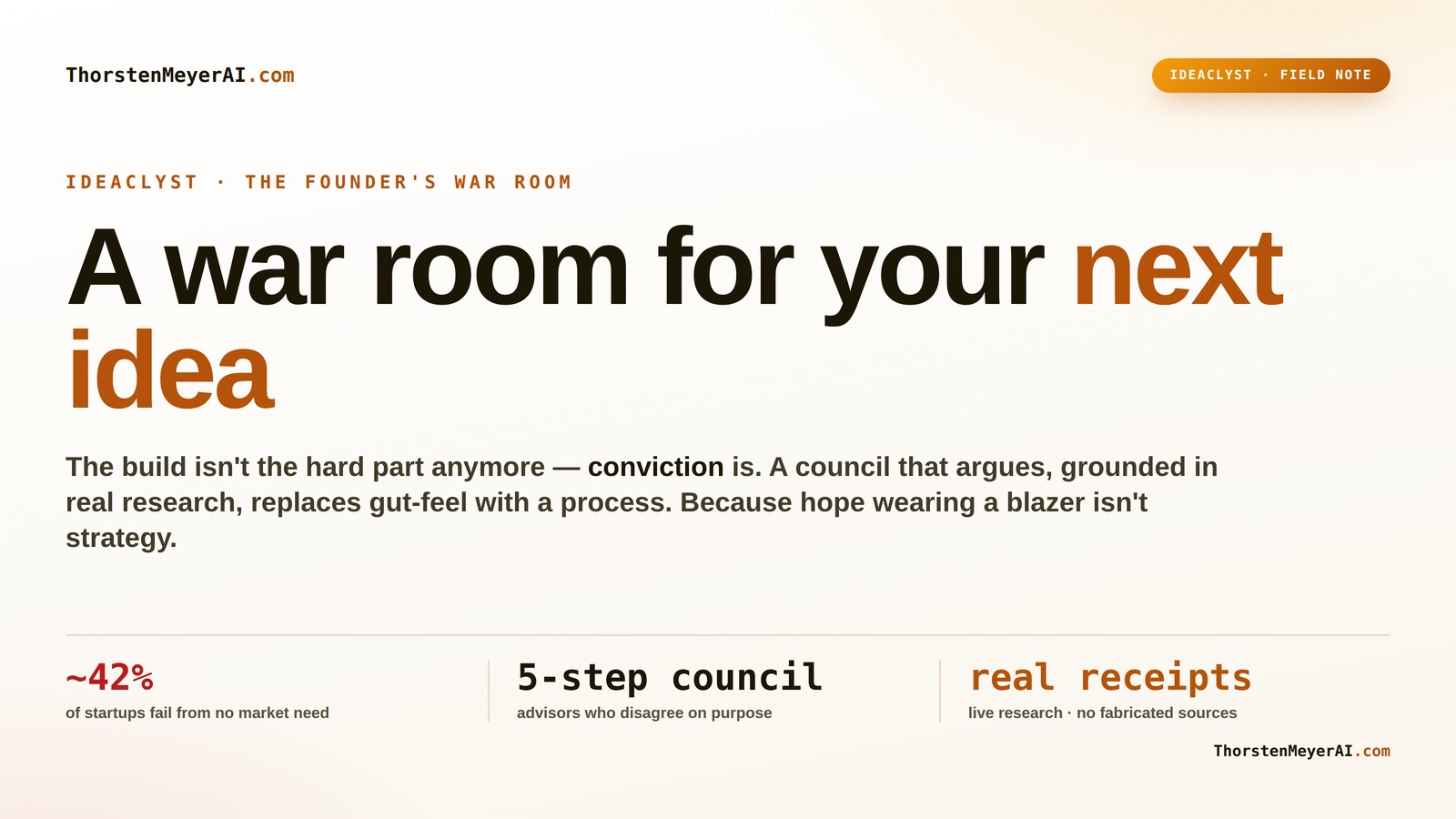
A war room for your next idea
The build isn’t the hard part anymore — conviction is. Knowing which idea deserves the next six months, and being able to defend it. Most founders answer with gut feel and optimistic math. That’s hope wearing a blazer. IdeaClyst replaces it with a process.
The most expensive decision is what to build
The single most valuable thing a tool can do is talk you out of the wrong six months. The numbers make the case better than any pitch.
Three tools in one — on your own machine
Strip away the framing and IdeaClyst is three things at once, all running locally with nothing leaving your laptop.
An AI council
Pressure-tests an idea you bring it — advisors who argue on purpose.
A discovery engine
Finds ideas you didn’t know to look for by hunting real demand signals.
A founder’s workspace
Carries winners from “interesting” all the way to “ready to build.”
Advisors who disagree on purpose
Not one confident, agreeable answer — a structured five-step deliberation where models play different roles and turn on their own work. The disagreement is the feature.
The five-step deliberation
A council that leads with the bad news surfaces the objections you’d otherwise find the expensive way, on month five.
Product strategy
Who’s it for, what’s the wedge, why now, what’s the business model.
Technical architecture
What would it actually take to build — and where’s the risk.
Critique pass
The council turns on its own work. Where’s the hand-waving? What kills this?
Second, independent critique
A different voice, a different angle — so blind spots don’t survive.
Final synthesis
Everything into one coherent founder packet: strategy, architecture, validation, plan.
When IdeaClyst cites a source, it actually fetched it
The hard departure from “ask an AI what it thinks of my startup.” It runs in a strict, real-data-only mode — if it can’t gather genuine evidence, it says so plainly rather than inventing a plausible paragraph.
Confidence with receipts
No fabricated statistics, no imaginary competitors, no made-up citations. The packet survives a skeptical co-founder or a sharp investor because the reasoning has receipts.
Market research first
Scouts the landscape before the council reasons about anything.
Competitor read
Real positioning, pricing signals, feature claims — differentiation vs. reality.
Validation with links
Not “talk to customers” — concrete signals & sources you can click.
From the blank page to build-ready
Evaluation is half the problem; the blank page is the other half. And a plan is worthless if it dies in a tab you never reopen.
Bring a space, not an idea
“AI for accountants,” “tools for indie game studios” — plus your goal and real capacity. It hunts demand signals across HN, Reddit, Product Hunt, GitHub, pricing pages.
- An honest market read — leads with the bad news when a space is hard
- An opportunity map — high pain, thin competition
- Ranked candidates — wedge, who pays, effort, risk, confidence
- each with KILL CRITERIA — when to walk away
A home and a forward path
Every promising idea gets carried forward, with every artifact in plain files on your disk.
- Validation tooling — sprint board, interview list, evidence browser
- Founder profile — a personal-fit lens; same discovery, different advice
- Build workspaces — funnel, personas, landing draft, version history
- “Build this idea” → a PRD + task queue, ready for a coding agent
Key Takeaways
- IdeaClyst transforms idea validation into a structured debate, surfacing weaknesses early and saving months of wasted effort.
- Its local-first design ensures your raw ideas stay private while still benefiting from AI-powered critique and discovery.
- The AI council stages disagreements from multiple angles, mimicking a real-world debate that leads to better decisions.
- Grounding the council in live web research turns assumptions into facts, reducing costly missteps.
- Building your own war room can be simple: just install the tool, organize your ideas, and start debating—no complex setup needed.
digital whiteboard for team collaboration
As an affiliate, we earn on qualifying purchases.
As an affiliate, we earn on qualifying purchases.
What Is a Digital War Room and Why You Need One
A digital war room is a dedicated workspace where your team can focus intensely on an idea or project, with all the critical information, critiques, and plans in one place. It’s like a command center for decision-making, combining collaboration, structured debate, and real-time data. It’s like a command center for decision-making, combining collaboration, structured debate, and real-time data.
In the startup world, the stakes are high. Building the wrong thing can cost hundreds of thousands and months of effort. A war room helps you avoid that by making sure every angle is examined before you commit. With IdeaClyst, this space lives on your own machine—no cloud, no third-party data, just your raw ideas and honest critique.
Think of it as a strategic battleground where your ideas are tested from multiple sides—product, tech, market—before you move to build. It’s a proven way to save time, money, and reputation by making smarter bets early on. Learn more about digital war rooms and how they can transform your decision-making process.
As an affiliate, we earn on qualifying purchases.
How IdeaClyst Turns Your Idea into a Full-Scale War Room
IdeaClyst is more than just a brainstorming app. It’s a multi-layered system built around three core features:
- The AI council that pressures your ideas by debating their strengths and weaknesses.
- A discovery engine that surfaces new opportunities you might not have considered.
- A founder’s workspace that keeps everything organized from initial idea to ready-to-build plan.
Here’s how it works in real life: you feed in a rough idea—say, a new SaaS feature—and the AI council stages a five-part debate. It questions who this is for, what the risks are, and how it fits your business. It then finds related ideas or gaps you missed, and finally, it synthesizes everything into a clear plan, all stored securely on your device.
This local-first approach means your raw, valuable ideas never leave your machine, protecting your intellectual property while still benefiting from AI’s sharp critique.
As an affiliate, we earn on qualifying purchases.
Inside the AI Council: Why Disagreement Sparks Better Ideas
The heart of IdeaClyst is its AI council—five steps of structured debate where models take on different roles. For example, one AI acts as a product strategist, another as a tech architect, and others as critics pointing out risks or flaws.
This multi-role debate isn’t just about finding flaws; it’s a deliberate strategy to surface assumptions and blind spots that might go unnoticed in traditional review. You can explore how AI debate systems are shaping the future of decision-making at Artificial Intelligence Max. When different AI agents challenge each other, they expose weaknesses in your ideas that might seem solid at first glance but crumble under scrutiny. This process encourages you to think more critically and develop more resilient, well-rounded plans. The final output isn’t just a yes or no; it’s a comprehensive, nuanced understanding of your idea’s strengths and vulnerabilities. This approach fosters a culture of rigorous critique that can significantly improve the quality of your decisions, especially in fast-paced environments where quick validation is crucial.
Why does this matter? Because in high-stakes situations, a single perspective often misses key flaws. Multiple AI viewpoints force you to confront assumptions from different angles, reducing blind spots. This tradeoff—more time spent on structured debate—pays off by dramatically increasing the reliability of your decisions and preventing costly missteps down the line.
As an affiliate, we earn on qualifying purchases.
Grounded in Real Research, Not Just Model Vibes
Many AI tools give you answers based on their training data—often outdated or unverified. IdeaClyst avoids that trap by anchoring its council in live web research. It pulls current data, market trends, and competitor info directly from the web, so your debates are based on facts, not assumptions. For more insights on AI-driven research tools, visit SmartCR.
For example, if you ask whether a new app feature makes sense, the council checks recent user reviews, industry reports, and real-time market stats. According to market research, the cost of building a product that nobody needs can run from $35,000 to over $150,000—an expense most founders want to avoid.
This grounding in live data helps you cut through hype and makes your validation process faster, cheaper, and more reliable. It turns guesswork into informed confidence, which is the core advantage of IdeaClyst.
Why does this matter? Because relying solely on model-generated insights can lead you astray when those models are outdated or biased. Incorporating live research introduces a necessary reality check, ensuring your decisions are based on the freshest, most relevant information. This reduces the risk of costly misjudgments and aligns your ideas with current market conditions—crucial in fast-changing industries.
Setting Up Your Own War Room: Physical, Digital, or Hybrid
Creating a war room doesn’t mean buying a conference table and filling it with markers. Discover how digital tools can help you set up an effective war room at CyberMedia Creations. With IdeaClyst, your war room lives digitally on your own machine, but you can also adapt the concept to physical spaces or hybrid setups.
For a digital setup, all you need is a laptop, a good internet connection, and a dedicated folder for your project. No cloud subscriptions or complex tools—just install IdeaClyst, start feeding ideas, and let the AI council do its work.
If you prefer a physical space, think of a whiteboard with sticky notes, a few comfortable chairs, and a projector for live demos. The key is creating an environment that encourages honest critique, rapid iteration, and visible progress.
Some teams combine both—using digital tools for structured critique and physical spaces for brainstorming. The best setup depends on your team’s size, workflow, and culture.
Choosing the right environment matters because it influences how openly and rigorously your team can critique ideas. Digital setups offer convenience and version control, but physical spaces can foster more spontaneous collaboration. Hybrid models aim to balance structure with immediacy, allowing for flexible workflows that adapt to your specific needs and culture.
Common Pitfalls and How to Avoid Them
Even a powerful tool like IdeaClyst can fall flat if used poorly. Common mistakes include relying too much on AI for validation, ignoring the structured disagreement process, or cluttering your workspace with too many ideas.
To maximize effectiveness:
- Always challenge the AI’s suggestions—don’t accept them at face value.
- Use the structured council debate to surface objections, even if they’re uncomfortable.
- Keep your workspace organized—version control, clear sections, and regular cleanup prevent overwhelm.
Why do these pitfalls matter? Because misusing the tool can lead to false confidence or analysis paralysis. Relying solely on AI without critical thinking can cause you to overlook fundamental flaws. Ignoring the structured critique process risks missing out on valuable insights that only emerge through disciplined debate. Cluttered workspaces hinder clarity, making it harder to focus on the most promising ideas. Recognizing and addressing these pitfalls ensures your war room remains an effective environment for rigorous decision-making, rather than becoming a distraction or a false sense of security.
FAQs About Building Your Own Digital War Room with IdeaClyst
Q1: Can I use IdeaClyst for solo projects?
Absolutely. Its local-first design makes it perfect for solo founders who want structured critique without sharing their ideas externally.
Q2: Is it suitable for remote teams?
Yes. While it’s a desktop app, you can share your files or set up a shared folder on a local network. For fully remote teams, combining it with a video call helps keep everyone aligned.
Q3: How much technical setup is involved?
Minimal. Just install the application, create a folder, and start feeding ideas. No cloud accounts, no APIs, just a straightforward local environment.
Q4: Will this replace my existing project management tools?
Not necessarily. Think of it as a supplement—a strategic space where your ideas get tested and refined before they enter your project pipeline.
Q5: What’s the biggest mistake founders make with war rooms?
They turn them into cluttered dumping grounds instead of structured decision hubs. Focus on clarity, discipline, and rigorous critique to get the most out of your war room.
Frequently Asked Questions
Can I integrate IdeaClyst with my existing tools?
Since IdeaClyst stores everything as plain Markdown files on your machine, you can easily import or export content to other tools like Notion, Trello, or your favorite project management app.Is IdeaClyst suitable for non-technical founders?
Yes. Its user-friendly interface and straightforward setup make it accessible for founders without technical backgrounds. The core strength is in structured critique, not coding.How does IdeaClyst compare to traditional brainstorming or whiteboarding?
While whiteboards are great for quick sketches, IdeaClyst offers a disciplined, debate-driven process that surfaces flaws early and creates a clear plan, all while keeping everything organized and versioned on your laptop. This process encourages deeper thinking, reduces the risk of overlooked assumptions, and results in more actionable insights—something traditional whiteboarding often lacks due to its informal nature and lack of structured critique.What kind of ideas or projects benefit most from IdeaClyst?
Complex projects with many moving parts—like SaaS features, new markets, or innovative products—gain the most. It helps you test assumptions, prioritize features, and build conviction before committing resources. By exposing weaknesses early, it reduces costly pivots and rework down the line, making it invaluable for high-stakes, ambitious initiatives.Conclusion
A strategic war room isn’t just for big teams or physical spaces. IdeaClyst proves that with the right tools, even solo founders can create a powerful decision-making hub—on their own machine. It’s about making smarter bets, faster, with confidence rooted in real critique and research. Your next big idea deserves that kind of focus. Are you ready to build your digital battleground?Fall Picks
fall essentials
As an affiliate, we earn on qualifying purchases.