TL;DR
CISA urged organizations on November 17, 2026, to patch Java4Shell, a memory-corruption flaw in an optimized Java Base64 decoder. The documented risk is limited to specified Java runtimes on x86-64 processors with AVX-512 VBMI; CISA’s record listed no exploitation as of November 17.
CISA urged organizations on November 17 to immediately patch CVE-2026-114938, a memory-corruption flaw in an optimized Base64 decoder in the Java virtual machine. The vulnerability, dubbed Java4Shell by its finders, could allow remote code execution under specific conditions, according to CISA; the agency’s record listed no exploitation at the time.

Get privacy and security gear delivered free with Prime
- Fast, free delivery on millions of items
- Prime Video, Amazon Music and more included
- Member-only deals all year
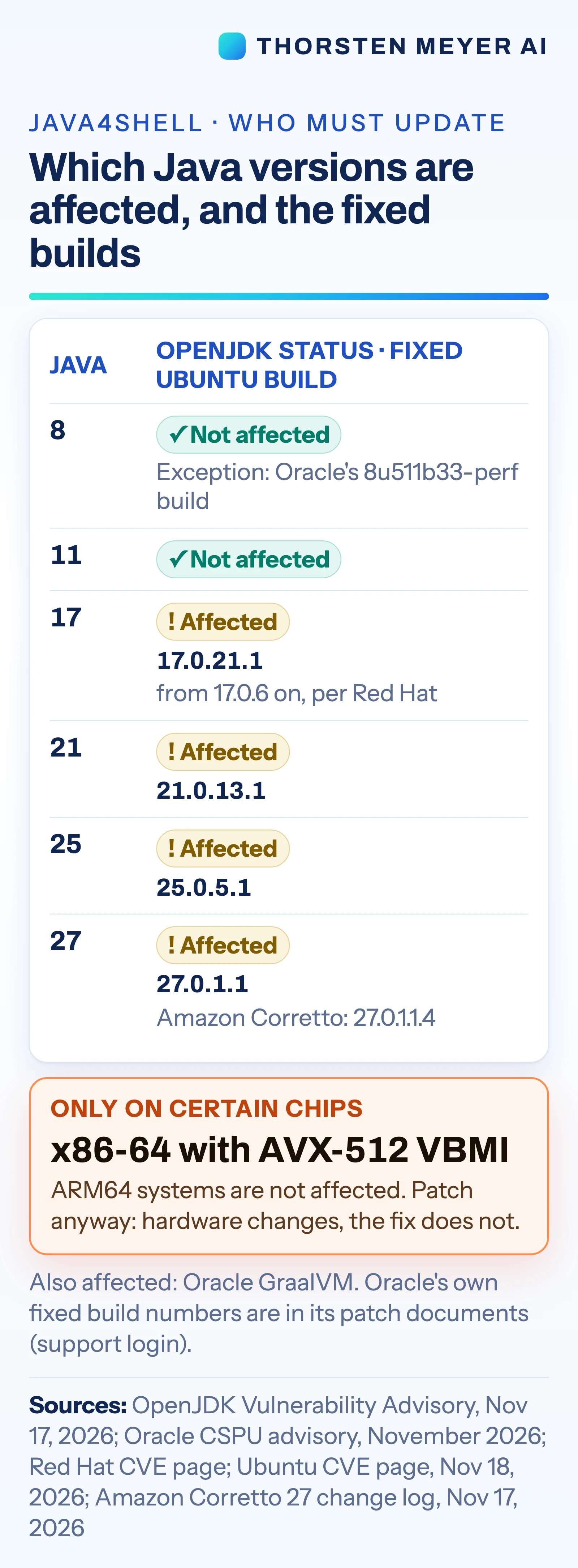
The flaw is in the x86-64 HotSpot JVM’s Base64 decoder, according to CISA. The affected runtime families listed in the source material include Java 17, 21, 25 and 27, Oracle’s GraalVM, and a specific Oracle Java 8 build. Red Hat says the vulnerable code entered OpenJDK in version 17.0.6. It says OpenJDK 8 and 11 are not affected.
The processor requirement narrows exposure further: the system must use an x86-64 processor with AVX-512 VBMI. Red Hat says ARM64 systems and x86-64 systems without that instruction set are not affected by this flaw. A vulnerable runtime must also process outside data through the relevant decoder path, such as a web service accepting user input, Oracle’s advisory says.
Oracle released a fix in its November 2026 Critical Security Patch Update, and OpenJDK published an advisory on November 17. The source material says Oracle’s monthly package contains 655 new security patches across its products, including 11 for Java SE. Administrators are advised to update Java runtimes to the vendor’s November release and check for Java bundled in other products and container images.
Why Java Servers Need Attention
Java runtimes are embedded in server applications and may also be included inside vendor products or container images, so an organization may run affected Java without managing it as a standalone installation. The combination of network-facing input and a vulnerable runtime on qualifying hardware makes inventory important: teams need to find where Java actually runs before they can confirm whether the conditions apply.
CISA’s warning raises the priority of patching, but the available records do not establish active exploitation. Severity assessments also differ: Oracle assigns 8.1 and describes exploitation as difficult; Red Hat assigns 9.8 and rates it critical; the finders give it 9.2 under CVSS 4.0. The National Vulnerability Database had not scored the CVE in the source material. These scores reflect different assessments and should not be treated as evidence of exploitation.
Products Worth Considering

Trezor Safe 7 Crypto Hardware Wallet with Bluetooth and Color Touchscreen

Ledger Nano Gen5 Crypto Wallet with Touchscreen, Black

LG 27GS60QC-B Ultragear 27-inch Curved Gaming Monitor (QHD, 180Hz, 1ms, 1000R)
As an affiliate, we earn on qualifying purchases.
How the Java4Shell Alert Emerged
CISA published its alert on November 17, 2026, naming the issue Java4Shell and linking Oracle’s advisory. The Canadian Centre for Cyber Security contributed to the alert. OpenJDK issued its own advisory the same day, while Siemens published an advisory on November 18, according to the supplied source list.
The name echoes Log4Shell, but the documented issue is a different vulnerability in a Base64 decoding routine. Base64 converts binary data into text and is commonly used to carry data in tokens, cookies, uploads and network messages. The supplied advisories describe a processor-specific flaw in an optimized Java implementation; they do not establish that every Java installation or every Base64 use is affected.
““strongly urges organizations to immediately patch” CVE-2026-114938.”
— CISA
Exposure and Exploitation Remain Open
CISA’s record listed “Exploitation: none” on November 17, and the flaw was not in the agency’s Known Exploited Vulnerabilities catalogue version dated November 18, according to the supplied material. Those records describe the status at those dates; they do not prove that exploitation has never occurred or establish the status after that period.
The source material does not provide a complete count of affected organizations, products or internet-facing systems. The National Vulnerability Database had not yet assigned a score, and the severity ratings from vendors and researchers differ. The finders said they were withholding product-specific attack chains while organizations upgraded. Further details about those chains and any later exploitation reports were not available in the supplied material.
Patch Runtimes and Bundled Java
Organizations should identify Java runtimes in their managed systems, applications, vendor products and container images, then apply the relevant vendor’s November 2026 fix. CISA’s guidance prioritizes immediate patching; teams can start with internet-facing systems that run affected versions on qualifying processors and accept outside input.
Administrators should consult the linked CISA, Oracle, OpenJDK and product-vendor advisories for version-specific instructions. The next developments to watch are updated vendor notices, the NVD assessment, and any change to CISA’s exploitation status or KEV catalogue. The available source material does not specify a further CISA deadline or a scheduled follow-up.
Key Questions
What is Java4Shell?
Java4Shell is the name used by the finders for CVE-2026-114938, a memory-corruption flaw in an optimized Base64 decoder in the x86-64 HotSpot Java virtual machine, according to CISA.
Which Java systems are listed as affected?
The supplied advisories list Java 17, 21, 25 and 27, Oracle’s GraalVM, and one specific Oracle Java 8 build. Red Hat says OpenJDK 8 and 11 are not affected. Check the relevant vendor advisory for the exact build in use.
Does the flaw affect every processor?
No. The documented conditions include an x86-64 processor with AVX-512 VBMI. Red Hat says ARM64 systems and x86-64 processors without that feature are not affected by this flaw.
Has Java4Shell been exploited?
CISA’s record listed no exploitation as of November 17, 2026, and the CVE was absent from the KEV catalogue version dated November 18, according to the supplied source. Those dated records do not establish what may have happened since.
What should organizations do now?
Inventory Java runtimes, including those bundled with products and container images, and apply the vendor’s November 2026 update to affected systems. Prioritize internet-facing systems that meet the documented runtime and processor conditions.
Source: Thorsten Meyer AI