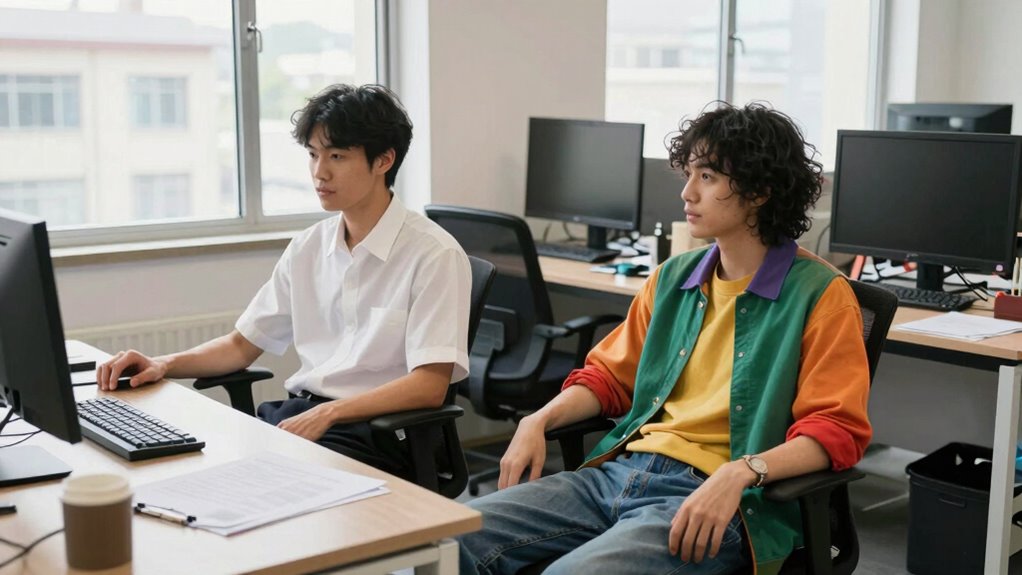

Your work style differences often come from combining traits like extroversion with thinking, making you quick and assertive, or introversion with feeling, leading you to prefer thoughtful, harmonious approaches. When extroverts team up with cautious types, conflicts can arise over decision speed. Similarly, logical thinkers paired with intuitive individuals might clash over priorities. Recognizing these combinations helps you understand how personalities influence work habits. Keep exploring to discover how embracing these differences can boost your team’s effectiveness.

Get privacy and security gear delivered free with Prime
- Fast, free delivery on millions of items
- Prime Video, Amazon Music and more included
- Member-only deals all year
Key Takeaways
- Combinations of extroversion and introversion influence communication preferences and collaboration styles.
- Pairings of thinking and feeling traits affect decision-making approaches and team interactions.
- Mixing assertiveness with cautiousness shapes responsiveness and risk-taking behaviors at work.
- Variations between perceiving and judging influence flexibility, planning, and adaptability in tasks.
- Divergent traits related to openness and conscientiousness impact creativity and organizational habits.

Have you ever wondered why some colleagues thrive in a fast-paced environment while others excel with a more methodical approach? It often comes down to the unique combination of traits that shape each person’s work style. These traits influence how you communicate within your team and how you approach decision making. When you understand these combinations, you can better navigate differences and foster a more effective work environment.
For instance, if you’re naturally assertive and quick to act, you might prefer a decision-making approach that’s decisive and swift. You value team communication that’s direct and to the point, expecting colleagues to share information efficiently. On the other hand, if you’re more reflective and cautious, you tend to favor a methodical decision-making style, taking time to analyze all options before proceeding. Your team communication might lean toward detailed discussions and thorough explanations, aiming to minimize risks.
These contrasting traits often come from fundamental personality differences like extroversion versus introversion or a preference for thinking versus feeling. An extroverted individual may be energized by rapid exchanges and spontaneous brainstorming, thriving in environments that reward quick thinking. Conversely, introverts might prefer written communication and well-structured meetings, excelling when given time to process and prepare. Similarly, someone who relies on logical thinking approaches problems analytically, favoring data-driven decisions, while a feeling-oriented person might prioritize harmony and values, influencing how they participate in team discussions.
Understanding personality traits like extroversion, introversion, thinking, and feeling helps tailor communication and teamwork effectively.
Your decision-making approaches are directly affected by these traits. Some people rely on intuition and gut feelings, making decisions quickly based on experience. Others prefer a more deliberate process, gathering extensive information and weighing every option. This variation can lead to misunderstandings if team members don’t recognize each other’s natural inclinations. For example, a fast decision-maker might see a methodical colleague as slow or indecisive, while the latter might view the former as reckless or impatient.
Understanding these trait combinations helps you appreciate your colleagues’ work styles and adapt your communication accordingly. Recognizing whether someone favors quick, decisive actions or careful, detailed analysis allows you to tailor your team communication and decision-making approaches. Additionally, utilizing personality assessments and outdoor features can create environments that encourage collaboration and balance different work styles within a team. Incorporating fundamental personality differences into your team strategies can further enhance understanding and cooperation. Moreover, understanding how work environment influences individual traits can help optimize team dynamics. Recognizing that traits may evolve based on circumstances enables you to support team members more effectively. By doing so, you create a balanced environment where different strengths complement each other, reducing friction and boosting overall productivity. Embracing these differences isn’t just about tolerating diversity; it’s about leveraging it to enhance teamwork and achieve shared goals more effectively.
personality assessment tools for teams
As an affiliate, we earn on qualifying purchases.
As an affiliate, we earn on qualifying purchases.
Frequently Asked Questions
How Do Personality Traits Influence Work Collaboration?
Personality traits shape your approach to collaboration, influencing how you communicate, problem-solve, and adapt. These personality dynamics can lead to collaboration challenges if team members don’t understand each other’s differences. By recognizing diverse traits, you can foster better teamwork, address conflicts more effectively, and leverage individual strengths. Embracing these differences helps create a more cohesive, productive work environment where everyone’s unique contributions are valued.
Can Work Style Differences Lead to Team Conflicts?
Yes, work style differences can lead to team conflicts by affecting interpersonal dynamics. When team members have diverse approaches to tasks and communication, misunderstandings may arise. However, you can manage this effectively through conflict resolution strategies, like open dialogue and active listening. Recognizing and respecting these differences helps foster a collaborative environment, ensuring that conflicts are addressed constructively and team cohesion remains strong.
Are Certain Trait Combinations More Adaptable to Change?
Research shows that 76% of highly adaptable individuals possess strong trait adaptability and personality flexibility. You’re more likely to handle change effectively if your traits include openness and resilience, allowing you to adjust quickly and embrace new circumstances. These trait combinations enable you to stay flexible, learn from experiences, and remain positive amid uncertainty. Cultivating personality flexibility boosts your ability to navigate change smoothly and thrive in dynamic environments.
How Do Cultural Backgrounds Affect Work Style Traits?
Your cultural background considerably influences your work style traits through cultural norms and communication styles. For example, in some cultures, hierarchical norms lead you to defer to authority, while others promote egalitarian communication. These differences shape how you approach teamwork, decision-making, and conflict resolution. Understanding these cultural influences helps you adapt better in diverse work environments, fostering more effective collaboration and mutual respect with colleagues from varied backgrounds.
What Strategies Help Manage Diverse Work Styles Effectively?
You can manage diverse work styles by focusing on personality alignment and applying effective collaboration techniques. Some might think differences hinder teamwork, but you can turn them into strengths. Foster open communication, tailor tasks to individual strengths, and encourage mutual respect. By understanding each person’s personality traits and integrating collaboration strategies, you create a cohesive environment where varied work styles enhance innovation and productivity.
As an affiliate, we earn on qualifying purchases.
Conclusion
So, next time you’re baffled by a coworker’s quirky work habits, remember—it’s probably just a delightful cocktail of trait combos like perfectionism with impatience or creativity with stubbornness. Embrace these quirks; they’re what make your team interesting, after all. After all, who wants a bunch of clones? Celebrate the beautiful chaos of diverse traits—because, really, who wants a boring, uniform work style? Cheers to your wonderfully unpredictable team!
As an affiliate, we earn on qualifying purchases.
personality trait analysis for workplace
As an affiliate, we earn on qualifying purchases.
As an affiliate, we earn on qualifying purchases.
Halloween Picks
halloween
As an affiliate, we earn on qualifying purchases.