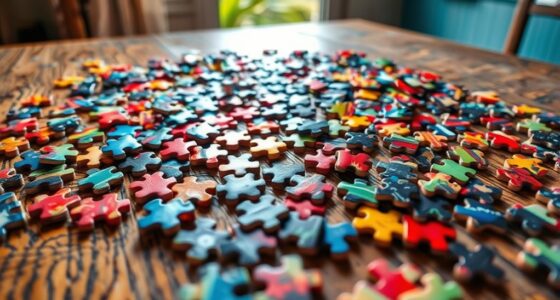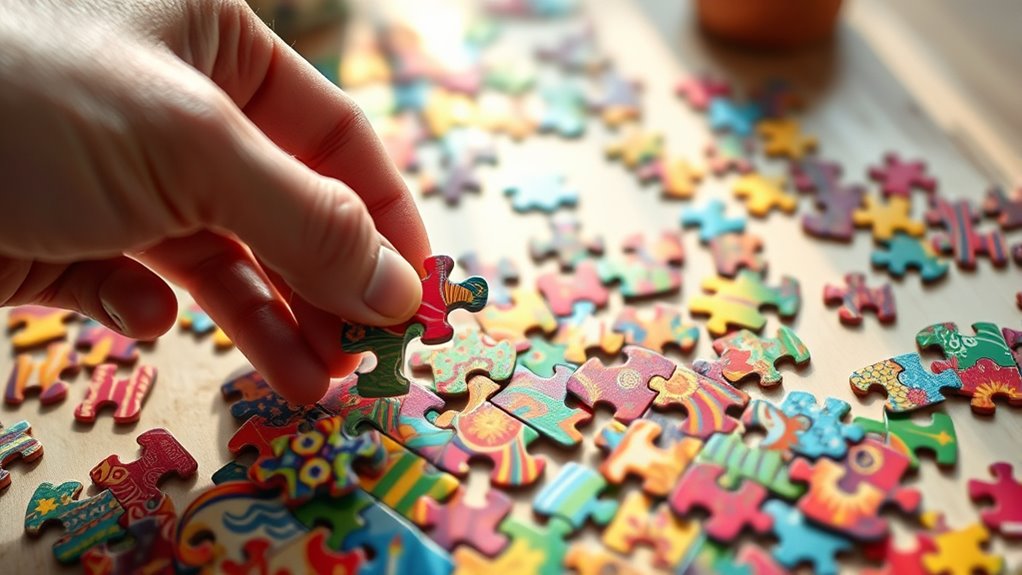

To get started with jigsaw puzzles, start by sorting your pieces, especially the edges, to build a sturdy frame that creates a clear boundary for the interior. Organize remaining pieces by color or pattern to make matching easier and reduce frustration. Keep your workspace tidy and use containers for different groups. Focus on matching distinctive features, and remember that a good foundation makes the entire process smoother. Keep exploring, and you’ll find more tips to boost your skills.
Key Takeaways
- Start by sorting edge pieces to create a clear puzzle frame.
- Organize remaining pieces by color, pattern, or features for easier assembly.
- Keep your workspace tidy with containers for different groups to streamline sorting.
- Use the sorted groups to quickly identify and match interior pieces.
- Pay close attention to color differences to improve accuracy and reduce mistakes.

Are you looking to improve your jigsaw puzzle skills and complete your puzzles more efficiently? One of the best starting points is mastering how to handle the edge pieces and implementing effective sorting techniques. Edge pieces are the foundation of your puzzle, forming the border and giving you a clear framework to work within. Begin by spreading out all the pieces and identifying the edge pieces first. These are usually distinguishable because they have one flat side. Sorting these out early helps you establish the puzzle’s perimeter, which simplifies the process of filling in the middle sections later.
Once you’ve separated the edge pieces, use sorting techniques to organize the remaining pieces. A practical approach is to group pieces based on color, patterns, or distinctive features. For example, if your puzzle depicts a landscape, gather all the sky pieces together, and do the same for trees, buildings, or other elements. Sorting by color is especially helpful because it narrows down your options when looking for specific pieces. This method saves you time and reduces frustration, as you won’t have to sift through every piece repeatedly.
As you work on assembling the border, keep your workspace tidy and separated into sections. You might find it helpful to use small containers or trays for different colors or sections of the puzzle. This keeps pieces organized and accessible without cluttering your table. When you start adding interior pieces, refer back to your sorted groups to find likely matches quickly. For example, if a piece has a blue pattern, check your blue pile first rather than searching through all the remaining pieces. This strategic approach keeps your focus sharp and makes the process more efficient. Recognizing the significance of color accuracy can further improve your sorting and matching skills, making assembly smoother.

Buffalo Games – Puzzle Sorting Trays – 7 Count (Pack of 1)
Puzzle Sorting Trays to enhance your puzzle experience
As an affiliate, we earn on qualifying purchases.
As an affiliate, we earn on qualifying purchases.
Frequently Asked Questions
What Is the Best Lighting for Assembling Puzzles?
The best lighting for assembling puzzles is natural light combined with an adjustable lamp. Natural light helps you see colors accurately and reduces eye strain. Position your puzzle near a window during the day for maximum brightness. Use an adjustable lamp with a daylight bulb in the evening or cloudy days to guarantee consistent, clear illumination. This setup lets you work comfortably and prevents mistakes caused by poor lighting.
How Should I Store My Puzzle During Breaks?
Think of your puzzle as a delicate butterfly needing a cozy cocoon during breaks. To store it safely, use a dedicated storage container with puzzle piece organization compartments. You can opt for a puzzle roll, a sturdy box, or a zippered bag to keep pieces secure and prevent loss. Make sure the container is airtight and labeled, so you can jump right back into your puzzle without losing momentum.
Are There Specific Tools That Make Puzzling Easier?
Yes, there are tools that make puzzling easier. Using a sorting tray helps you organize pieces by color or edge type, streamlining puzzle assembly. A piece maintenance kit, including a small brush and storage containers, keeps your pieces clean and prevents loss. These tools simplify puzzle sorting and help maintain your pieces, making the whole experience more enjoyable and efficient. Invest in them to improve your puzzling process.
How Do I Prevent Puzzle Pieces From Getting Lost?
To prevent puzzle pieces from getting lost, start by sorting your pieces, especially edge pieces, into a separate container. Keep the sorted pieces close to your workspace, so you’re less likely to misplace them. As you work, regularly gather loose pieces and double-check your sorting. This way, you’ll stay organized, and all your pieces stay within reach, making your puzzling experience smoother and more enjoyable.
What Are Some Common Mistakes Beginners Make?
Did you know that 60% of beginners struggle with common puzzle mistakes? You might rush into assembling without sorting pieces first, making it harder to find what you need. A key mistake is neglecting edge identification, which makes building the frame difficult. Take your time with piece sorting and focus on edges early; it makes the process smoother and more enjoyable. Avoid rushing, and you’ll see better progress and less frustration.

Puzzle Sorting Trays – 6X Puzzle Organizer for Sorting 1000 Pieces up to 4800 Pieces, Stackable Jigsaw Accessories for Adults
Versatile Design: These Puzzle Sorting Trays function as both Puzzle Piece Sorter Trays 7"x7" and a flat Puzzle…
As an affiliate, we earn on qualifying purchases.
As an affiliate, we earn on qualifying purchases.
Conclusion
Just like a master detective solving a mystery, you’ll find each piece falling into place with patience and persistence. Remember, every puzzle is a journey—each challenge an opportunity to learn. As the great Sherlock Holmes once said, “The game is afoot”—so trust your instincts, stay focused, and enjoy the process. Before you know it, you’ll have completed your masterpiece, feeling as triumphant as a detective unravelling the final clue. Keep puzzling, and let your confidence grow!

Lightingsky DIY IQ Jigsaw Puzzle Lampshade Ceiling Pendant Lamp Shade Kit with 15 Feet Hanging Light Cord (White, XL-16 inch)
Kit includes 30 pieces PP plastic pieces for easy assembly of up to 15 possible lamp designs
As an affiliate, we earn on qualifying purchases.
As an affiliate, we earn on qualifying purchases.

YMNLWZ Puzzle Storage 1000 Pieces Large-Capacity Storage Puzzle, 20 Transparent Pockets, Portable, Dustproof and Stain-Proof, Suitable for Puzzle Lovers to Collect Puzzle Storage Gifts
Make full use of space:This YMNLWZ puzzle storage is the best choice for puzzle lovers to store puzzles….
As an affiliate, we earn on qualifying purchases.
As an affiliate, we earn on qualifying purchases.