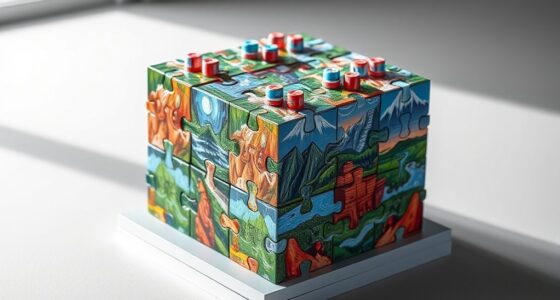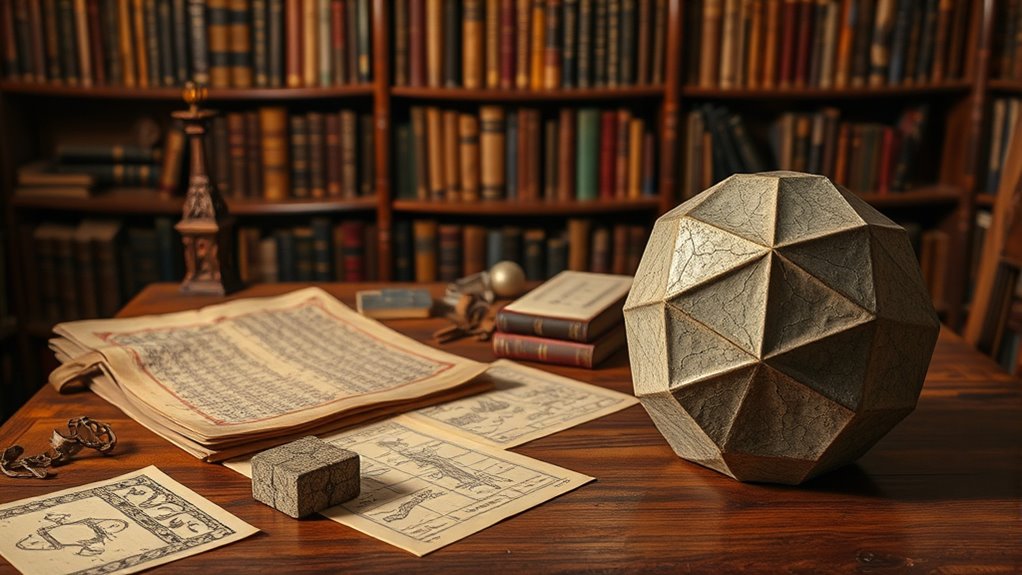

The history of puzzles begins with simple riddles and carved artifacts from ancient civilizations like China, Egypt, and Greece, where puzzles served as entertainment and learning tools. Over time, inventions like the tangram and mechanical puzzle boxes advanced puzzle complexity. Today, digital and 3D puzzles use technology to challenge your mind in new ways. If you keep exploring, you’ll discover how humanity’s fascination with problem-solving has evolved into the remarkable puzzles we enjoy now.
Key Takeaways
- Puzzles originated in ancient civilizations like China, Egypt, and Greece, serving as entertainment and educational tools.
- Medieval and Renaissance periods saw the development of complex riddles, encoded messages, and mechanical puzzles.
- The 18th and 19th centuries introduced mechanical puzzles such as puzzle boxes, emphasizing craftsmanship and problem-solving.
- Modern puzzles incorporate digital technology, including virtual reality, 3D models, and interactive video games.
- The evolution reflects humanity’s ongoing fascination with challenging the mind through increasingly sophisticated forms.

Have you ever wondered how puzzles have evolved over centuries to become the popular pastime they are today? The journey begins with ancient civilizations, where early forms of puzzles served as both entertainment and tools for education. Archaeologists have uncovered evidence of puzzle-like objects from civilizations such as the Chinese, Egyptians, and Greeks. These early puzzles often took the form of carved stone or clay items, designed with intricate patterns or riddles that challenged the mind. For example, the Chinese invented tangram puzzles around 3000 BCE, which involved rearranging geometric shapes to form various figures. Meanwhile, the Egyptians created hieroglyphic puzzles that required deciphering symbols, serving both as entertainment and a way to communicate complex ideas. The Greeks, too, contributed with riddles and labyrinth designs, like the famous Minotaur maze, which was not just myth but also a form of puzzle solving.
As centuries passed, the puzzle evolution continued, influenced by different cultures and technological advances. During the Middle Ages, puzzle-making became more sophisticated, often used in literature and art to encode messages. By the Renaissance, puzzles started to incorporate more complex logic and mechanics, reflecting a growing interest in intellectual challenge. The invention of printing presses in the 15th century helped spread puzzles more widely, allowing riddles and brainteasers to reach a broader audience. The 18th and 19th centuries marked a significant leap, with the rise of mechanical puzzles like the puzzle box and unraveling puzzles that required physical manipulation and clever thinking. These innovations laid the groundwork for modern puzzle design, blending craftsmanship with mental challenge.
Today, the evolution of puzzles has reached new heights with digital technology. From simple jigsaw puzzles to complex 3D models, puzzles now engage multiple senses and skills. Video games and virtual reality have introduced immersive puzzles that require strategic thinking and spatial awareness. The development of 3D puzzles has revolutionized the industry, offering tactile and visual complexity that wasn’t possible before. You can now assemble intricate models, explore virtual escape rooms, or solve digital riddles that challenge your logic and creativity simultaneously. This progression from ancient carvings and riddles to high-tech 3D models reflects an ongoing desire to entertain, educate, and stimulate the mind. The history of puzzles is a tribute to humanity’s fascination with problem-solving and the endless ways we find to twist, turn, and challenge our brains through the ages.

Onietoiy Big 32 Steps Wooden Secret Puzzle Box Toys Beech Wood Money Holder Handmade Storage Brain Teaser Unlocking Games Retro Compartment Thinking Toy Mysterious Birthday Gift for Kids and Adults
[ENGAGING 32-STEP CHALLENGE] – FUN FOR KIDS & TEENS Unlock the joy of discovery! Our 32-step interlocking mechanism…
As an affiliate, we earn on qualifying purchases.
As an affiliate, we earn on qualifying purchases.
Frequently Asked Questions
How Have Puzzles Influenced Modern Cognitive Development Strategies?
Puzzles influence your modern cognitive development strategies by enhancing problem-solving techniques and boosting cognitive skills. When you engage with puzzles, you improve your critical thinking, pattern recognition, and logical reasoning. These activities challenge your brain, encouraging adaptive thinking and mental flexibility. By incorporating puzzles into your routine, you actively develop essential skills that support learning, creativity, and decision-making, making your cognitive processes sharper and more resilient in everyday situations.
What Are the Most Rare and Valuable Historical Puzzles?
You should know that some of the most rare and valuable historical puzzles include antique riddles and rare artifact puzzles. These pieces were often handcrafted, making them highly sought after by collectors. Their historical significance and craftsmanship increase their value, especially when they’re in good condition. You might find that owning such puzzles offers a unique glimpse into ancient cultures and problem-solving techniques, making them treasured artifacts today.
How Did Digital Technology Transform Puzzle Design and Distribution?
Digital technology has revolutionized puzzle design and distribution like a painter releasing a vibrant palette. You now explore digital customization, crafting puzzles tailored to your interests, while virtual puzzle games serve as boundless playgrounds where no physical space limits your creativity. Online platforms enable instant sharing and access, transforming puzzles from solitary challenges into social adventures, making the experience more immersive, accessible, and ever-evolving in the digital domain.
Are There Cultural Differences in Puzzle Types and Preferences?
You’ll notice cultural variations markedly influence puzzle types and preferences. Regional preferences shape the themes, styles, and difficulty levels that resonate most with different audiences. For example, some cultures favor traditional riddles, while others prefer digital or 3D puzzles. Embracing these differences helps creators design puzzles that appeal globally, ensuring each culture’s unique preferences are celebrated and integrated into puzzle development.
What Future Innovations Are Anticipated in Puzzle Creation?
Imagine solving a puzzle where pieces come alive through Augmented Reality, guiding you with hints powered by Artificial Intelligence. Future innovations will likely blend AR and AI to create immersive, personalized experiences, making puzzles more engaging and interactive. You might see 3D printed puzzles that adapt to your skill level or virtual reality environments that challenge you in entirely new ways. These advancements will revolutionize how you play and learn with puzzles.

Wrebbit3D Cinema 3D Puzzle | Urbania Collection | 300 Jigsaw Puzzle Pieces | Charming and Unique Streetscape of a Small Town
RECREATE A VINTAGE CINEMA IN 3D – With bold lines, rooftop jazz marquee, and double door entry, this…
As an affiliate, we earn on qualifying purchases.
As an affiliate, we earn on qualifying purchases.
Conclusion
As you reflect on the history of puzzles, from ancient riddles to intricate 3D models, it’s clear how your curiosity has evolved. Today’s digital puzzles contrast sharply with the handcrafted marvels of the past, yet both challenge your mind in unique ways. Whether you’re solving a centuries-old riddle or assembling a modern 3D model, you’re part of a timeless tradition—one that connects the simple joy of discovery with the complexity of innovation.

Escape Room Quest: Escape the Video Game!: An Interactive Puzzle Adventure (Arcturus Escape Rooms)
As an affiliate, we earn on qualifying purchases.
As an affiliate, we earn on qualifying purchases.
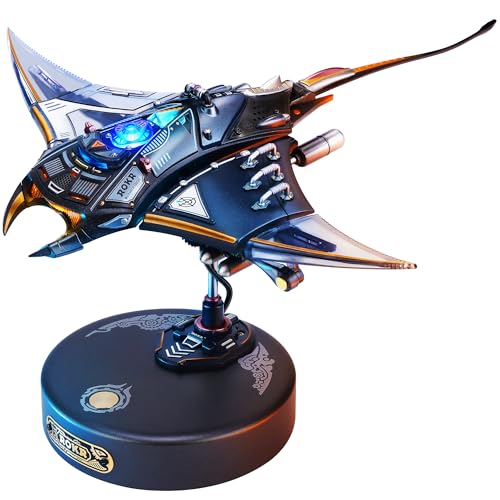
ROKR 3D Metal Puzzles for Adults, Manta Ray Mechanical, 3D Metal Model Kits for Adults to Build, Unique Electric Mechanical Toy
【Dynamic Mechanical Aesthetics】The ROKR Manta Ray model showcases unparalleled dynamic beauty through its sophisticated planetary gear system, making…
As an affiliate, we earn on qualifying purchases.
As an affiliate, we earn on qualifying purchases.