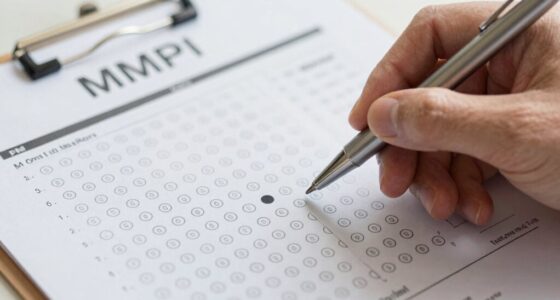

You should never interpret MMPI results in isolation because scores alone don’t give the full picture of a person’s mental health. Factors like cultural background, emotional state, and response biases can influence answers, leading to misdiagnosis. Clinical judgment and personal history are essential to understanding the results accurately. Recognizing the complexity of profiles is crucial for meaningful insights. If you keep exploring, you’ll discover how to interpret these results more effectively within a broader context.

Get privacy and security gear delivered free with Prime
- Fast, free delivery on millions of items
- Prime Video, Amazon Music and more included
- Member-only deals all year
Key Takeaways
- MMPI results are part of a broader assessment and must be combined with interviews, observations, and personal history for accurate interpretation.
- Factors like response biases, cultural background, and emotional state can distort test results, requiring clinical judgment for proper understanding.
- High or low scores on individual scales are insufficient; understanding the interaction among multiple scales provides meaningful insights.
- Validity of responses must be evaluated to avoid misinterpretation caused by exaggeration, minimization, or other response styles.
- Clinical context and personal circumstances are essential to accurately interpret the nuanced and complex profiles generated by the MMPI.

While the MMPI provides valuable insights into an individual’s psychological functioning, you should never interpret its results in isolation. The test is a powerful tool, but it’s only a piece of the puzzle. Relying solely on MMPI scores can lead to misinterpretations and flawed conclusions. To truly understand what the results mean, you need to consider the broader context—clinical interpretation is essential. This means integrating the test data with other information like clinical interviews, behavioral observations, and personal history. Without this thorough approach, you risk overestimating or underestimating certain issues, which can impact the accuracy of your assessment.
The primary reason for this caution is diagnostic accuracy. The MMPI is designed to identify patterns and traits associated with various mental health conditions, but it’s not infallible. Factors like test-taking attitude, cultural background, or current emotional state can influence responses. For example, someone might exaggerate symptoms to appear more distressed, or they might downplay issues due to stigma. If you interpret the results without considering these factors, you might arrive at an inaccurate diagnosis. That’s why clinical judgment is crucial—your understanding of the person’s life circumstances, history, and current situation guides you in making sense of the raw scores. Additionally, understanding the complexity of psychological assessment helps ensure that interpretations are comprehensive and accurate. Recognizing the multifaceted nature of MMPI profiles further emphasizes the importance of a nuanced and informed approach. Moreover, awareness of response styles and biases can significantly influence interpretation, making it essential to evaluate the validity of the responses before drawing conclusions. A thorough knowledge of psychological testing principles can help interpret results more accurately and avoid common pitfalls.
Being familiar with assessment validity and reliability ensures that the conclusions drawn from the MMPI are based on sound data, reducing the risk of misinterpretation. Furthermore, MMPI results are complex and multifaceted. They comprise multiple scales and subscales, each providing different pieces of information. Simply looking at a high score on one scale isn’t enough; you need to analyze how various scales interact and what that combination signifies within the person’s overall profile. This nuanced interpretation requires experience and skill. Without it, you could misattribute symptoms or overlook important comorbidities. Clinical interpretation ensures that you don’t see just numbers but understand the person behind those numbers, leading to more accurate and meaningful insights.
As an affiliate, we earn on qualifying purchases.
Frequently Asked Questions
How Do Cultural Differences Affect MMPI Interpretation?
Cultural differences profoundly impact MMPI interpretation because cultural biases can influence how you understand responses. Interpretation challenges arise when cultural norms shape individuals’ answers, possibly leading to misdiagnosis or misunderstanding. You need to take into account cultural context to avoid overgeneralizing or misinterpreting results. By acknowledging these differences, you guarantee a more accurate, fair assessment, recognizing that responses are shaped by cultural background, not just psychological traits.
Can MMPI Results Predict Future Mental Health Issues?
MMPI results can give you some insights, but they have predictive limitations for future mental health issues. You shouldn’t rely solely on them because outcomes are uncertain, and many factors influence mental health. While the test can highlight current concerns, it doesn’t definitively forecast future problems. Always consider additional assessments and professional judgment to understand and address potential mental health challenges accurately.
What Training Is Required to Accurately Interpret MMPI Scores?
You need specific training prerequisites to accurately interpret MMPI scores, such as a background in psychology or counseling. Developing strong interpretative skills involves understanding the test’s structure, scales, and validity indicators. You should complete formal training courses or workshops focused on MMPI interpretation, practice under supervision, and stay current with updates in psychological assessment standards. This guarantees you analyze results responsibly and avoid misinterpretation.
How Do Comorbid Conditions Influence MMPI Outcomes?
You might be surprised, but comorbid conditions can considerably influence MMPI outcomes due to the complexity of overlapping symptoms. When multiple disorders coexist, they can mask or mimic each other, leading to misleading interpretations if not carefully considered. Recognizing this, you need to assess the full clinical picture, understanding that comorbidity complexity requires a nuanced approach. Always integrate MMPI results with other data to guarantee precise, thorough understanding.
Are There Alternative Assessments to MMPI for Personality Evaluation?
You can consider alternative tests like the NEO-PI-R or the Millon Clinical Multiaxial Inventory for personality evaluation. These assessments often provide different insights and may be more suitable depending on your specific needs. Remember to account for cultural considerations, as some tests may not be valid across diverse populations. Combining multiple assessments and cultural factors gives a more complete understanding of personality traits.
As an affiliate, we earn on qualifying purchases.
Conclusion
So, next time you get those MMPI results, remember—relying solely on them is like trying to read a book by its cover. The irony? They’re helpful, yet incomplete. Don’t let the numbers deceive you into thinking you’ve got the full story. Always consider the bigger picture—your history, your environment, your quirks. After all, the true puzzle isn’t in the scores alone; it’s in what you and your clinician piece together.
As an affiliate, we earn on qualifying purchases.
mental health evaluation resources
As an affiliate, we earn on qualifying purchases.
As an affiliate, we earn on qualifying purchases.
Halloween Picks
halloween
As an affiliate, we earn on qualifying purchases.