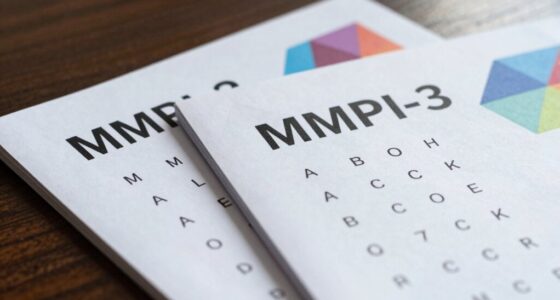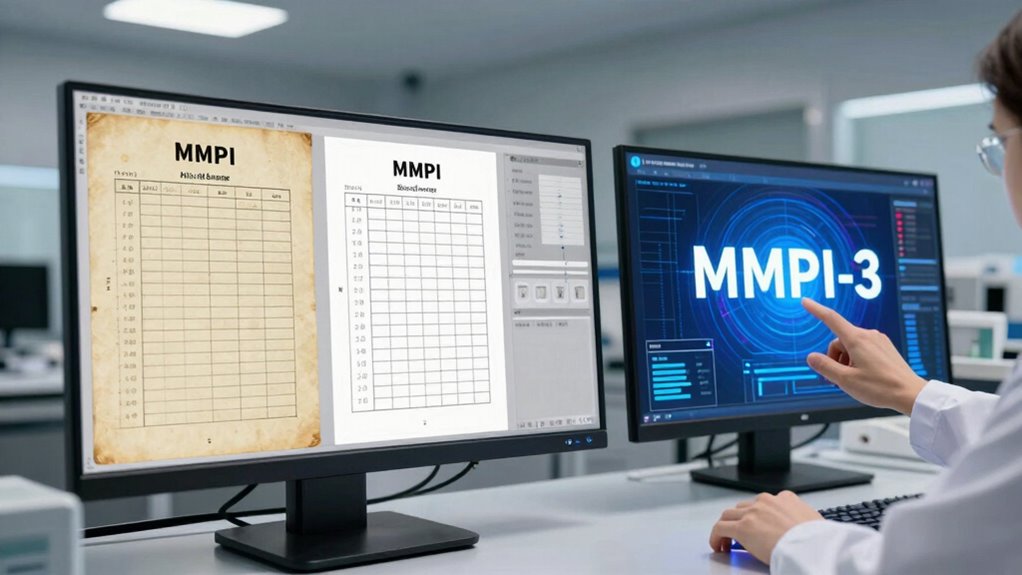
You see the MMPI evolve from its 1940s origins, addressing cultural limits of early versions. The MMPI-2, introduced in the 1980s, improved reliability, language, and norms. The latest, MMPI-3, launched in 2020, refines scales for better mental health differentiation and adds cultural sensitivity. These updates aim to make assessments more accurate and inclusive. If you keep exploring, you’ll uncover how these changes shape modern psychological evaluation even further.
Key Takeaways
- The original MMPI was developed in the 1940s, with early versions limited by cultural and linguistic factors.
- MMPI-2, introduced in the late 1980s, improved language, normative data, and psychometric reliability.
- Continuous refinements enhanced validity scales, accuracy, and cultural sensitivity across versions.
- MMPI-3, launched in 2020, features modern, culturally inclusive items and streamlined administration.
- The evolution reflects ongoing efforts to improve reliability, clinical utility, and relevance in diverse societal contexts.
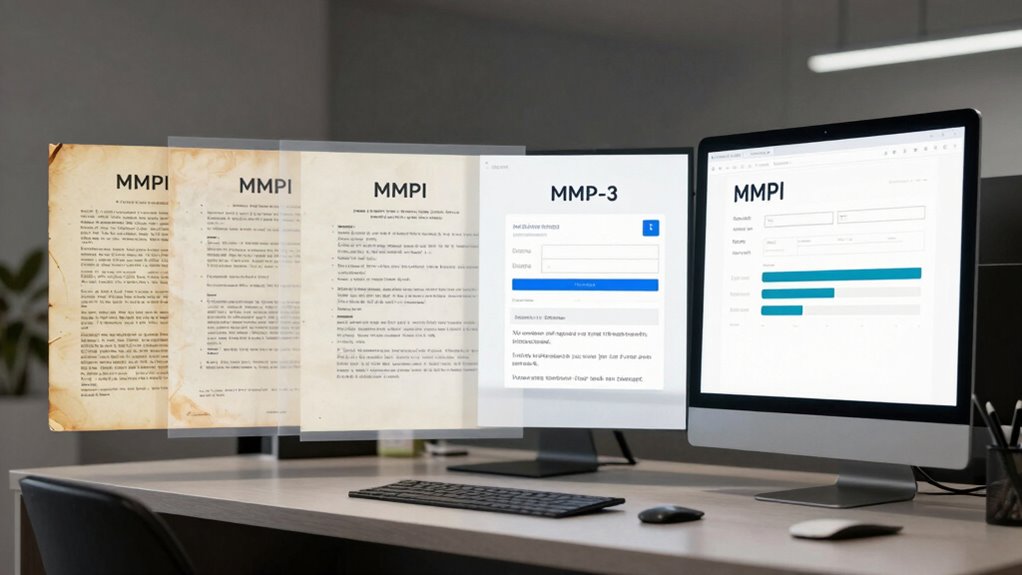
Have you ever wondered how the MMPI, one of the most widely used psychological assessment tools, has evolved over time? The journey from the original versions to the latest MMPI-3 reflects significant psychometric enhancements that improve both accuracy and relevance. Early versions, like the MMPI and MMPI-2, laid a strong foundation for personality assessment, but they faced limitations. Over the years, researchers worked diligently to refine the items, improve reliability, and reduce biases, guaranteeing the tests better serve diverse populations. These improvements aren’t just academic; they directly impact clinical applications. Implementing standardized testing procedures with each iteration, clinicians gain more precise tools to evaluate mental health conditions, personality structure, and behavioral tendencies. The ongoing efforts to update and adapt the MMPI demonstrate a commitment to maintaining its psychometric integrity amidst evolving societal and cultural landscapes. Additionally, the integration of cultural sensitivity features in newer versions underscores the importance of inclusive assessment practices. The continuous refinement of test validity further ensures that the assessments are accurate and meaningful across different settings and populations. Moreover, the incorporation of psychometric enhancements ensures the MMPI remains a reliable and valid instrument for psychological assessment in diverse contexts.
The evolution of the MMPI enhances accuracy, cultural sensitivity, and clinical utility for diverse populations.
The original MMPI, developed in the 1940s, was groundbreaking but had notable shortcomings. Its items were rooted in the cultural context of that time, which limited its effectiveness across different groups. The MMPI-2, introduced in the late 1980s, addressed many of these issues by updating language and expanding normative data. Its psychometric enhancements included better internal consistency and validity scales, allowing clinicians to interpret results with greater confidence. These upgrades made the MMPI-2 more reliable for diagnosing psychological disorders and understanding personality traits, broadening its clinical applications. Mental health professionals could now use it more effectively in forensic, clinical, and research settings.
As psychological research advanced, so did the need for a more modern tool. The MMPI-3, launched in 2020, represents the latest development. It incorporates contemporary language and culture-sensitive items, ensuring that assessments are more inclusive and accurate across diverse populations. Psychometric improvements include refined scales that better distinguish between different mental health issues and personality features. The MMPI-3 also offers a more streamlined administration process, making it more accessible for clinicians and clients alike. These updates enhance clinical applications by providing richer, more nuanced insights into an individual’s psychological makeup. They help clinicians tailor treatment plans more effectively and identify issues that might have been overlooked with previous versions.
In essence, each version of the MMPI reflects a commitment to improving psychometric properties and expanding its clinical usefulness. From the early days of psychological assessment to the sophisticated tools of today, the evolution of the MMPI ensures that mental health professionals can rely on it for accurate, culturally sensitive, and all-encompassing evaluations.
MMPI-3 psychological assessment kit
As an affiliate, we earn on qualifying purchases.
As an affiliate, we earn on qualifying purchases.
Frequently Asked Questions
How Has Cultural Diversity Influenced MMPI Revisions?
Cultural diversity has considerably influenced MMPI revisions by emphasizing cultural sensitivity and assessment adaptation. You’ll see updates that better account for diverse backgrounds, ensuring the test is fair and accurate across various cultures. These changes help you interpret results more precisely, reducing bias and improving relevance. As a result, the MMPI now better reflects different cultural perspectives, making it a more effective tool for psychological assessment worldwide.
What Technological Advancements Impacted MMPI Development?
You’re riding the wave of technological progress, which has dramatically shaped the MMPI’s evolution. Digital scoring transforms paper tests into lightning-fast results, while computerized administration makes taking the assessment as simple as clicking a button. These advances turbocharge accuracy and efficiency, allowing you to get insights in real-time. As the test adapts like a chameleon to new tech, your experience becomes smoother, more precise, and instantly accessible.
Are There Alternative Assessments to MMPI?
Yes, there are alternative assessments to the MMPI. You might explore other psychometric tools like the Personality Assessment Inventory (PAI), the NEO Personality Inventory, or projective tests such as the Rorschach inkblot test. These alternatives can provide different insights into personality and mental health, offering a variety of approaches depending on your specific needs. Each tool has its unique strengths and limitations, so choose based on your assessment goals.
How Is Reliability Maintained Across MMPI Versions?
You can guarantee reliability across MMPI versions by maintaining scale consistency and scoring accuracy. Test developers update items and scoring protocols based on extensive research, which helps preserve the instrument’s reliability. Regular calibration, rigorous validation studies, and standardized administration procedures further support consistent results. By focusing on these factors, you can trust that each version accurately measures psychological traits and maintains its reliability over time.
What Future Changes Are Anticipated for MMPI?
You can expect future MMPI updates to incorporate psychometric innovations that enhance accuracy and validity. These advancements aim to better capture diverse populations and emerging psychological constructs. Additionally, ethical considerations will guide these changes, ensuring fairness, confidentiality, and respectful assessment practices. As technology evolves, integrating computerized testing and adaptive algorithms may become standard, further refining the MMPI’s utility while maintaining its core reliability and ethical integrity.

Clinical Applications of the Personality Assessment Inventory
As an affiliate, we earn on qualifying purchases.
As an affiliate, we earn on qualifying purchases.
Conclusion
So, after all these updates, you might think the MMPI has become more precise and reliable. But isn’t it ironic that, despite centuries of evolution, we’re still searching for the perfect tool to understand human complexity? Perhaps the real truth is that no single version can truly capture the intricacies of the mind—yet we keep refining, hoping, and testing. Maybe, in the end, the journey is more revealing than the destination.

Psychological Evaluations for the Courts: A Handbook for Mental Health Professionals and Lawyers
As an affiliate, we earn on qualifying purchases.
As an affiliate, we earn on qualifying purchases.

IQ and Psychometric Test Workbook: Essential Preparation for Verbal Numerical and Spatial Aptitude Tests and Personality Tests (Testing Series)
New
As an affiliate, we earn on qualifying purchases.
As an affiliate, we earn on qualifying purchases.