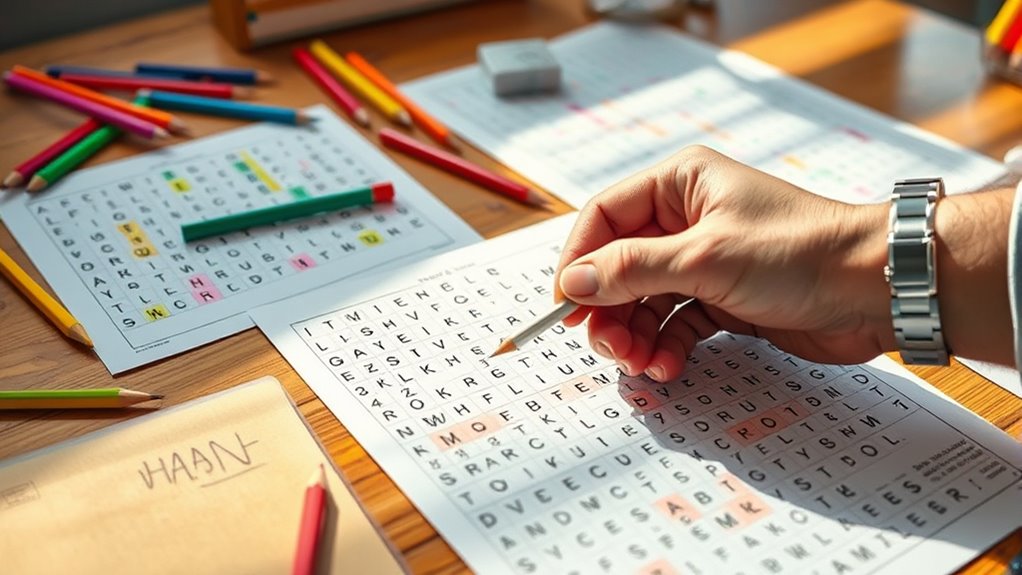

Word puzzles improve your vocabulary by challenging you to decode words, recognize patterns, and make meaningful connections. As you solve crosswords, word searches, or anagrams, you actively engage with unfamiliar words, boosting your understanding and retention. These puzzles also develop your ability to decode new words quickly and enhance your language skills overall. Keep exploring this engaging approach, and you’ll discover even more ways to expand your word knowledge.

Get privacy and security gear delivered free with Prime
- Fast, free delivery on millions of items
- Prime Video, Amazon Music and more included
- Member-only deals all year
Key Takeaways
- Word puzzles encourage active engagement, leading to vocabulary expansion through exposure to new words and contexts.
- Recognizing patterns and solving clues enhance understanding of word structures and meanings.
- Puzzles promote critical thinking and decoding skills, helping learners grasp unfamiliar words quickly.
- Regular puzzle-solving fosters a habit of exploring and learning new vocabulary actively.
- Engaging with puzzles improves comprehension and confidence in using a broader range of words.
Have you ever wondered how word puzzles can boost your vocabulary? Engaging with these puzzles isn’t just about having fun; it’s a powerful way to enhance your language skills. When you approach word puzzles, you naturally employ various word puzzle strategies that make learning new words easier and more enjoyable. These strategies often involve deciphering clues, recognizing patterns, and making connections between words and meanings. By actively applying these techniques, you reinforce your understanding of vocabulary and improve your ability to recall and use new words in everyday conversation.
One of the key benefits of tackling word puzzles is that they serve as excellent vocabulary building techniques. Unlike passive reading or memorization, puzzles require you to think critically about word meanings and relationships. For example, crossword puzzles challenge you to fill in words based on clues, which often involve synonyms, antonyms, or definitions. This pushes you to expand your vocabulary actively, as you encounter unfamiliar words and learn their context. Similarly, word searches and anagrams encourage you to recognize word patterns and letter combinations, fostering a deeper familiarity with spelling and word structures.
Engaging with puzzles enhances vocabulary through critical thinking and pattern recognition.
Your engagement with these puzzles trains your brain to think flexibly about language. As you develop your word puzzle strategies, you start to notice common roots, prefixes, and suffixes, helping you decode unfamiliar words more efficiently. This analytical approach enhances your overall vocabulary building techniques, making it easier to infer meanings without constantly relying on a dictionary. Over time, this mental agility translates into improved reading comprehension and more confident writing, as you become comfortable incorporating new words into your vocabulary.
Furthermore, playing word puzzles regularly helps establish a habit of continuous learning. As you challenge yourself with progressively harder puzzles, you push your linguistic boundaries and broaden your lexical repertoire. This consistent practice encourages you to seek out new words, understand their meanings, and remember them better. The interactive nature of puzzles also makes learning feel less like a chore and more like a game, which boosts motivation and retention. Vocabulary expansion techniques foster a proactive approach to learning new words in a fun and engaging way.
word puzzle books for vocabulary building
As an affiliate, we earn on qualifying purchases.
As an affiliate, we earn on qualifying purchases.
Frequently Asked Questions
Can Word Puzzles Help With Language Learning for Non-Native Speakers?
Yes, word puzzles can definitely aid your language learning as a non-native speaker. They promote contextual learning by helping you see how words fit in different situations, making meanings clearer. Plus, puzzles often include culturally relevant terms, giving you cultural exposure that enriches your understanding. Engaging with puzzles regularly boosts your vocabulary, improves your problem-solving skills, and makes learning new words more fun and effective.
What Types of Word Puzzles Are Most Effective for Vocabulary Building?
You find that anagram challenges and crossword puzzles are highly effective for vocabulary building. Anagram challenges push you to rearrange letters, strengthening your understanding of word structures. Crossword puzzles, on the other hand, help you learn new words in context, reinforcing spelling and meaning. By regularly engaging with these puzzles, you actively expand your vocabulary, making language learning engaging and enjoyable.
How Often Should I Do Word Puzzles to See Vocabulary Improvement?
To see vocabulary improvement, you should practice consistency with word puzzles, ideally doing them several times a week. Aim for at least 15-30 minutes per session, and include puzzle variety to challenge different word skills. Regular practice keeps your mind engaged and helps reinforce new words. By maintaining a steady routine and mixing puzzle types, you’ll notice gradual vocabulary growth and greater language confidence over time.
Do Age or Skill Level Affect the Benefits of Word Puzzles?
Age and skill level do influence how you benefit from word puzzles. Older adults gain age-related cognitive benefits like sharper memory and mental agility, while beginners or advanced solvers find puzzles more engaging and challenging based on their skill level. You’ll see the most improvement when you adapt puzzles to your abilities, ensuring they remain stimulating without causing frustration. This personalized approach maximizes the cognitive and vocabulary gains you seek.
Are Digital or Physical Word Puzzles Better for Vocabulary Enhancement?
Like choosing between a map and a compass, deciding whether digital formats or physical puzzles are better depends on your preferences. Digital puzzles offer convenience and interactive features, making learning engaging and fun. Physical puzzles, on the other hand, provide a tactile experience that can boost retention. Both types enhance vocabulary, but you might find mixing them keeps your learning fresh and effective. Ultimately, choose what motivates you most!
crossword puzzle game for adults
As an affiliate, we earn on qualifying purchases.
As an affiliate, we earn on qualifying purchases.
Conclusion
As you solve word puzzles, you’re planting seeds in a garden of language, each puzzle a watering can nurturing your vocabulary. With every new word uncovered, you’re building a colorful mosaic of understanding, each piece shining brighter. Soon, your words bloom like vibrant flowers, revealing a landscape rich with expression. Keep solving, and watch your language flourish—your mind a thriving orchard where words grow freely, transforming your communication into a vivid, beautiful masterpiece.
As an affiliate, we earn on qualifying purchases.
As an affiliate, we earn on qualifying purchases.
Halloween Picks
halloween
As an affiliate, we earn on qualifying purchases.