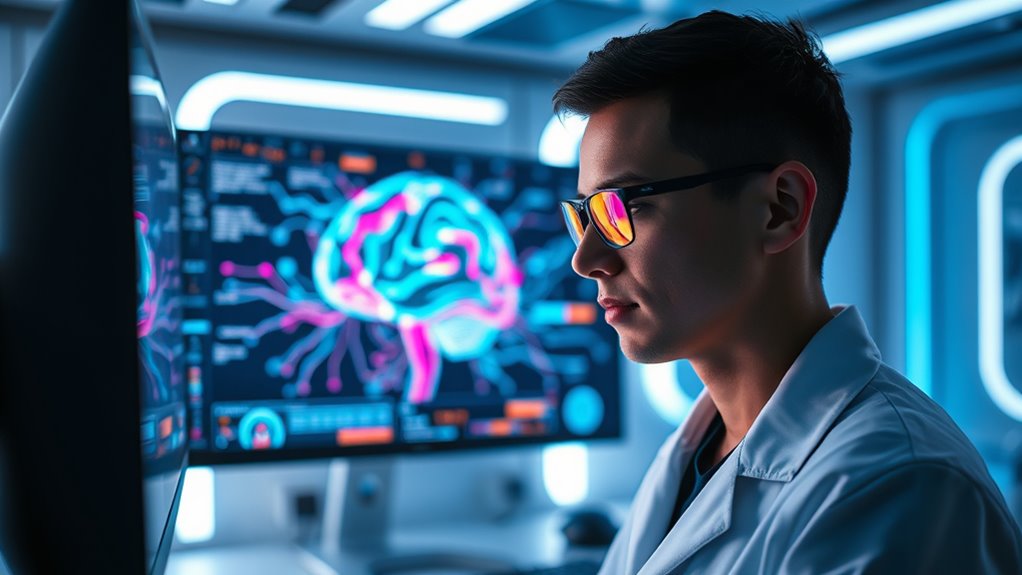

Real-time cognitive tracking works by capturing and analyzing your brain’s electrical signals as they happen. Advanced devices like EEG and neuroimaging detect specific neural patterns associated with your focus, thoughts, or emotions. Sophisticated algorithms interpret these signals instantly, revealing shifts in your mental state or attention. This technology provides immediate insights into your inner experiences, enabling smarter responses and interventions. Keep exploring to discover how these systems can transform understanding and support your mental well-being.
Key Takeaways
- Neural patterns are electrical signals from neuron groups that reveal thoughts, feelings, and attention focus.
- Devices like EEG and neuroimaging capture real-time neural activity for analysis.
- Algorithms process streaming neural data to identify changes in mental states instantly.
- Shifts in attention produce distinct neural signatures, allowing detection of focus transitions.
- Integration with automation enables rapid interpretation and responses based on cognitive activity.
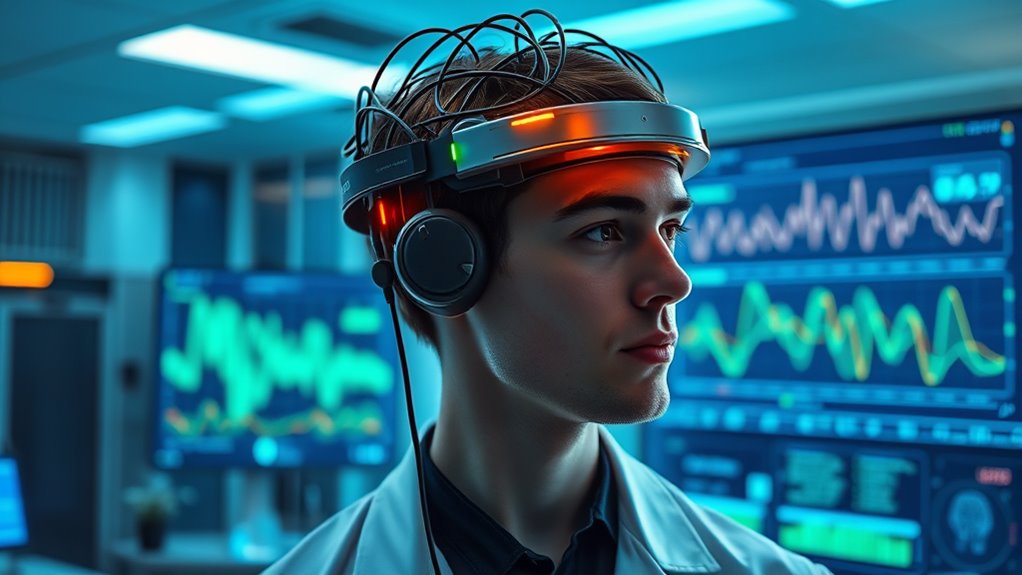
Have you ever wondered how we can monitor a person’s thoughts and mental states as they happen? Thanks to advances in neural technology, researchers now have the ability to observe and interpret brain activity in real time. At the core of this process are neural patterns—specific electrical signals generated by groups of neurons firing in particular arrangements. These patterns act like signatures that reveal what a person is thinking, feeling, or focusing on at any given moment. By analyzing these neural patterns, scientists can decode mental states with remarkable accuracy, providing a window into the mind’s inner workings. Automation in business technologies are also being integrated into neural systems to improve data analysis speed and accuracy. When your attention shifts from one thing to another, your brain’s neural activity changes correspondingly. These attention shifts cause distinct neural patterns to emerge, making it possible to track where your focus lies at any moment. For example, if you’re reading a book and suddenly look up, the neural signals associated with reading will decrease, while those linked to visual attention and environmental awareness will increase. This dynamic change in neural activity allows for continuous, real-time monitoring of your mental focus. Devices such as EEG (electroencephalography) or more advanced neuroimaging tools pick up these electrical signals and interpret them quickly, enabling near-instantaneous insights into mental states.
The process involves sophisticated algorithms that analyze the raw neural data as it streams in. These algorithms are trained on vast datasets to recognize specific neural patterns associated with different tasks, emotions, or thoughts. When a pattern matching a known mental state appears, the system can identify your current focus or emotional response almost immediately. This real-time feedback can be used in numerous applications, from enhancing brain-computer interfaces to improving mental health treatments. For instance, if you’re using a neurofeedback device to manage anxiety, the system can detect when your attention shifts to anxious thoughts and provide calming stimuli accordingly.

SereniBrain EEG Neurofeedback Headband for Meditation & Brainwave Monitoring, Real-Time Brain Activity Tracker with App, Train Focus, Relaxation & Sleep Preparation
Real-Time EEG Neurofeedback Headband for Brainwave Monitoring: Monitor your brain activity in real time using advanced EEG sensors….
As an affiliate, we earn on qualifying purchases.
As an affiliate, we earn on qualifying purchases.
Frequently Asked Questions
What Industries Benefit Most From Real-Time Cognitive Tracking?
You’ll find that industries like marketing, healthcare, and education benefit most from real-time cognitive tracking. It helps you interpret data swiftly, enabling you to understand user engagement levels instantly. With real-time insights, you can adapt your strategies, improve user experiences, and optimize outcomes efficiently. This technology empowers you to make informed decisions quickly, ensuring your efforts resonate better and drive meaningful results across these sectors.
How Accurate Is Real-Time Cognitive Tracking Technology?
You might think real-time cognitive tracking is flawless, but its accuracy varies with technology and context. Neuroscience insights show it can be highly precise in controlled environments, aiding cognitive enhancement efforts. However, factors like sensor quality and user variability can impact results. While promising, it’s not yet perfect, so don’t rely solely on it for critical decisions. Instead, see it as a valuable tool to complement your understanding of brain activity.
What Ethical Considerations Surround Cognitive Data Collection?
When collecting cognitive data, you must prioritize ethical considerations like informed consent and data security. You should guarantee individuals understand what data is being gathered and how it’ll be used, giving them full control. Protecting this sensitive information with robust security measures is essential to prevent breaches. By respecting privacy and transparency, you foster trust and avoid potential misuse or ethical breaches in cognitive tracking technology.
Can Real-Time Cognitive Tracking Be Integrated With Existing Systems?
You can definitely integrate real-time cognitive tracking with existing systems, but remember, “a chain is only as strong as its weakest link.” You’ll need seamless sensor integration to guarantee data flows smoothly, and prioritizing data security is vital to protect sensitive information. With careful planning, you can enhance your system’s capabilities while maintaining privacy and security, creating a powerful, cohesive solution.
What Are the Privacy Implications for Users?
You should be aware that real-time cognitive tracking raises privacy concerns, especially around data security and user consent. When you use these systems, it’s essential that your data is protected through robust security measures, and that you’re fully informed and give clear consent. Without proper safeguards and transparency, your sensitive cognitive data could be vulnerable, making it imperative for developers to prioritize privacy and obtain explicit user approval.
SereniBrain EEG Neurofeedback Headband for Meditation & Brainwave Monitoring, Real-Time Brain Activity Tracker with App, Train Focus, Relaxation & Sleep Preparation
Real-Time EEG Neurofeedback Headband for Brainwave Monitoring: Monitor your brain activity in real time using advanced EEG sensors….
As an affiliate, we earn on qualifying purchases.
As an affiliate, we earn on qualifying purchases.
Conclusion
As you navigate the intricate dance of your mind, real-time cognitive tracking acts like a vigilant lighthouse, illuminating your thoughts with precision. It captures your mental currents as they flow, revealing hidden patterns beneath the surface. With each moment, you gain a clearer view of your internal landscape—like watching a sunrise unfold in slow, deliberate strokes. Embrace this technology, and let it guide you through the evolving tapestry of your consciousness with grace and insight.
neuroimaging brain scanner
As an affiliate, we earn on qualifying purchases.
As an affiliate, we earn on qualifying purchases.

Muse S Athena: The Brain Sensing Headband – Deep Sleep Boost, Sleep Assist and Tracking – Neurofeedback Devices for Meditation Tracking & Monitoring with EEG and fNIRS Sensors – Carbon (Dark Grey)
Deep Sleep Boost – Newest feature designed to detect slow-wave sleep and sustain it longer for a more…
As an affiliate, we earn on qualifying purchases.
As an affiliate, we earn on qualifying purchases.