To incorporate puzzles into your classroom, start by selecting ones that align with your curriculum and students’ ability levels. Use puzzles as warm-ups, group activities, or end-of-lesson challenges to boost engagement and critical thinking. Encourage collaboration, facilitate discussions, and provide hints to keep motivation high. Monitor student reactions and adjust difficulty to maintain interest. If you continue exploring, you’ll discover effective strategies to make puzzle integration seamless and impactful for all learners.
Key Takeaways
- Align puzzles with curriculum goals to reinforce learning and boost engagement.
- Schedule dedicated puzzle activities during warm-up, transition, or end of lessons.
- Use group puzzles to promote collaboration, communication, and peer learning.
- Scaffold puzzles with hints and adjust difficulty based on student progress.
- Reflect on student responses to refine puzzle choices and enhance critical thinking skills.
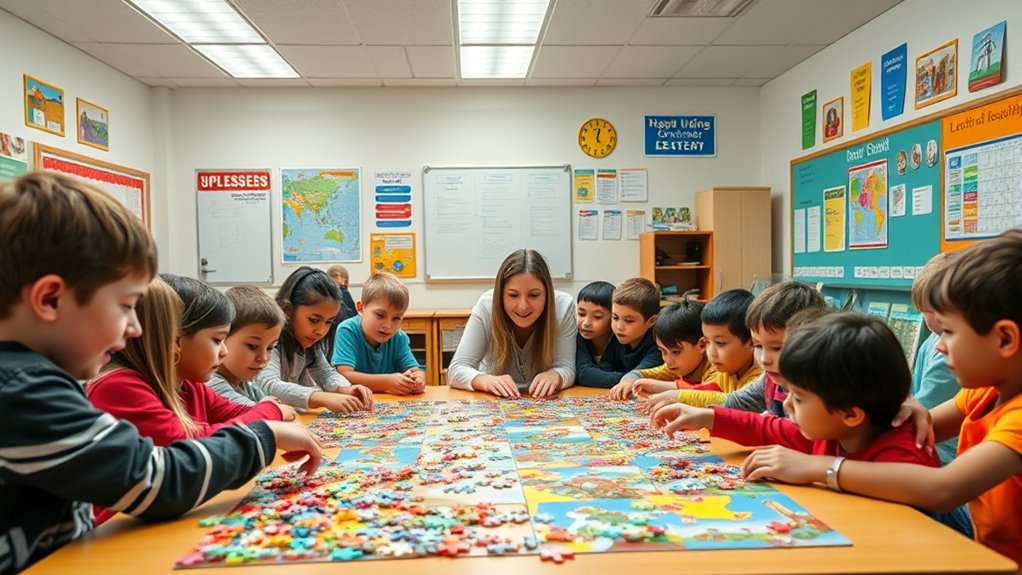
Incorporating puzzles into classroom learning can considerably boost student engagement and critical thinking skills. When you introduce puzzles into your lessons, you’re not just making the material more fun—you’re actively encouraging students to think deeply and participate more fully. Puzzles challenge students to analyze problems from different angles, fostering critical thinking that goes beyond rote memorization. As students work through these brainteasers, they learn to apply logic, evaluate evidence, and develop problem-solving strategies, which are essential skills for academic success and real-world situations.
To effectively incorporate puzzles, start by selecting ones that align with your educational goals. For example, if you’re teaching math, riddles that require numerical reasoning can reinforce concepts while keeping students interested. For language arts, word puzzles or crossword challenges can boost vocabulary and comprehension. The key is to choose puzzles that are neither too easy nor too difficult, so students remain motivated without feeling overwhelmed. You can also tailor puzzles to different ability levels, ensuring everyone can participate meaningfully.
Choosing age-appropriate puzzles enhances engagement and supports diverse learning needs.
Next, consider how you introduce puzzles into your classroom routine. You might dedicate a specific time during lessons for puzzle-solving, such as a warm-up activity or a group challenge at the end of class. Group puzzles are especially effective because they promote collaboration, communication, and peer learning. When students work together to solve a puzzle, they exchange ideas, challenge each other’s assumptions, and develop critical thinking skills collectively. Encourage open discussion and reflections afterward, so students can articulate their reasoning processes and learn from each other’s strategies.
Another effective approach is to integrate puzzles as part of project-based learning. For instance, you could assign students a puzzle-based project where they need to research, collaborate, and find solutions to real-world problems. This not only reinforces critical thinking but also makes learning more relevant and engaging. Providing hints or scaffolded clues can help students stay motivated and develop confidence as they work through the challenges. Remember to celebrate successes and emphasize the learning process rather than just the correct answer to foster a growth mindset.
Finally, assess how puzzles impact your students’ engagement and critical thinking. Observe their enthusiasm, participation levels, and the quality of their reasoning during puzzle activities. Use these insights to refine your approach, choosing new puzzles that stimulate curiosity and challenge their thinking even further. Additionally, leveraging AI-powered content clusters can enhance your puzzle selection process by identifying relevant and appropriately challenging puzzles that align with your curriculum. When you consistently incorporate puzzles into your teaching, you’ll notice students becoming more active, thoughtful participants in your classroom, ready to tackle complex problems with confidence.

Puzzles for Kids Ages 4-8, 14 Pack Wooden Jigsaw Puzzles 30 Pieces Preschool Educational Learning Toys Set for Toddler Boys and Girls Stocking Stuffers
Value Pack: You will get 14 packs wooden jigsaw puzzles for toddlers, Dinosaur, Bus, Spacer, Insect, Animal…Sufficient quantity…
As an affiliate, we earn on qualifying purchases.
As an affiliate, we earn on qualifying purchases.
Frequently Asked Questions
How Can Puzzles Improve Student Critical Thinking Skills?
Puzzles boost your students’ critical thinking by encouraging problem solving strategies and enhancing cognitive development. When you introduce puzzles, you challenge students to analyze, evaluate, and find solutions, which sharpens their reasoning skills. This active engagement helps them approach complex problems with confidence and creativity. By integrating puzzles into lessons, you’re fostering a learning environment where students develop essential critical thinking abilities that benefit their academic and real-world success.
What Types of Puzzles Are Best for Different Age Groups?
Your classroom is a garden, and puzzles are the seeds that grow young minds. For early learners, simple brain teasers and colorful word scrambles sprout curiosity and foundational skills. As students grow, challenging riddles and logic puzzles help their critical thinking blossom. Tailor puzzles to age, like nurturing delicate seedlings or robust trees, ensuring each build their mental strength at the right time, cultivating lifelong learning.
How Do I Assess Student Progress Through Puzzles?
To assess student progress through puzzles, you observe their engagement and problem-solving strategies, which serve as formative assessments. You can track how students approach puzzles, noting improvements in critical thinking and collaboration over time. By analyzing their responses and strategies, you gain insights into their understanding, allowing you to tailor future instruction effectively. This active process helps you gauge individual growth while keeping students motivated and involved.
Are There Digital Tools to Create Classroom Puzzles?
Imagine a toolbox filled with digital platforms waiting to turn your ideas into engaging puzzles. Yes, there are many digital tools for puzzle creation, like Canva, Quizizz, and Puzzle Maker. These platforms act as your creative partners, helping you craft riddles, crosswords, and interactive challenges effortlessly. With just a few clicks, you transform lesson concepts into mesmerizing puzzles that spark curiosity and deepen understanding in your classroom.
How Can I Encourage Collaboration With Puzzle-Based Activities?
To encourage collaboration with puzzle-based activities, you should design tasks that require group work and problem solving. Assign students to small teams, and give each group a puzzle that needs collective effort to solve. Promote open communication, idea sharing, and active listening. By doing so, you foster teamwork and critical thinking, making the learning process engaging and effective. This approach helps students build essential collaboration skills while tackling fun, challenging puzzles.

24 Pcs Balance IQ Maze Game,Mini Maze Cube Puzzle Box 3D Brain Maze Toy Puzzles Party Favor Games, Ideal Prizes Gifts for Kids and Adults
【24 PACK Brain Puzzle Cubes】These challenging and rewarding brain puzzle games come in pack of 24. Each mini…
As an affiliate, we earn on qualifying purchases.
As an affiliate, we earn on qualifying purchases.
Conclusion
Incorporating puzzles into your classroom can boost student engagement and improve problem-solving skills. Did you know that students who participate in puzzle-based activities score 15% higher on critical thinking assessments? By integrating puzzles, you’re not just making learning fun—you’re enhancing understanding and retention. So, start small, stay consistent, and watch your students become more motivated and confident learners. Puzzles are a simple yet powerful tool to transform your teaching experience.

Evan-Moor Skill Sharpeners Critical Thinking, Grade 4 Workbook, Problem Solving Skills, Fun Activities, Higher-Order, Open-Ended Questions and Challenges, Science, Math, Social Studies, Language Arts
As an affiliate, we earn on qualifying purchases.
As an affiliate, we earn on qualifying purchases.

Ultimate Puzzle Challenge!: 125+ Brain Games for Kids, Mazes, Brain Teasers, Word Searches, Crossword Puzzles, Sudoku, Logic Puzzles and More, Kids Activity Book (Highlights Jumbo Books & Pads)
As an affiliate, we earn on qualifying purchases.
As an affiliate, we earn on qualifying purchases.