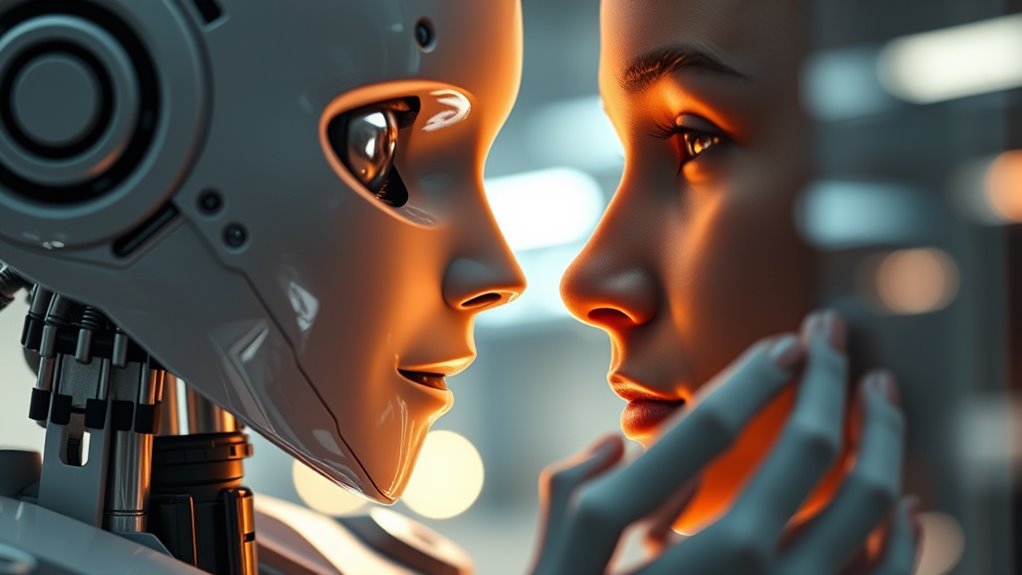

Emotional AI is designed to recognize and interpret your feelings by analyzing facial expressions, voice tone, body language, and physiological signals. It responds with empathy, adjusting its behavior to create more natural and supportive interactions. Advances in machine learning continually improve its accuracy, helping machines understand complex emotions across different cultures. As technology develops, these systems will become better at building genuine connections. Keep exploring to discover how this rapidly evolving field is shaping human-machine interactions.
Key Takeaways
- Emotional AI detects human feelings by analyzing facial expressions, voice tone, body language, and physiological signals.
- It uses machine learning to interpret emotional cues and generate context-aware, empathetic responses.
- Advances in neural networks improve the accuracy of emotion recognition, including microexpressions and speech patterns.
- Challenges include understanding cultural differences and emotional complexity to prevent misinterpretation.
- Future applications aim to enhance mental health support, personalized learning, and customer service through emotionally aware AI.
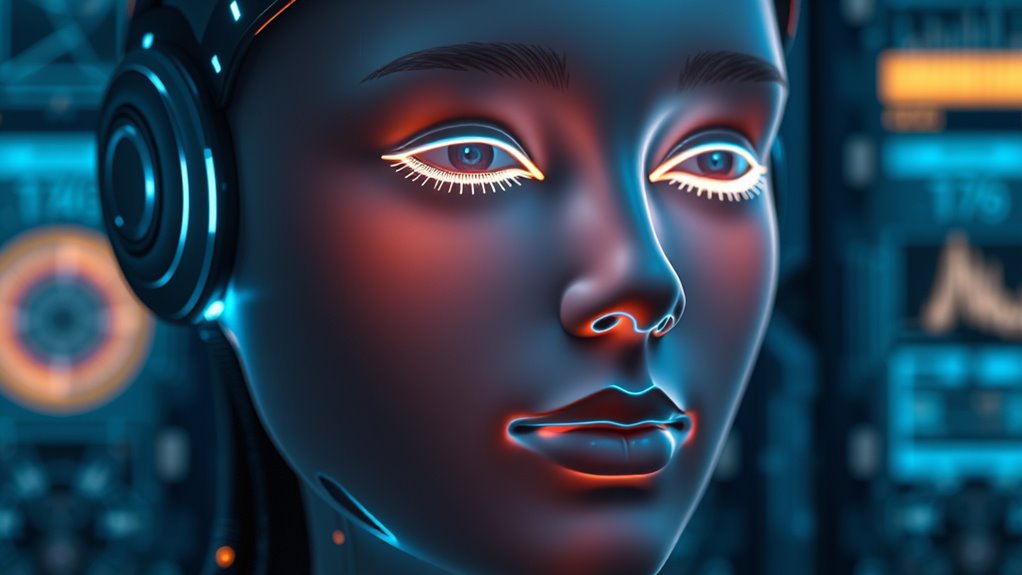
As artificial intelligence advances, developers are increasingly focusing on Emotional AI—technology designed to recognize, interpret, and respond to human emotions. This shift aims to make machines more intuitive and capable of understanding your feelings, creating more natural interactions. At the core of this effort are emotion detection systems, which analyze facial expressions, voice tone, body language, and even physiological signals to gauge your emotional state. By recognizing subtle cues, these systems can determine whether you’re happy, frustrated, anxious, or upset. The goal is to bridge the gap between human emotional complexity and machine responsiveness, making digital interactions feel more genuine.
Emotional AI analyzes facial cues, voice, and body language to understand and respond to human emotions naturally.
Empathetic algorithms play a critical role in this process. These are specially designed AI models trained to interpret emotional data and generate appropriate responses. For example, if you’re speaking to a customer support chatbot and seem distressed, the empathetic algorithm might recognize your frustration and respond with soothing language or escalate the issue to a human agent. Such algorithms don’t just identify emotions—they adapt their behavior based on your emotional cues, fostering a sense of understanding and care. This ability to respond empathetically can improve user experience considerably, making interactions smoother and more satisfying.
You might wonder how accurate emotion detection can be. In reality, advances in machine learning and deep neural networks have improved these systems tremendously. They now process vast amounts of data to identify emotional patterns with remarkable precision. For instance, analyzing your voice pitch and speech patterns allows AI to detect stress or excitement, while facial recognition software can interpret microexpressions that reveal fleeting emotions. These technologies work together to build a nuanced picture of your emotional state, enabling machines to respond in ways that feel more human and less mechanical. Emotion detection systems are continuously refined to better understand the complexity of human feelings and improve accuracy.
Despite these advancements, emotional AI still faces challenges. Emotions are complex and often context-dependent, so AI might misinterpret some cues or fail to grasp cultural differences in emotional expression. Developers are continually refining empathetic algorithms to handle such nuances better, aiming for systems that are not only accurate but also respectful of individual differences. As these technologies evolve, you’ll notice more applications—whether in mental health support, personalized learning, or customer service—where machines can genuinely understand and respond to your feelings.
In essence, emotion detection and empathetic algorithms are transforming AI from simple tools into emotionally aware companions. They’re designed to recognize your feelings more accurately and respond in ways that foster trust, comfort, and understanding. As this field progresses, you’ll experience interactions that feel less cold and more human, creating a future where machines can truly connect with your emotional world.

FACIAL EMOTION RECOGNITION FOR DECISION MAKING
As an affiliate, we earn on qualifying purchases.
As an affiliate, we earn on qualifying purchases.
Frequently Asked Questions
How Accurate Is Emotional AI in Detecting Complex Emotions?
Emotion recognition in emotional AI is still evolving, so its accuracy in detecting complex emotions isn’t perfect. You might find it struggles with subtle cues or mixed feelings, facing accuracy challenges that limit its reliability. While AI can often identify basic emotions like happiness or anger, understanding nuanced or layered emotions remains difficult. You should keep in mind that emotional AI’s performance varies depending on the context and quality of data it analyzes.
Can Emotional AI Interpret Cultural Differences in Emotional Expression?
You might wonder if emotional AI can truly grasp cultural nuances and emotional diversity. The truth is, it struggles to interpret these differences accurately because it relies on patterns from its training data. Cultural expressions of emotion vary widely, and AI often misses these subtle cues. While advancements are ongoing, recognizing and responding appropriately to diverse emotional displays remains a significant challenge for emotional AI.
What Are the Privacy Concerns With Emotional AI Data Collection?
You should be aware that emotional AI data collection raises privacy concerns, especially around data security and consent management. When personal emotions are analyzed, there’s a risk of sensitive information being mishandled or leaked. Companies must make sure you give clear consent and implement strong data security measures to protect your privacy. Without proper safeguards, your emotional data could be exploited or accessed improperly, risking your personal confidentiality.
How Does Emotional AI Handle False Positives or Negatives?
They say “a chain is only as strong as its weakest link,” and emotional AI faces misinterpretation risks with false positives or negatives. To handle this, developers focus on calibration challenges, refining algorithms to better distinguish genuine emotions. When the system misreads feelings, it’s vital to update and improve the model continually, reducing errors. This ongoing process helps guarantee emotional AI responds accurately, minimizing misunderstandings and fostering trust.
What Are Future Developments Expected in Emotional AI Technology?
You’ll see future emotional AI develop with advanced predictive analytics, enabling it to better anticipate human feelings before they fully surface. This tech will enhance emotional empathy, allowing AI to respond more naturally and genuinely. As these systems learn from vast data, they’ll become more nuanced, improving interactions. Expect smarter, more intuitive emotional AI that understands your emotions deeply, fostering stronger connections and more personalized experiences.

AI Voice Recorder, Transcribe & Summarize with Deep AI Analysis, Support 152 Languages, App Control, AI Noise Cancellation, Upgraded Built-in MagSafe, 64GB Audio Recorder for Meetings, Lectures, Call
🤖 【Your Personal AI Note Taker】- Powered by cutting-edge AI models including GPT-5, GPT-4o, GPT-4.1, o3-mini, GPT-5-mini, Gemini…
As an affiliate, we earn on qualifying purchases.
As an affiliate, we earn on qualifying purchases.
Conclusion
Think of Emotional AI as a skilled lighthouse keeper, guiding ships through stormy seas of human emotion. It senses your feelings like a steady beacon, illuminating your unspoken words and responding with understanding. As you navigate life’s tempests, this technology becomes your silent companion, shaping connections that feel truly human. Remember, just like a lighthouse doesn’t control the storm, Emotional AI guides without overriding your authentic feelings, helping you find your way in the vast ocean of human emotion.

Emotional Life of Your Brain, The
As an affiliate, we earn on qualifying purchases.
As an affiliate, we earn on qualifying purchases.

EMOTIONALLY INTELLIGENT CHATBOTS FOR CUSTOMER ENGAGEMENT: BUILD CHATBOTS WITH ADVANCED EMOTIONAL INTELLIGENCE CAPABILITIES
As an affiliate, we earn on qualifying purchases.
As an affiliate, we earn on qualifying purchases.