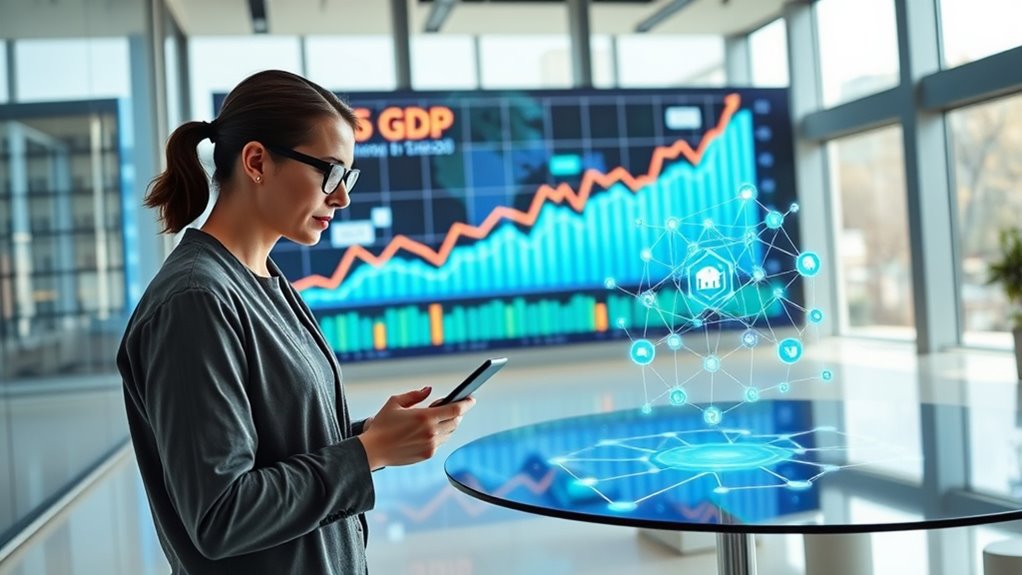

Measuring AI’s economic impact involves examining how investments in AI boost productivity and contribute to GDP growth. You’ll want to look at productivity gains across sectors and how AI-driven innovations streamline processes. However, it’s important to think about the disruptions caused by job displacements and labor shifts, which can obscure short-term effects. If you keep exploring, you’ll uncover how policymakers and businesses balance these factors to understand AI’s true economic influence.
Key Takeaways
- AI-driven productivity gains can boost GDP, but measuring these effects requires isolating AI contributions from other factors.
- Short-term labor disruptions from automation may temporarily obscure true productivity improvements.
- Investment levels in AI influence the scale of economic impact on GDP and overall productivity.
- Displacement of routine jobs complicates assessments of AI’s net effect on employment and economic output.
- Effective policy and workforce adaptation are crucial for accurately capturing AI’s long-term influence on economic growth.

Artificial intelligence is transforming economies at a rapid pace, but quantifying its true impact remains a complex challenge. As AI continues to evolve, businesses and policymakers are investing heavily in AI investment, hoping to harness its potential to boost productivity and economic growth. However, these investments also raise concerns about labor displacement, as automation replaces certain jobs and shifts the employment landscape. Understanding how AI influences GDP and productivity requires digging into these competing forces—where increased efficiency can propel economies forward, but also create disruptions that are harder to measure.
AI rapidly transforms economies, but measuring its true impact involves balancing productivity gains and labor market disruptions.
When you look at AI investment, it’s clear that resources funneled into developing and deploying AI technologies are a key driver of economic change. These investments fuel innovation, improve operational efficiencies, and open new markets. For instance, companies adopting AI can streamline supply chains, personalize marketing, and enhance customer experiences, all of which contribute to higher output. Such productivity gains often translate into higher GDP, but the link isn’t always straightforward. The immediate effects might be concentrated within certain sectors, and the gains could take time to ripple through the broader economy. Furthermore, the benefits of AI investment depend heavily on how quickly businesses can adopt these technologies and integrate them into their workflows. Additionally, effective regulatory frameworks can influence how quickly and broadly AI benefits are realized across different industries.
In parallel, labor displacement remains a significant factor in measuring AI’s impact on the economy. As machines and algorithms take over routine tasks, some workers find their roles becoming obsolete, leading to job losses in certain industries. While new jobs are created in tech development and AI maintenance, the transition can be challenging, especially for workers in low-skill roles. This displacement can temporarily dampen economic growth or skew productivity measurements, as the workforce adjusts. The challenge lies in distinguishing between productivity improvements driven by AI and the short-term economic drag caused by labor dislocation. Policymakers need to evaluate these dynamics when assessing AI’s contribution to GDP and overall productivity.
Ultimately, measuring AI’s economic impact involves balancing these factors: the positive effects of increased investment and efficiency against the disruptive consequences of labor displacement. It’s a nuanced picture, where growth isn’t just about numbers but also about how societies adapt to technological shifts. While AI investment can accelerate productivity and expand economic output, the true measure of its impact will depend on how effectively economies manage labor transitions and distribute the gains. As you analyze this process, remember that the full story of AI’s economic influence is still unfolding, shaped by ongoing innovation and policy responses.
Top picks for "measur economic impact"
Open Amazon search results for this keyword.
As an affiliate, we earn on qualifying purchases.
Frequently Asked Questions
How Does AI Impact Income Inequality Across Different Regions?
AI can widen income inequality across regions by deepening urban disparity and affecting regional development unevenly. You might notice that cities with better access to AI technology grow faster, boosting incomes and job opportunities. Meanwhile, rural or less-developed areas risk falling behind, as they lack resources for AI integration. To address this, you should support policies aimed at equitable AI distribution, ensuring regional development benefits everyone, not just urban centers.
What Industries Are Most Affected by Ai-Driven Productivity Changes?
You might think AI’s most impactful in tech or finance, but surprisingly, automation jobs and supply chains feel the biggest squeeze. As AI streamlines processes, manufacturing, logistics, and retail transform rapidly. While it boosts efficiency, it also risks displacing workers, highlighting a strange irony—progress that makes industries more productive often challenges employment stability. So, if you’re in these sectors, expect AI to reshape your work in profound, unpredictable ways.
How Can Policymakers Effectively Measure Ai’s Long-Term Economic Effects?
You can effectively measure AI’s long-term economic effects by developing robust quantitative metrics that track productivity, innovation, and employment changes over time. Incorporate long-term forecasting models to project potential impacts and identify trends. Regularly analyze data from diverse industries and adjust policies accordingly. This approach helps you understand AI’s evolving influence, enabling informed decisions to maximize benefits and mitigate risks in the economy’s future.
Are There Any Negative Economic Consequences of AI Adoption?
Yes, AI adoption can lead to negative economic consequences like workforce displacement, where jobs become obsolete or reduced, affecting income stability. You also face regulatory challenges as governments struggle to create effective policies that manage AI’s rapid growth. These issues can slow economic progress, increase inequality, and cause social unrest if not addressed promptly. To minimize these impacts, you need proactive strategies, reskilling programs, and clear regulations.
How Does AI Influence Global Trade Dynamics and Competitiveness?
AI acts like a powerful engine, steering global trade dynamics and sharpening your competitive edge. It streamlines supply chains, making them faster and more resilient, but also risks creating trade imbalances as some nations surge ahead. You might find yourself maneuvering a shifting landscape where AI-driven innovations redefine market leaders, forcing you to adapt quickly or fall behind in the race for economic dominance.
Conclusion
As you consider AI’s influence, imagine that by 2030, AI could add up to $15.7 trillion to the global economy—about 14% of the current world GDP. This staggering figure shows how AI can dramatically boost productivity and reshape industries. As you embrace these changes, remember that your role in harnessing AI’s potential can help unleash unprecedented economic growth, transforming the way we work and live in ways you might have never imagined.