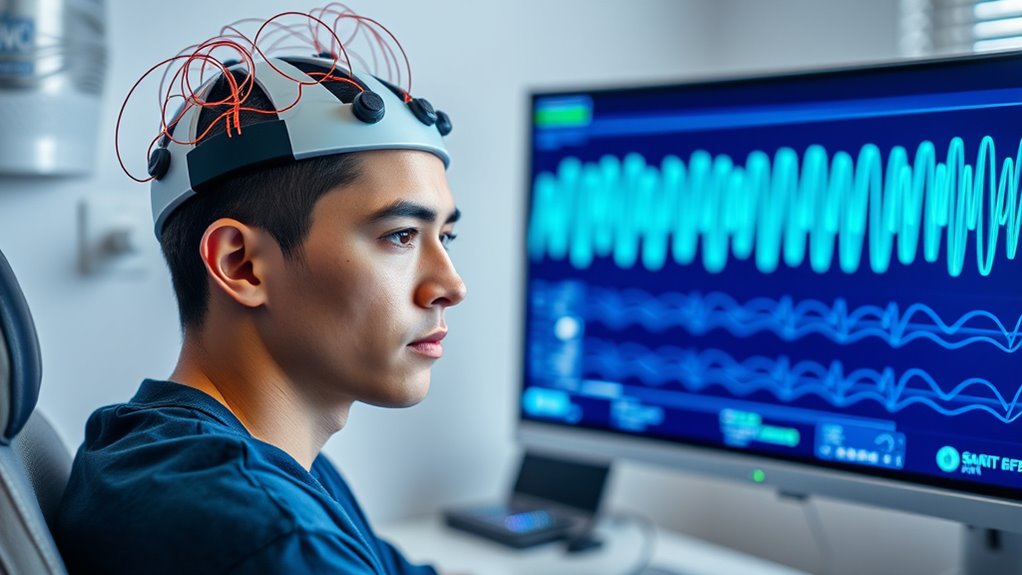

Neurofeedback techniques for attention improvement involve real-time monitoring of your brain waves using sensors placed on your scalp. This feedback helps you learn to regulate your mental states by showing when your focus-related brain patterns are achieved, encouraging positive habits through instant reinforcement. As you practice, you’ll develop greater awareness and control over your attention, reducing distractions naturally. To explore more effective strategies and how they work, keep exploring these methods further.
Key Takeaways
- Neurofeedback uses real-time brain wave monitoring to reinforce focus-related patterns, enhancing attention control.
- Sensors detect brain activity and provide visual or auditory feedback, guiding individuals to optimize their mental states.
- Repeated practice with neurofeedback strengthens neural pathways associated with sustained attention and reduces distractibility.
- Positive reinforcement during sessions encourages maintaining desired brain wave patterns linked to alertness and concentration.
- Long-term neurofeedback training develops lasting skills for better mental clarity, focus, and cognitive flexibility without medication.
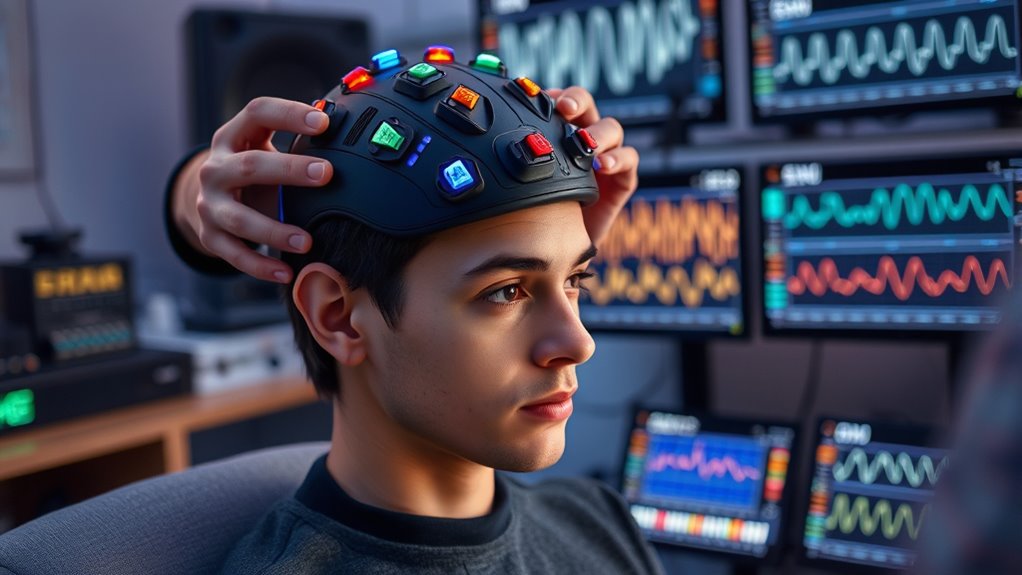
Have you ever wondered how you can train your brain to function better? Neurofeedback offers an exciting way to do just that by harnessing the power of brain wave modulation. This technique involves monitoring your brain’s electrical activity in real time feedback, allowing you to see and influence your brain’s patterns as they happen. When you engage in neurofeedback sessions, sensors are placed on your scalp to pick up your brain waves, which are then translated into visual or auditory signals. These signals serve as immediate feedback, helping you learn how to regulate your brain activity more effectively. The core idea is that by observing your brain’s responses in real time, you can develop greater control over your attention and mental states.
The process of real time feedback is vital because it creates a direct link between your thoughts, feelings, and brain activity. Instead of relying on guesswork, you see instant results of your efforts, which accelerates learning. For example, if your goal is to increase focus, the neurofeedback system will show you when your brain is producing the desired wave patterns associated with concentration. When your brain shifts toward these patterns, the system provides positive reinforcement, encouraging you to maintain or replicate that state. Over time, this repeated cycle of feedback helps your brain naturally adopt more ideal wave patterns associated with alertness and attention. This method enables you to train your brain to sustain focused states more easily, without medication or other invasive techniques.
By engaging in regular neurofeedback sessions focused on brain wave modulation, you can develop a heightened awareness of your mental processes. This awareness allows you to recognize when your attention drifts and to actively bring it back. The real time feedback mechanism acts as a mirror, reflecting your brain’s current state and guiding you toward better control. As your skills improve, you’ll notice that your ability to concentrate during everyday tasks, such as work or studying, becomes more consistent and resilient. Neurofeedback doesn’t just teach you to concentrate better; it also helps reduce distractions, manage stress, and enhance overall cognitive flexibility. Understanding the significance of brain wave modulation can deepen your appreciation for how neurofeedback works and its potential benefits.
In essence, neurofeedback leverages the science of brain wave modulation combined with real time feedback to empower you to maximize your attention. It transforms passive awareness into active control, giving you the tools to shape your mental landscape. This technique isn’t just about quick fixes; it’s about building lasting skills that support your focus and mental clarity over time. By understanding and harnessing your brain’s natural rhythms, you can open a new level of cognitive potential, making attention improvement a tangible and achievable goal.

SereniBrain EEG Neurofeedback Headband for Meditation & Brainwave Monitoring, Real-Time Brain Activity Tracker with App, Train Focus, Relaxation & Sleep Preparation
Real-Time EEG Neurofeedback Headband for Brainwave Monitoring: Monitor your brain activity in real time using advanced EEG sensors….
As an affiliate, we earn on qualifying purchases.
As an affiliate, we earn on qualifying purchases.
Frequently Asked Questions
How Long Does It Typically Take to See Results?
You might start noticing results within 10 to 20 sessions, but it varies based on individual factors. Treatment duration depends on your specific needs and consistency. Keep an eye on progress indicators like improved focus, reduced distractibility, and better task completion. Regular sessions and feedback from your practitioner help track your advancement. Remember, patience is key; consistency over several weeks often yields the best attention improvements through neurofeedback.
Are There Any Side Effects of Neurofeedback Training?
Imagine you’re stepping into a time machine—neurofeedback has potential risks and long-term effects you should contemplate. Most people experience minimal side effects like slight headaches or fatigue, but some may encounter more serious issues such as increased anxiety or discomfort. While these effects are usually temporary, it’s important to work with a trained professional to minimize risks and monitor your progress to guarantee safe, effective training.
Can Neurofeedback Replace Medication for Attention Issues?
Neurofeedback can’t fully replace medication for attention issues, but it offers a promising alternative. It helps train your brain to improve focus and reduce symptoms over time, with fewer long-term effects than medication. While some people see significant benefits, others might need a combined approach. You should discuss your options with a healthcare professional to determine if neurofeedback is suitable as a medication alternative for your specific needs.
Is Neurofeedback Suitable for Children and Adolescents?
Neurofeedback is a promising tool for children and adolescents, acting like a gentle GPS guiding their attention. You can be confident that it fosters child engagement and supports adolescent development. While it’s generally suitable, each young person’s needs vary, so consulting a professional guarantees the approach aligns with their growth. As with fine tuning an instrument, neurofeedback helps young minds find their best rhythm for learning and focus.
How Much Does Neurofeedback Therapy Usually Cost?
Neurofeedback therapy typically costs between $50 and $200 per session, with a total price depending on how many sessions you need. Costs can vary based on location and provider. It’s helpful to compare prices and check insurance coverage, as some plans may partially cover neurofeedback. Doing a cost comparison can guarantee you find an option that fits your budget and maximizes your insurance benefits.
SereniBrain EEG Neurofeedback Headband for Meditation & Brainwave Monitoring, Real-Time Brain Activity Tracker with App, Train Focus, Relaxation & Sleep Preparation
Real-Time EEG Neurofeedback Headband for Brainwave Monitoring: Monitor your brain activity in real time using advanced EEG sensors….
As an affiliate, we earn on qualifying purchases.
As an affiliate, we earn on qualifying purchases.
Conclusion
Just as Icarus aimed for the sun, you can elevate your focus with neurofeedback. By harnessing these techniques, you’re opening a powerful tool to sharpen attention and enhance overall well-being. Remember, the sky’s the limit when you take control of your brain’s potential. So, embrace neurofeedback as your wings—guiding you toward clarity and focus, soaring beyond previous boundaries, and reaching new heights in your mental acuity.

Entertech Flowtime: Biosensing Meditation Headband – Brain Tracker for Neurofeedback Training at Home – Heart Rate, Breath, HRV, Stress, Flow, Alpha, Theta, Beta, Gamma Wave Breakdowns
VISUALIZE YOUR MEDITATION PERFORMANCE. Supported by the biosensing technology, see how your brain and body are working when…
As an affiliate, we earn on qualifying purchases.
As an affiliate, we earn on qualifying purchases.

Is My Brain Broken?: Why Your Brain Adapted- and How to Retrain It with Neurofeedback
As an affiliate, we earn on qualifying purchases.
As an affiliate, we earn on qualifying purchases.