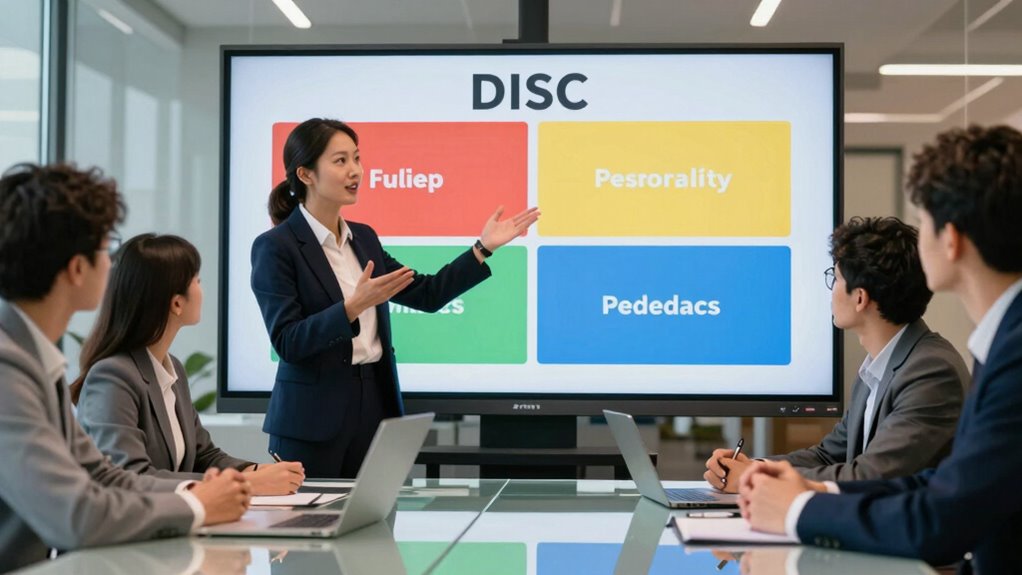

To give better feedback using DISC, you observe each team member’s personality style and adjust your approach accordingly. For example, be direct and challenge-oriented with D types, offer reassurance to S types, provide specific data to C types, and use positive reinforcement for I types. Tailoring your communication helps prevent misunderstandings and encourages growth. By understanding these traits, you can craft more effective, personalized feedback that motivates and builds stronger team connections—discover how to master this process to improve your leadership skills.

Get privacy and security gear delivered free with Prime
- Fast, free delivery on millions of items
- Prime Video, Amazon Music and more included
- Member-only deals all year
Key Takeaways
- Managers tailor feedback tone and style based on DISC personality traits to enhance understanding and receptiveness.
- They provide specific data and clear expectations to meet Conscientiousness (C) preferences.
- Managers use positive reinforcement and encouragement to motivate Influence (I) personalities effectively.
- They deliver supportive, respectful feedback aligned with Steadiness (S) traits to maintain harmony and trust.
- Observing behavioral cues allows managers to proactively adjust communication, preventing misunderstandings and promoting growth.

Have you ever wondered why some feedback motivates employees while others fall flat? The difference often lies in how well you understand their personalities and how you communicate. As a manager, using a personality assessment like DISC can be a game-changer. It helps you tailor your feedback to resonate with each individual, making your communication more effective and fostering growth. When you know whether someone prefers directness, detail, or appreciation, you can adjust your approach accordingly. This targeted method not only improves communication but also boosts engagement and morale.
By leveraging DISC, you gain insights into the unique traits that influence how each person perceives and reacts to feedback. For example, a Dominance (D) personality appreciates straightforward, challenge-oriented feedback, while an Influence (I) type responds best to positive reinforcement and encouragement. When you understand these nuances, you avoid the common pitfalls of generic feedback that can seem insincere or unhelpful. Instead, your messages become more meaningful and impactful, prompting the recipient to take constructive action rather than feeling defensive or misunderstood. Recognizing and applying personality types helps you craft more personalized and effective communication strategies.
Understanding personality traits helps tailor feedback to inspire action and prevent misunderstandings.
Implementing DISC for communication improvement involves actively observing and adapting your tone, language, and delivery style. If you’re speaking to a Steadiness (S) personality, who values harmony and stability, you might frame your feedback in a supportive, respectful manner that emphasizes team cohesion. Conversely, for a Conscientiousness (C) individual, who values accuracy and details, providing specific data and clear expectations works better. This level of personalization ensures your feedback is not only heard but also appreciated, increasing the likelihood of positive change. When you understand how different personality types respond to various communication styles, you can enhance your feedback delivery, which can significantly influence team dynamics. Additionally, understanding these personality traits can help you develop more empathetic and constructive interactions in all areas of leadership.
Furthermore, understanding the behavioral tendencies associated with each DISC personality type allows you to predict how they might perceive your feedback, enabling more proactive adjustments.
DISC personality assessment tool
As an affiliate, we earn on qualifying purchases.
As an affiliate, we earn on qualifying purchases.
Frequently Asked Questions
How Can DISC Improve Overall Team Communication?
You can improve overall team communication by leveraging DISC’s personality insights to understand each team member’s preferred communication style. This allows you to tailor your communication strategies effectively, ensuring your message resonates. Recognizing diverse personality traits helps you address potential misunderstandings proactively, fostering a more collaborative environment. By adapting your approach based on DISC insights, you create clearer, more efficient interactions, ultimately strengthening team cohesion and productivity.
Is DISC Suitable for Remote or Virtual Team Feedback?
Yes, DISC is suitable for remote or virtual team feedback. Its framework supports remote adaptability by helping you understand each team member’s communication style, making virtual engagement more effective. You can tailor your feedback to match individual preferences, ensuring clarity and receptiveness. Using DISC tools in a virtual setting fosters better understanding, strengthens connections, and promotes open dialogue, even when team members are dispersed across different locations.
How Quickly Can Managers See Results Using DISC?
You might expect instant results from a personality assessment like DISC, but real change takes time. With effective feedback strategies, you can start noticing improvements within a few weeks, as team members better understand their styles. The key is consistent, tailored feedback that aligns with each personality type. So, while the timeline varies, patience and strategic use of DISC can accelerate positive outcomes faster than you’d think.
Can DISC Be Integrated With Other Performance Tools?
Yes, you can integrate DISC with other performance tools, enhancing your understanding of team dynamics through a thorough personality assessment. By combining DISC with tools like 360-degree feedback or KPI trackers, you get a clearer picture of individual strengths and areas for growth. This integration helps you tailor your management approach better, fostering improved communication, collaboration, and overall team performance.
What Training Is Needed for Effective DISC Implementation?
To implement DISC effectively, you need targeted training programs that focus on skill development. You should participate in workshops or online courses that teach you how to interpret DISC profiles and apply them in real-world situations. Ongoing practice and feedback are essential to refine your understanding. This training helps you communicate more effectively, tailor your feedback, and foster better team dynamics, ultimately improving overall performance.
As an affiliate, we earn on qualifying purchases.
Conclusion
By understanding DISC, you can tailor your feedback to resonate better with each team member’s personality. When you adapt your approach, you’re more likely to foster growth and trust. Notably, 70% of employees say they’re more motivated when managers customize feedback based on their DISC style. So, next time you give feedback, remember to consider their personality type—it could make all the difference in boosting performance and engagement.
team communication improvement books
As an affiliate, we earn on qualifying purchases.
As an affiliate, we earn on qualifying purchases.
personalized employee feedback guide
As an affiliate, we earn on qualifying purchases.
As an affiliate, we earn on qualifying purchases.
Halloween Picks
halloween
As an affiliate, we earn on qualifying purchases.