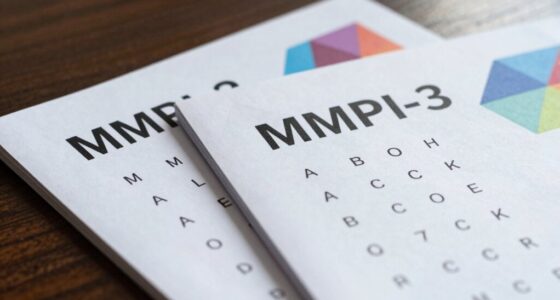

The MMPI has a long history dating back to the 1930s, making it one of the most trusted tools for evaluating mental health and personality. Over decades, it’s been refined to guarantee accuracy and cultural relevance, maintaining its scientific validity. Its ongoing updates help it stay useful for diverse populations worldwide. If you keep exploring, you’ll discover how its proven reliability continues to shape essential psychological practices today.
Key Takeaways
- Developed in the 1930s, the MMPI has evolved to remain a fundamental tool in psychological assessment.
- Its strong psychometric validity ensures accurate, reliable measurement of mental health and personality traits.
- Continuous research and updates keep the MMPI relevant and scientifically robust for modern clinical use.
- Cultural adaptations improve its applicability across diverse populations, reducing bias and misinterpretation.
- Its long history and ongoing validation affirm its status as a gold standard in psychological diagnosis.

The Minnesota Multiphasic Personality Inventory (MMPI) has a long-standing history that continues to influence psychological assessment today. Developed in the 1930s and refined over decades, the MMPI remains one of the most widely used tools for evaluating mental health, personality structure, and psychological disorders. Its enduring relevance stems from its solid psychometric validity, which guarantees that the test accurately measures what it’s intended to. When you use the MMPI, you can be confident that the results are dependable indicators of various psychological traits and conditions, thanks to rigorous research and continuous updates. This psychometric robustness has helped the MMPI maintain its status as a gold standard in clinical psychology.
However, you also need to recognize that the MMPI’s effectiveness isn’t solely based on its psychometric properties. Cultural adaptations have played a crucial role in its ongoing applicability across diverse populations. Originally developed with a mainly Western sample, the MMPI has undergone numerous revisions and translations to better serve individuals from different cultural backgrounds. These adaptations guarantee that the test remains valid and meaningful, regardless of cultural differences in expression and understanding of psychological symptoms. When you administer the MMPI in multicultural settings, these cultural adaptations help prevent misinterpretations that could lead to inaccurate diagnoses or misunderstandings about a person’s mental health.
The process of cultural adaptation involves more than just translating language; it requires careful consideration of cultural norms, values, and idioms. By doing so, the MMPI can accurately capture a person’s psychological makeup without cultural bias distorting the results. This ongoing effort to adapt the test for various populations underscores its flexibility and relevance in an increasingly globalized world. As you interpret MMPI scores, it’s essential to remember that cultural context influences responses, and understanding this context leads to more precise assessments. Additionally, ongoing research ensures that the MMPI remains scientifically valid, which is vital in maintaining the trust of clinicians and patients alike.
Furthermore, the development and continuous refinement of the MMPI are supported by extensive psychometric research, which ensures its validity and reliability over time. In essence, the combination of robust psychometric validity and thoughtful cultural adaptations ensures the MMPI remains a critical tool in modern psychological practice. Its long history demonstrates an ability to evolve while maintaining scientific rigor. As mental health professionals, you can rely on the MMPI not just because of its historical significance, but because it continues to meet the demands of contemporary assessment—accurately, fairly, and inclusively. This enduring legacy highlights why the MMPI remains relevant and why it will continue to be a cornerstone in psychological evaluation for years to come.
Frequently Asked Questions
How Has the MMPI Evolved Over the Decades?
Over the decades, you’ve seen the MMPI evolve through psychometric advancements and cultural adaptations. These changes improve its accuracy and relevance across diverse populations. Modern versions incorporate better standardization, expanded scales, and digital formats, making assessments more precise and accessible. This evolution guarantees the MMPI remains a crucial tool for psychological evaluation, reflecting ongoing efforts to enhance its reliability and cultural sensitivity in a changing world.
Are There Modern Alternatives to the MMPI?
While some might argue traditional assessments like the MMPI are outdated, modern alternatives and digital adaptations offer more dynamic insights. You can explore alternative assessments such as the PAI or the SCL-90, which provide thorough evaluations. Digital adaptations enable quicker, more accessible testing, enhancing accuracy and user experience. These innovations ensure you stay current, leveraging technology to improve mental health assessments beyond the classic MMPI framework.
How Reliable Is the MMPI Across Diverse Populations?
You might wonder about the MMPI’s reliability across diverse populations. While it’s generally dependable, cultural biases and language translation issues can affect results. Some questions may not resonate equally across cultures, leading to skewed interpretations. Researchers continually work to adapt the test, but you should be cautious, recognizing that cultural differences may influence responses. Using supplementary assessments can help guarantee a more precise, all-encompassing understanding of an individual’s psychological profile.
What Are Common Criticisms of the MMPI?
You might criticize the MMPI for potential cultural bias, which can affect how different groups interpret questions, leading to inaccurate results. Additionally, concerns about response validity arise if individuals intentionally or unintentionally provide misleading answers, skewing assessments. These issues highlight that while the MMPI is a valuable tool, its effectiveness depends on understanding and addressing cultural differences and ensuring honest, valid responses for reliable outcomes.
How Is the MMPI Used in Legal Settings?
You might wonder if the MMPI truly holds weight in court. It’s often used in forensic assessments to evaluate mental health and establish legal credibility. Courts rely on the test to provide objective insights into a defendant’s psychological state, helping determine competency or insanity defenses. While its scientific basis is strong, you should also consider potential biases or limitations, ensuring the results are interpreted within a broader legal and clinical context.
Conclusion
As you consider the MMPI’s long history, it’s clear it’s more than just a test—it’s a window into human complexity. Its enduring relevance hints at ongoing developments and surprises yet to come. Will future innovations reshape how we grasp mental health? Or will the MMPI continue to evolve, revealing even deeper truths? One thing’s certain: the story isn’t over. And as you stay curious, you’ll be part of what’s next in this fascinating journey.