

You’ll find that AI regulation varies widely across countries and regions, creating a patchwork of rules reflecting different priorities, cultures, and risk perceptions. Some focus on safety and ethics, while others emphasize innovation or privacy. International efforts, like the EU’s AI Act or US guidelines, aim to harmonize standards but face challenges due to conflicting interests. If you want to understand how this complex landscape might evolve, there’s more to explore ahead.
Key Takeaways
- Regulatory frameworks vary widely across countries, reflecting diverse priorities, cultural values, and risk perceptions.
- International efforts like the EU’s AI Act and US guidelines aim to harmonize standards, but inconsistencies remain.
- Divergent regional policies challenge global cooperation and create complex compliance requirements for cross-border AI deployment.
- Rapid AI advancements often outpace existing regulations, leading to gaps and potential exploitation.
- Collaborative initiatives and dialogues strive to develop unified standards, but a comprehensive global framework remains uncertain.
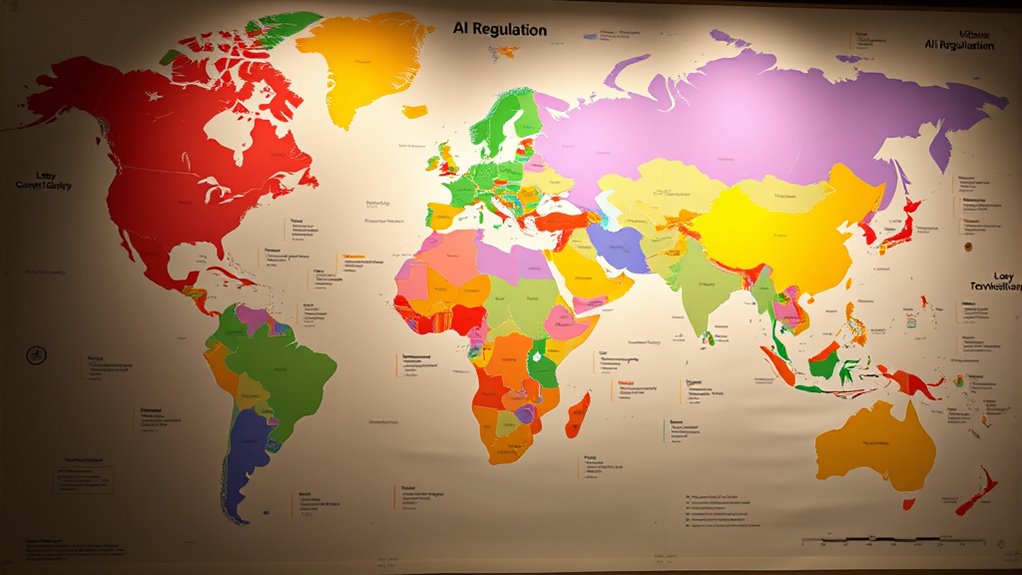
As AI technology advances rapidly, governments worldwide are implementing a patchwork of regulations that vary widely in scope and strictness. This fragmented approach reflects differing priorities, cultural values, and perceptions of risk, making it challenging to develop a cohesive global framework. One of the core concerns fueling regulation is the ethical implications of AI deployment. You’re likely aware that AI systems can inadvertently perpetuate biases, invade privacy, or make decisions that lack transparency, raising questions about accountability and fairness. Governments are trying to address these issues through diverse policies, but without a unified standard, ethical considerations often become a secondary priority amid competing interests. Meanwhile, technological innovation continues at a breakneck pace, and regulators struggle to keep up. As new AI capabilities emerge, existing rules may lag behind, leaving gaps that can be exploited or lead to unintended consequences. You might see this tension in how some nations emphasize innovation as a driver of economic growth, while others focus on strict controls to mitigate potential harms. This divergence can hinder international cooperation, which is *vital* given AI’s borderless nature. For example, a company operating across borders faces a complex web of compliance requirements, increasing costs and slowing down innovation. Countries that adopt lax regulations risk becoming testing grounds for unregulated AI, while those with stringent rules may stifle progress, creating a competitive imbalance. The international community has attempted to forge agreements, like the EU’s AI Act or the US’s emerging guidelines, but these efforts are often inconsistent or incomplete. This inconsistency complicates efforts to establish shared standards for safety, ethics, and transparency. You also need to *weigh* that different regions prioritize various ethical issues—some focus on protecting individual rights, others on preventing misuse or ensuring economic stability. As a result, the global landscape resembles a patchwork quilt, with each jurisdiction tailoring its approach based on local values and technological priorities. Despite these differences, there’s a growing recognition that collaboration is essential. Governments, tech companies, and civil society are increasingly engaging in dialogues to harmonize standards and share best practices. Still, the path toward a cohesive international regulatory framework remains uncertain, leaving you to navigate a complex, evolving landscape where innovation and ethics intersect in unpredictable ways. Additionally, the importance of home improvement concepts like organization and regulation can be applied metaphorically to managing AI policy—highlighting the need for structured, adaptable frameworks to ensure safety and progress.

Build Financial Software with Generative AI (From Scratch)
As an affiliate, we earn on qualifying purchases.
As an affiliate, we earn on qualifying purchases.
Frequently Asked Questions
How Do International AI Regulations Impact Global Trade?
International AI regulations impact your global trade by increasing cross-border compliance requirements, which can complicate processes and delay shipments. You might face new trade barriers as countries implement different standards, making it harder to navigate international markets smoothly. These regulations can raise costs and create uncertainties, forcing you to adapt quickly to diverse legal frameworks. Overall, they can slow down your ability to expand globally and affect your competitive edge.
What Penalties Exist for Non-Compliance With AI Regulations?
Ever wonder what happens if you don’t follow AI regulations? Penalties vary across regions but typically involve hefty fines, sanctions, or restrictions. Enforcement mechanisms are designed to guarantee compliance, often including audits and legal actions. Penalty structures aim to deter violations and protect public interests. If you ignore these rules, you risk significant financial and operational consequences—so it’s essential to understand and adhere to the specific enforcement measures in place.
How Do Regulations Address AI Ethics and Human Rights?
Regulations emphasize ethical considerations and protect human rights by setting clear standards for AI development and use. You’re expected to guarantee your AI systems respect privacy, prevent bias, and promote fairness. These rules require transparency and accountability, so you must document decisions and address potential harm. By following these guidelines, you help safeguard individual rights and uphold ethical principles, fostering trust and responsible AI deployment across different sectors.
Are There Standards for Transparency in AI Systems?
Transparency in AI systems is like shining a light in the dark—you need clear standards to see what’s happening. You’ll find regulations emphasize algorithm accountability and bias mitigation, ensuring developers disclose how models work and make decisions. While standards vary, many guidelines now promote transparency, requiring companies to explain AI processes and reduce biases. This helps build trust, making AI more understandable and fair for everyone involved.
How Can Businesses Navigate Conflicting Regional AI Rules?
You can navigate conflicting regional AI rules by prioritizing regional compliance and staying updated on local regulations. Develop flexible policies that adapt to different standards, and consider implementing universal best practices for transparency and safety. Address cross-border challenges by working with legal experts, leveraging international standards, and maintaining clear documentation. This proactive approach helps guarantee your AI systems meet diverse regional requirements while minimizing legal risks and fostering trust worldwide.
AI ethics and safety training courses
As an affiliate, we earn on qualifying purchases.
As an affiliate, we earn on qualifying purchases.
Conclusion
As you navigate this shifting landscape, imagine a tapestry woven from countless threads of state and international rules, each adding its own color and texture. The patchwork may seem chaotic now, but with careful stitching and shared purpose, it can become a resilient fabric protecting us from unseen risks. Stay vigilant, for in this intricate mosaic, your awareness and voice help shape a future where AI serves us all wisely and safely.

Artificial Intelligence for Cybersecurity: Develop AI approaches to solve cybersecurity problems in your organization
As an affiliate, we earn on qualifying purchases.
As an affiliate, we earn on qualifying purchases.

Redefining Cross-Border Financial Flows: Transforming Remittances with AI and Other Technologies
As an affiliate, we earn on qualifying purchases.
As an affiliate, we earn on qualifying purchases.