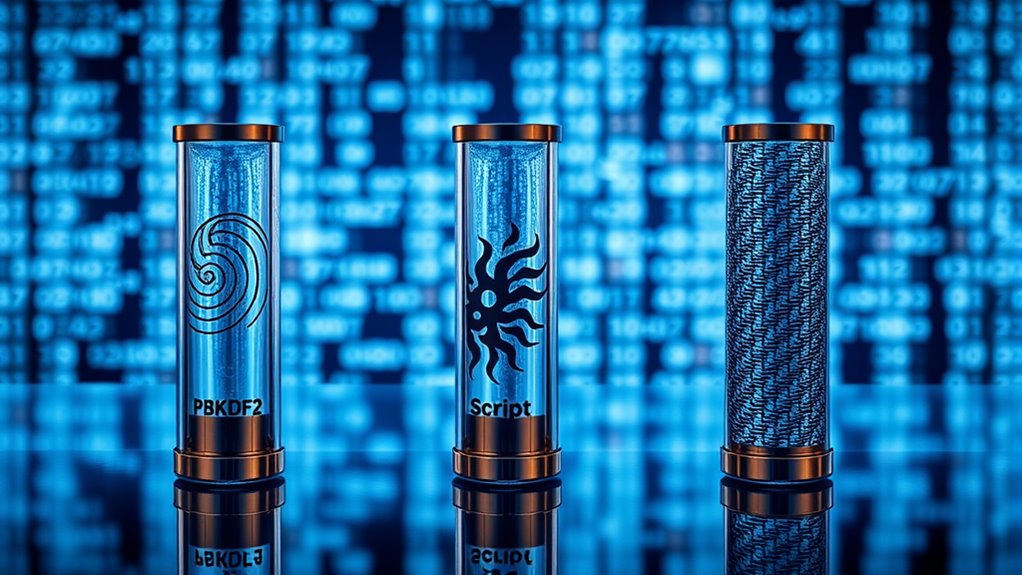

When choosing password hashing algorithms like PBKDF2, Argon2, and Scrypt, you need to take into account their strengths. PBKDF2 offers security through repeated hashing and salting, but it’s less resistant to modern hardware attacks. Argon2 uses memory-hard functions to fight GPU and ASIC cracking, while Scrypt emphasizes memory hardness for added protection. Understanding how each works can help you secure user credentials better—if you keep exploring, you’ll discover which fits your needs best.

Get privacy and security gear delivered free with Prime
- Fast, free delivery on millions of items
- Prime Video, Amazon Music and more included
- Member-only deals all year
Key Takeaways
- PBKDF2, Argon2, and Scrypt are key password hashing algorithms, each with distinct security features and resistance to attacks.
- PBKDF2 uses iterative hashing with salting to increase brute-force attack difficulty.
- Argon2 offers configurable memory-hard parameters, enhancing resistance against GPU and ASIC cracking.
- Scrypt emphasizes high memory usage to thwart hardware-accelerated attack methods.
- Secure hardware modules or trusted environments further strengthen password storage and processing security.
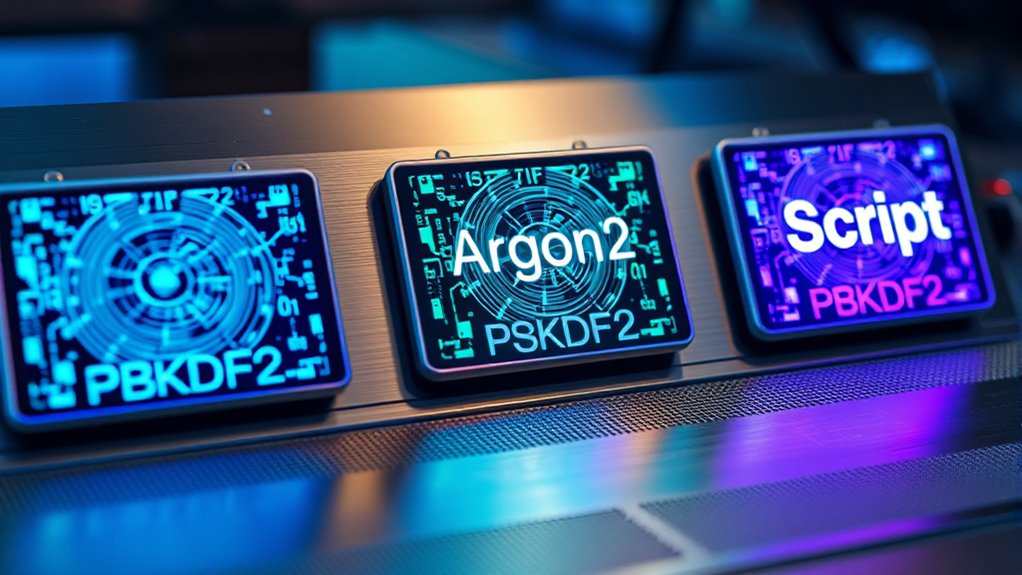
Password hashing algorithms are essential tools for securing user credentials in today’s digital landscape. When you implement these algorithms correctly, you considerably reduce the risk of password theft and unauthorized access. To achieve this, you need to follow password storage best practices, which include using robust hashing functions designed to resist attacks. Additionally, hardware security plays a pivotal role; storing hashed passwords in secure hardware modules or trusted execution environments can add an extra layer of protection, preventing attackers from extracting sensitive data even if they breach your systems.
Implementing robust hashing and secure hardware storage protects user credentials from theft and breaches.
PBKDF2, or Password-Based Key Derivation Function 2, is one of the most widely used hashing algorithms. It applies a cryptographic hash function repeatedly, often thousands of times, to make brute-force attacks computationally expensive. This iterative process ensures that even if an attacker gains access to your password database, cracking the hashes will take a substantial amount of time and resources. PBKDF2 also supports salting, which adds a unique random value to each password before hashing, preventing attackers from using precomputed rainbow tables. When you implement PBKDF2, it’s imperative to choose a high iteration count and a strong hash function like SHA-256 to maximize security. Using hardware security modules (HSMs) to perform these operations can further safeguard the process, guaranteeing that sensitive computations don’t leak through side channels or other vulnerabilities. Employing hardware security measures can significantly enhance overall password protection.
Argon2 is a newer, memory-hard hashing algorithm designed explicitly to resist GPU and ASIC-based attacks. Its design makes it more resistant to brute-force attacks compared to older algorithms like PBKDF2. When you use Argon2, you can configure parameters such as memory cost, time cost, and parallelism, allowing you to tailor the hashing process to your security needs and hardware capabilities. This flexibility means that you can optimize for both security and performance. Incorporating hardware security measures, such as dedicated secure processors or trusted execution environments, enhances the protection of password hashes stored using Argon2, ensuring they remain safe even if other parts of your system are compromised.
Scrypt, like Argon2, is a memory-hard key derivation function that emphasizes resistance to hardware-accelerated attacks. It’s particularly suited for environments where you want to balance security and computational efficiency. Scrypt’s design requires significant memory resources, making it difficult for attackers to leverage specialized hardware for rapid cracking. When deploying Scrypt, you should follow password storage best practices by salting hashes and choosing parameters that match your threat model and hardware capabilities. Using hardware security solutions to safeguard the storage and processing of Scrypt hashes can further prevent attackers from extracting or manipulating sensitive data.
Hardware Security Modules for password hashing
As an affiliate, we earn on qualifying purchases.
As an affiliate, we earn on qualifying purchases.
Frequently Asked Questions
Which Password Hashing Algorithm Is Fastest for High-Volume Applications?
You should choose Scrypt for high-volume applications if speed is your priority, as performance benchmarks show it’s faster than PBKDF2 and Argon2 in many scenarios. Scrypt benefits from hardware optimization, making it more efficient on modern systems. While Argon2 offers strong security, Scrypt’s balance of performance and security makes it ideal for handling large-scale authentication processes where throughput matters most.
How Do These Algorithms Perform on Mobile Devices?
When it comes to mobile devices, these algorithms are like apples and oranges—they perform differently depending on mobile energy efficiency and device compatibility. Argon2 offers strong security but can drain battery quickly, while PBKDF2 is more energy-efficient and widely supported. Scrypt strikes a balance but may still challenge some devices. You need to weigh security needs against device limitations to choose the best fit for your mobile app.
Can These Algorithms Be Combined for Enhanced Security?
Yes, you can combine algorithms for security enhancement, but it’s complex and usually unnecessary. Typically, you select a robust algorithm like Argon2 or Scrypt for hashing passwords. If you want extra protection, consider layering techniques, such as salting or applying multiple algorithms sequentially. However, this can introduce performance issues or compatibility problems. Focus on choosing a strong, proven algorithm and proper implementation for ideal security.
What Are the Real-World Attack Examples Against Each Algorithm?
You face fierce foes like hardware vulnerabilities and implementation flaws with each algorithm. PBKDF2, often targeted by brute-force attacks, can suffer from weak iterations. Argon2, while robust, isn’t immune to side-channel attacks if poorly implemented. Scrypt’s high memory demands can be bypassed through specialized hardware attacks. Staying vigilant with secure setups and updates helps defend you from these real-world risks and reduces attack success.
How Often Should Password Hashing Algorithms Be Updated or Replaced?
You should update or replace your password hashing algorithms regularly to maintain strong security. Algorithm longevity depends on advances in computing power and new attack techniques, so stay vigilant. Typically, review security updates annually or when vulnerabilities are discovered. As hardware improves, what once was secure may become vulnerable. Keep informed on best practices and upgrade your algorithms promptly to guarantee ongoing protection against evolving threats.
Secure hardware key storage devices
As an affiliate, we earn on qualifying purchases.
As an affiliate, we earn on qualifying purchases.
Conclusion
Remember, in the world of security, an ounce of prevention is worth a pound of cure. Choosing the right password hashing algorithm—whether PBKDF2, Argon2, or scrypt—can profoundly strengthen your defenses. Each has its strengths, so pick what best suits your needs. Stay vigilant, keep your passwords strong, and don’t wait until it’s too late. After all, a secure system isn’t built in a day, but it’s worth every effort.
Password hashing hardware security modules
As an affiliate, we earn on qualifying purchases.
As an affiliate, we earn on qualifying purchases.
Trusted execution environment hardware
As an affiliate, we earn on qualifying purchases.
As an affiliate, we earn on qualifying purchases.
Halloween Picks
halloween
As an affiliate, we earn on qualifying purchases.